
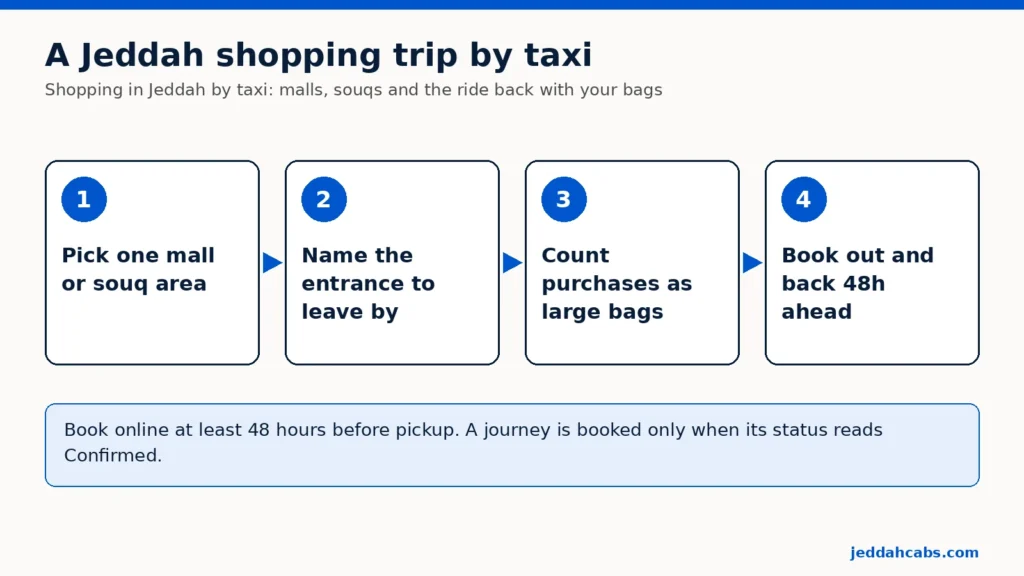
Shopping in Jeddah by taxi is simplest when each shopping trip has one named place, one pickup time out and one pickup time back, with the return booked for more luggage than you left with. Choose a specific mall or a specific market area, book the ride there and the ride back as two journeys at least 48 hours ahead, and meet the car at a named entrance rather than “outside the mall”. The biggest mistake is forgetting that the return journey carries your purchases as well as your party.
This guide is for visitors and residents planning a shopping outing in Jeddah by private car: an afternoon at one of the large Jeddah malls, souq shopping in Jeddah’s historic district, or a last shopping trip before flying home. It covers choosing between malls and markets, turning a mall into a destination the booking system can use, meeting points, counting purchases as luggage, combining two places in one day, and the Jeddah Cabs booking rules. There is a comparison table, a worked example and a checklist near the end.
Malls or souqs: two different kinds of shopping trip
Before booking any car, decide which kind of shopping you want. The transport follows that choice.
Jeddah malls are large enclosed centres with shops, restaurants and entertainment under one roof, several entrances and large car parks. You arrive at an entrance, spend a few hours inside and leave from an entrance, which may or may not be the one you arrived at.
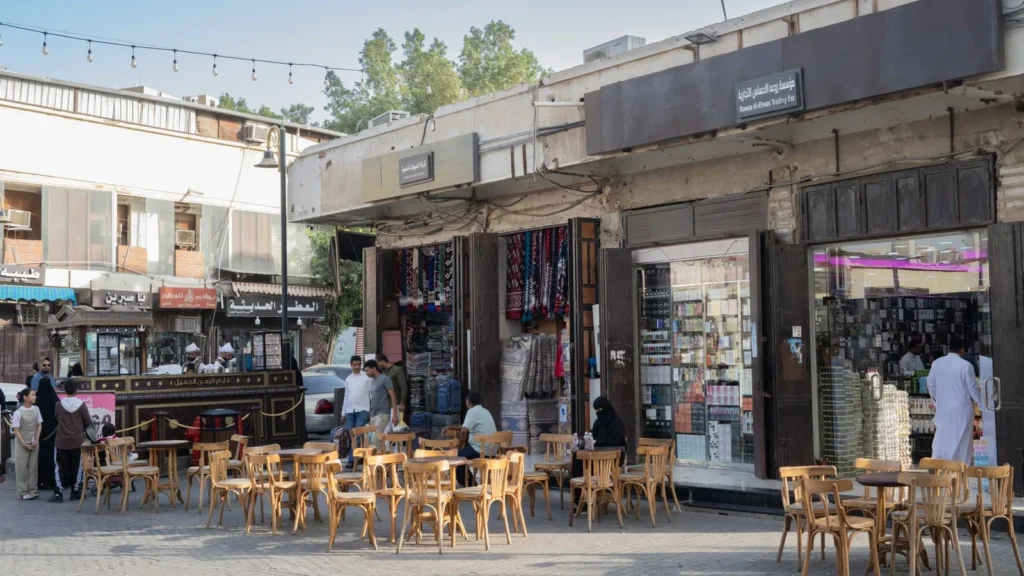
Souqs are traditional markets, and Jeddah’s historic souqs are in the old district, Al Balad. They are made up of lanes and small shops rather than one building. You arrive at the edge, walk, and finish wherever the walk ends.
The practical difference is the meeting point. A mall has named entrances. A souq has lanes, squares and gates. Both can be planned; they are just planned differently.
Jeddah malls: examples from official sources
We only describe venues from what their owners and official bodies publish, and details change, so always check the venue’s own website before you go.
Red Sea Mall. Its developer, SEDCO Holding, describes Red Sea Mall as located in Jeddah’s northern suburbs on King Abdulaziz Road, officially opened in 2008 and expanded in 2017, with parking for more than 5,000 vehicles, a connected hotel, a cinema and children’s attractions.
Mall of Arabia. Its operator, Cenomi Centers, gives the Mall of Arabia address as Medina Road, An Nuzhah, Jeddah, with a phone number and email for enquiries.
The Jeddah Waterfront. The Saudi Press Agency describes the waterfront as having high-end shops offering local and imported goods alongside its restaurants and cafés. This is not a mall, so treat it like any waterfront outing: book to a named point.
There are many other shopping centres in Jeddah. The same approach applies to all of them: find the official name, the address and, if possible, the entrance names, from the venue itself.
What to check with the mall
Before you book a car to a large mall, check on the mall’s own website or by phone:
- the opening hours on your day, which may differ at weekends, during Ramadan and on public holidays;
- the names or numbers of the entrances, and which one is nearest the shops you want;
- where taxis and private cars set down and pick up, if the mall says;
- whether any area you want to visit, such as a cinema or play centre, needs a separate booking.
The last point matters for families. A cinema or children’s attraction is a separate purchase, and the transport booking does not include it.
Souq shopping in Jeddah’s historic district
Souq shopping in Jeddah usually means Al Balad, the historic district that UNESCO inscribed as a World Heritage Site in 2014. UNESCO’s description of Historic Jeddah, the Gate to Makkah records traditional souqs running east to west from the sea towards Makkah Gate.
The Saudi Press Agency names two of the traditional markets, Souq Al Alawi and Souq Qabil, as offering spices, oriental perfumes, textiles and handcrafted goods. It also reported in March 2026 that the Al Balad Bazaar, on Al-Dahab Street, offers handmade crafts, antiques and traditional clothing from stalls within the historic buildings and alleys, alongside daily cultural programmes.
Getting in and out of the souqs
Al Balad is a district of narrow lanes, so plan to be set down and collected at a named point on its edge, not inside the market. Plan it like a walk:
- Choose a named arrival point on the edge of the district, such as a gate, square or main road landmark, and use it as the destination.
- Decide where you will finish. A souq walk rarely ends where it started. Book the return from the point you expect to reach, not the point where you were dropped.
- Agree a meeting point everyone can find, and share it with the group before you set off.
Our article on an Al-Balad walk that finishes somewhere else explains how to set the pickup at the end of the walk, and our guide to Al Balad by taxi covers when to go.
Carrying purchases through the lanes
In a souq, you carry what you buy until you reach the car. Spices and perfumes are light; textiles, lanterns and rugs are not. Bring a strong bag, and think about whether a heavy purchase should be the last one of the day.
Shopping in Jeddah by taxi: choosing the destination and meeting point
A good destination for a shopping trip has a name the transfer finder can find and a point where a car can reasonably stop. This table compares the options.
| Place | What to type as the destination | Where to meet for the return | Notes to add |
|---|---|---|---|
| A large mall | The mall’s official name | The named or numbered entrance you will leave from | Entrance name, and which shops it is near |
| A mall with a connected hotel | The mall, or the hotel if you prefer its entrance | The same entrance | “Hotel entrance” or “mall entrance” |
| Al Balad souqs | A named point on the edge of the district | The point on the edge nearest where you finish | Gate, square or landmark |
| Waterfront shops | A named point on the waterfront | A named point you can walk to | Which stretch of the waterfront |
| A single shop on a main road | The shop’s name and address | The same, or a landmark nearby | Branch name if it is a chain |
When you enter a mall, type its full official name into the Jeddah transfer finder and check the pin on the route summary before paying. Large malls occupy whole blocks, and the pin may sit at the centre of the building or on a service road. The booking notes are the place to name the entrance. They help the driver; they are not a promise about where a car may stop, which is managed on the day and may mean a short walk.
Counting purchases as luggage
This is the part of shopping in Jeddah by taxi that people most often get wrong. You search the outward journey with a party and a handbag. You come back with the same party and six carrier bags, a boxed appliance and a new suitcase.
The transfer finder shows only the vehicle classes that pass the capacity check for your passengers and large bags. If you enter no bags for the return, you may be offered a car with too little space. As a guide from the fleet list, with models shown as examples “or similar”:
- Economy (Toyota Camry class): 4 seats, 2 large bags.
- Business and Executive: 4 seats, 3 large bags.
- Premium SUV (Chevrolet Tahoe): 6 seats, 4 large bags.
- Hyundai H1 or GMC Yukon XL: 7 seats, 6 large bags.
When you search the return, count anything boxed or bulky as a large bag, and several full carrier bags as at least one. If you expect a large purchase, such as a rug or a boxed television, ask the shop about delivery or confirm the dimensions with the booking team before you rely on a car. Our article on reading the seats and bags labels in results explains the figures.
The passenger count and vehicle cannot be changed online after booking. If you are unsure, choose the larger class for the return.
One place or two in a day?
Many visitors want a mall in the morning and the souqs in the afternoon. That is possible, but it is two outings joined together, and it is worth thinking about honestly.
Stops versus separate journeys
The system lets you add up to 8 stops to a journey, visited in the order you enter them. A stop suits a quick errand on the way, such as collecting an order. It is not a way to keep a car while you shop for three hours. Included waiting differs by vehicle class and is not shown in the search results, so if you want a driver to wait at a stop, ask the booking team to confirm the arrangement in writing.
For two proper shopping visits, book separate journeys: hotel to mall, mall to souq, souq to hotel. Each has its own time, and each carries its own minimum booking value equivalent to £40.
Is it worth it?
Two big shopping places in one day is tiring, especially in the heat and with children. Our article on heritage and coast as one outing or two makes the same case for sightseeing: one area, well planned, is usually better than two rushed.
Shopping with children and older relatives
Large Jeddah malls are long buildings, and souq lanes are uneven and crowded at busy times. Plan the day around the person who tires first.
Children. Enter every child and infant in both searches and add an infant seat, child seat or booster. Seats are confirmed for the vehicle on each journey separately, so add them to the return as well as the outward trip. If you are bringing a pushchair, count it as a large bag.
Older relatives. Choose the mall entrance nearest the shops you actually want, and tell the booking team in the notes if someone walks slowly. In Al Balad, pick a meeting point on the edge of the district close to where you will finish, so the last walk is short. A café stop before the return pickup is better than a long wait standing at the kerb.
Wheelchairs. Add the wheelchair requirement in the search so it is confirmed for the vehicle. Ask the mall or the relevant authority about step-free routes inside; the transport covers the journey, not access within the venue.
What the car is for, and what it is not
A shopping journey is a transfer between two named places. It helps to be clear about what that includes.
- The journey carries you and the bags you counted between the pickup and the destination. That is why the luggage count in the search matters.
- The car is not storage. Between two separate journeys, your purchases stay with you. Do not plan to leave bags in a car while you shop elsewhere.
- The driver is not a delivery service. For large items, ask the shop about delivery to your hotel or home.
- Keep valuables with you. Passports, cards, phones and expensive purchases belong in your hand luggage, not in a boot full of carrier bags.
If any of these matter to your plan, ask the booking team before you book, and keep their answer in writing.
Worked example: a mall morning and a souq evening
Aisha and her mother Khadija are spending a week in Jeddah. They want to buy clothes and gifts at a large mall, and perfumes and textiles in Al Balad. Khadija walks slowly and tires in the afternoon heat.
Aisha’s first idea is one long outing: hotel to the mall, then Al Balad, then back. She rethinks it. Her mother would be exhausted, and they would carry mall shopping through the souq lanes.
Instead she books two separate days:
- Day 3, mall: hotel to the mall at 10:00, two passengers, no bags. The notes name the entrance nearest the department store the mall’s website lists. The return is from the same entrance at 13:30, two passengers and two large bags, because they expect to buy clothes and a small suitcase for gifts. The results show Economy cars and larger for both; she chooses an Economy car, or similar, for the outward trip and a Business class car for the return, for the extra boot space.
- Day 5, souqs: hotel to a named gate on the edge of Al Balad at 18:30, when it is cooler. The return is from a named square on the far side of the district at 21:00, one large bag entered for textiles.
She books all four journeys more than 48 hours ahead, pays the deposits and waits for each to read Confirmed. On Day 3 they are at the entrance by 13:25, with more bags than planned; the return car has room.
Last-minute shopping before a flight
A shopping trip on departure day needs extra care. If your luggage is already in the car for the airport, you cannot go shopping with it; a journey has one pickup and one destination, and the car is not storage.
The simplest plans are:
- Shop the day before, and pack everything into your cases that evening.
- Shop near your hotel on the morning of departure, and return in time for the hotel-to-airport journey.
- Ask your hotel whether it can hold your luggage after checkout, then book shopping journeys from the hotel and the airport journey from the hotel.
Remember that new purchases change your airport luggage count too. Recount for the airport search. If the booking has already been made with fewer bags, the vehicle cannot be changed online; talk to the booking team.
Booking rules for shopping trips
Notice. Online bookings need at least 48 hours’ notice before pickup, so a Saturday shopping trip should be booked by Thursday.
Payment and confirmation. Payment secures a provisional request, and the booking team updates the status within 1 to 12 hours. The journey is booked only when it reads Confirmed. Jeddah Cabs may take only a deposit online, with the balance paid in cash to the driver; the checkout shows both amounts. Our guide to paying in pounds, riyals or another currency explains how they are shown.
Changing the time. You can request a new pickup time from your account before the pickup. An approved change carries a £5 rescheduling fee, converted into the booking currency and added to the cash paid to the driver. A rejected request costs nothing. Only the time can change online.
Cancelling. Bookings are subject to our cancellation terms (free cancellation with a full refund up to 48 hours before pickup; inside 48 hours the deposit element of the price is kept) if you cancel. If Jeddah Cabs or the transport partner cancels, or cannot supply the journey and no suitable alternative is accepted, you receive a full refund for the affected journey. The cash due to the driver is a separate payment and is not covered by any refund from us. Read the cancellation and refund policy before booking.
Checklist before you book a shopping trip
- Decide the kind of shopping: a mall, the souqs, the waterfront or a single shop.
- Choose one named place per outing and check its opening hours on your day.
- For a mall, find the entrance names and choose the one you will leave from.
- For Al Balad, choose a named arrival point and a named finishing point on the edge of the district.
- Search the outward journey and check the pin on the route summary.
- Search the return with every passenger and a realistic count of purchases as large bags.
- Choose the larger class if in doubt, because the vehicle cannot be changed online.
- Book each visit as its own journeys, not as a long stop.
- Book at least 48 hours ahead, pay and wait for Confirmed.
- Share the meeting point with everyone in the group before you set off.
Planning your shopping day
Shopping in Jeddah by taxi goes well when the place is specific, the meeting point is named and the return has room for what you buy. Pick the mall or the souq, check the venue’s own details, and book both journeys in the Jeddah Cabs transfer finder.