

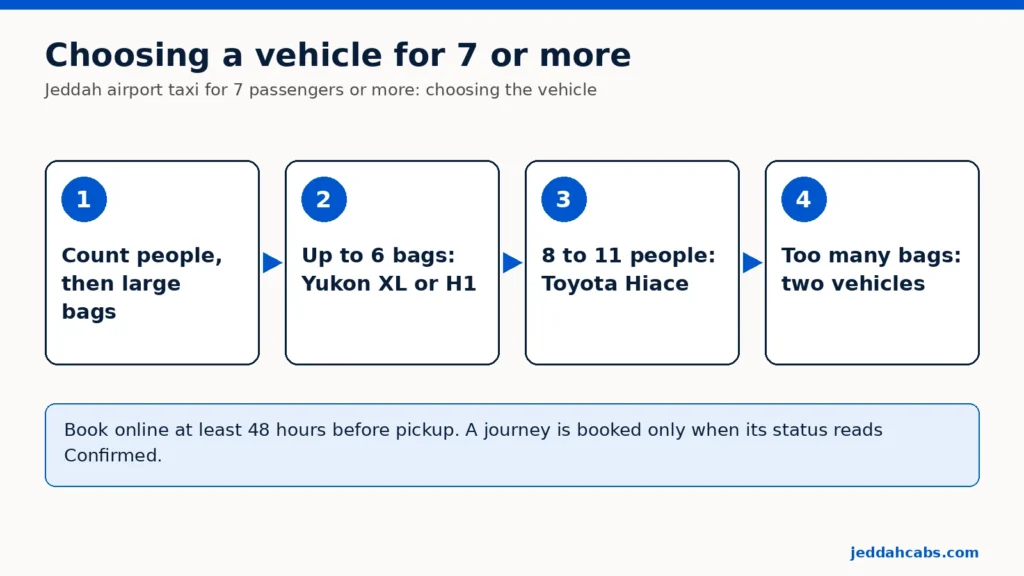
A Jeddah airport taxi for 7 passengers needs a seven-seat class at the very least: on Jeddah Cabs that means a GMC Yukon XL or a Hyundai H1 family van, each listed for 7 seats and 6 large bags. If your seven travellers carry more than six large cases, or you are eight to eleven people, the Toyota Hiace (11 seats, 10 large bags) is the next step. Groups of up to 19 fit a Toyota Coaster minibus, and larger parties a coach. In practice, luggage decides the class more often than seats do, so count the cases before you look at the cars.
This guide is for families and groups landing at King Abdulaziz International Airport together: extended families, wedding parties, friends travelling as a group and small organised groups. It explains which vehicles take seven or more people, how luggage changes the answer, when two vehicles beat one, how to handle a group arriving on more than one flight, and what the group leader needs at checkout. There is a table, a worked example and a checklist near the end.
Jeddah airport taxi for 7 passengers: the classes that fit
The table shows the Jeddah Cabs classes that seat seven or more, with the capacity figures the search uses. Models are examples; the vehicle is of that class “or similar”.
| Class | Example model | Seats | Large bags | Fits well |
|---|---|---|---|---|
| Seven-seat SUV | GMC Yukon XL | 7 | 6 | Seven people with up to six cases |
| Family van / MPV | Hyundai H1 | 7 | 6 | Seven people with up to six cases |
| Large van | Toyota Hiace | 11 | 10 | Eight to eleven people, or seven with lots of luggage |
| Minibus | Toyota Coaster | 19 | 11 | Twelve to nineteen people with modest luggage |
| Coach | Coach | 53 | Discuss at booking | Large groups and organised parties |
Two six-seat classes, the Hyundai Staria (6 seats, 2 large bags) and the Premium SUV (6 seats, 4 large bags), are too small for seven people. You will not see them in your results once you enter seven passengers, because the search shows only classes that pass the capacity check for your party and luggage.
Why luggage usually decides the class
Seven people rarely travel with only six cases. A family flying in for a wedding, or relatives arriving for a long visit, often carry one large case each and sometimes more. The moment the large-bag count passes six, the seven-seat classes stop fitting, however comfortable the seats would be.
The live capacity checks show how early this happens. A search for five adults with five large cases already returns only seven-seat vehicles and larger. Add two more people and two more cases, and you are beyond the seven-seat classes altogether.
Count bags the way the search does
- Large bags are full-size suitcases and anything similar that would travel in an aircraft hold.
- Cabin bags are entered separately in the search.
- Awkward items, such as a pushchair, a folding wheelchair or a boxed gift, are not described by the bag count. Treat each as a large bag when you judge fit, and describe it in the booking notes.
If you are not sure how many cases the group will bring, ask each traveller before you book, not at the airport.
The 7 seater taxi in Jeddah: Yukon XL or H1
When seven people and no more than six large cases are travelling, the 7 seater taxi in Jeddah is either the GMC Yukon XL or the Hyundai H1. Their figures are identical, 7 seats and 6 large bags, so the choice is about preference.
GMC Yukon XL is a full-size SUV. Some travellers prefer its ride on longer roads.
Hyundai H1 is a family van. Some families find a van body easier for children and older relatives getting in and out.
Because both are “or similar”, the exact model may differ on the day. If one feature is essential to a traveller, describe the need in the booking notes and ask the booking team to confirm it in writing. Our guide to reading the vehicle class before the photograph explains why the written capacity matters more than the image.
Seven people and a pushchair
A common borderline case is seven travellers with five or six cases and a pushchair. On paper the seven-seat classes fit; in practice the pushchair takes luggage space the bag count does not show. Count it as a large bag. If that takes you past six, compare the Hiace before you book, or ask the booking team whether the pushchair and cases will go in a seven-seater together, and get the answer in writing.
Eight to eleven people: the Toyota Hiace
The Toyota Hiace takes 11 passengers and 10 large bags. It is the natural choice for eight to eleven people, and also for seven people whose luggage outgrows the seven-seat classes.
For an extended family, one Hiace keeps everyone together with one driver, one pickup time and one cash balance. That simplicity is often worth more than the small savings of a split.
Twelve to nineteen, and beyond: Coaster and coach
The Toyota Coaster minibus seats 19 but is listed for 11 large bags, only one more than the Hiace. It suits groups where seats matter more than luggage: a group that has sent bags ahead, or one travelling with mainly cabin bags. A group of fifteen with a large case each will not fit its luggage in one Coaster, and needs a second vehicle or a different plan.
For larger parties, the coach seats 53. Discuss luggage and access with the booking team before booking, especially if the destination is a hotel or venue with limited space for a large vehicle. Where vehicles may stop is managed on the day.
Counting children and infants
Enter every traveller in the search: adults, children and infants are entered separately. Do not leave anyone out to make a smaller class appear, because the vehicle has to carry the real party.
Infant seats, child seats and boosters can be added in the search and are then confirmed for the vehicle. In a group with several young children, add all the seats you need before comparing classes. If you are not sure how a particular combination of ages and seats will fit, ask the booking team before paying.
One vehicle or two for a large group
Sometimes the group is better in two vehicles. Common reasons:
- The luggage exceeds any single class that seats the group, as with fifteen people and fifteen cases.
- The group is heading to two hotels. One vehicle could make a stop, since up to 8 stops can be added in journey order, but two direct journeys may suit tired travellers better.
- Part of the group is on a different flight.
- Some travellers need more space or quiet, such as older relatives after a long flight.
Each vehicle is a separate journey with its own booking, its own minimum booking value equivalent to £40, and, on Jeddah Cabs, its own deposit and cash balance for the driver. Two vehicles also means two drivers to meet at the airport. Compare both plans honestly: search the whole group once, then each half, and weigh the totals alongside the extra coordination.
Group airport pickup in Jeddah: flights, terminals and meeting
A group airport pickup in Jeddah works best when every detail of the arrival is in the booking.
One flight or several
If the whole group is on one flight, one journey (or one journey per vehicle) at one pickup time works. If relatives are arriving on different flights, even an hour apart, book each arrival as its own journey. A single pickup time cannot cover two landing times, and the first group would wait for the second.
Which terminal
King Abdulaziz International Airport has more than one passenger terminal. The airport’s own About KAIA page describes Terminal 1 as the main hub for international and domestic flights, the North Terminal, and a separate Hajj and Umrah Complex. Check your arrival terminal with your airline, and write it in the booking notes. The flight number is requested at checkout for airport journeys; enter it for every arrival.
Meeting the driver
The airport’s parking and transport page describes designated pick-up and drop-off areas near Terminal 1 and near the North Terminal entrance, and zones for passengers with limited mobility at each terminal. Where your driver meets you is set out in the driver-assigned email, which includes the vehicle registration, meeting and waiting instructions, and a secure link to view the vehicle photo in your account. We do not offer name boards or meet-and-greet products, so agree the meeting point in advance and keep the group leader’s phone switched on after landing.
Keeping a group together at arrivals
Large groups tend to spread out between immigration, baggage reclaim and the exit. Choose one person to lead, and ask everyone to wait for them at a single agreed spot inside the terminal before walking out together. One person phoning the driver is far easier than seven.
The group leader’s details at checkout
Checkout requires a mobile number for the customer. If the booking is for someone else, the traveller’s name, the traveller’s phone and an emergency contact are required. There is also an optional group leader phone field.
For a group, fill in the group leader field with the number of the person who will actually be at the airport. If the booker is at home and the group leader is on the plane, the driver needs the group leader.
The basket can also email a secure review link, so another member of the group can check the date, flight, passengers and bags before one person pays.
Onward from the airport
Where the group goes next changes how much the vehicle choice matters.
- To a Jeddah hotel. Our live route check puts the airport to the Jeddah Hilton at about 21 km. See our page on transfers from Jeddah Airport to your hotel.
- To Taif. About 197 km to the Taif InterContinental. Comfort matters more over a long road; see the Jeddah Airport to Taif transfer.
- To Yanbu. About 323 km. See the Jeddah Airport to Yanbu transfer.
- To a cruise ship. A group joining a ship needs the right terminal building; see our guide to the airport to cruise terminal transfer.
- To King Abdullah Economic City. Give the actual venue, as our guide to the Jeddah Airport to KAEC transfer explains.
Paying for a group transfer
On Jeddah Cabs, the checkout may take only a deposit online, 30% for a single journey, with the balance paid in cash to the driver. Both amounts are shown before you pay, and your account shows the cash due to the driver afterwards in your booking currency. It is a separate payment made directly to the driver, not covered by any refund from us. Ask the booking team to confirm in writing how the driver will take it, and give the cash to the group leader before the flight. With two vehicles, there are two balances for two drivers. If the group is booking from abroad, our guide to Jeddah airport taxi currency explains what the currency you book in changes, and what your card issuer may add, so the person paying and the group leader carrying the cash are working from the same figures.
Payment secures a provisional request. The booking team updates the status within 1 to 12 hours, and the journey is booked only when it reads Confirmed. Online bookings need at least 48 hours’ notice before pickup.
Changes, delays and the journey home
Group plans change more often than solo ones, and the booking rules are the same for every size of vehicle.
If a flight time changes before the day
If the airline moves the arrival time, request a new pickup time from your account before the original pickup time, and add a short note. Only one open request of each type is allowed per booking, and it remains pending until the booking team approves it. An approved new time carries a £5 rescheduling fee, converted into your booking currency and added to the cash paid to the driver at pickup; a rejected request costs nothing. With two vehicles, remember to request the change on both bookings.
If the group size changes
Only the time can be changed online. The number of passengers, the vehicle, the pickup and the destination cannot. If two relatives drop out, or three more join, contact the booking team, or make a new booking plus a cancellation request. Bookings are subject to our cancellation terms (free cancellation with a full refund up to 48 hours before pickup; inside 48 hours the deposit element of the price is kept) if the customer cancels, so check the numbers with every traveller before paying rather than after. The cancellation and refund policy sets out when a full refund for the affected journey applies, such as when we or the transport partner cannot supply the journey and no suitable alternative is accepted.
Booking the group’s departure
The journey home is a separate booking, and it deserves the same care. Groups usually leave with more than they arrived with, so count the bags again before searching: a Jeddah airport taxi for 7 passengers that fitted on arrival may need to become a Hiace on the way back. If the group is staying at two hotels, one vehicle can collect from both as stops in journey order, or two vehicles can go direct. Check the departure terminal with the airline, because it may not be the one you arrived at, and write it in the notes.
Older relatives and reduced mobility
For a group with older relatives, a wheelchair requirement can be added in the search and is then confirmed for the vehicle. The airport describes zones for passengers with limited mobility at each terminal. Tell the booking team in the notes who needs help and what kind, so the vehicle and the meeting arrangements suit them.
A worked example: the Hendry wedding party
Moira Hendry is organising transport for relatives flying into Jeddah for a family wedding.
The first group is seven people on one flight: four adults, two teenagers and a child of eight, with six large cases. Moira enters six adults, one child and six large bags, and adds a booster seat. The Yukon XL and the H1 both appear. She chooses the H1, enters the flight number, and puts her brother Alasdair’s phone in the group leader field, since he will be travelling with them.
The second group is nine people landing two hours later on another flight, with twelve large cases. Moira enters nine adults and twelve large bags. The Hiace is listed for ten large bags and the Coaster for eleven, so neither takes all twelve cases, and a coach is far more vehicle than nine people need. She books two journeys instead, a Yukon XL for four people with six cases and a Hyundai H1 for five people with six cases, and names a group leader for each.
All three journeys are booked more than 48 hours ahead and read Confirmed the same day. Moira writes each group’s terminal, flight number and group leader in a single message to the family, together with the cash due for each vehicle.
Group arrival checklist
- Count every traveller, including children and infants.
- Count large cases and awkward items per person, before you search.
- Enter the real figures and add any child seats or wheelchair requirement.
- Choose from the classes that appear: seven-seaters, Hiace, Coaster or coach.
- If luggage exceeds any single class, plan two vehicles.
- Book one journey per arriving flight, with the flight number at checkout.
- Check the arrival terminal with your airline and put it in the notes.
- Enter the group leader’s phone for the person actually travelling.
- Share a review link before paying, and wait for Confirmed.
- Give the group leader the cash due to the driver for each vehicle.
When the numbers are right, the right Jeddah airport taxi for 7 passengers or more follows. Enter your group’s passengers and bags in the Jeddah Cabs transfer finder to see every class that fits your arrival.