

To compare Jeddah transfer options fairly, compare only results for the same journey, in the same currency, for your real party and luggage. Then look past the headline figure: check that the vehicle’s seats and large bags both cover your group, see how much is taken online and how much is due to the driver in cash, and note any minimum booking amount line. The cheapest card is only a saving if the vehicle fits. The best result is usually the smallest class whose capacity covers everyone and everything you are carrying, at a price you are comfortable with.
This guide is for travellers looking at a list of Jeddah Cabs results for an airport arrival, a hotel move or an onward journey to Taif or Yanbu, and trying to decide which card to choose. It explains what each result card tells you, how to use ordering and filters without being misled by them, how to weigh the cheapest vs best-fit vehicle, how the deposit and cash balance affect a comparison, and when one vehicle beats two. There is a comparison table, a worked example and a checklist near the end.
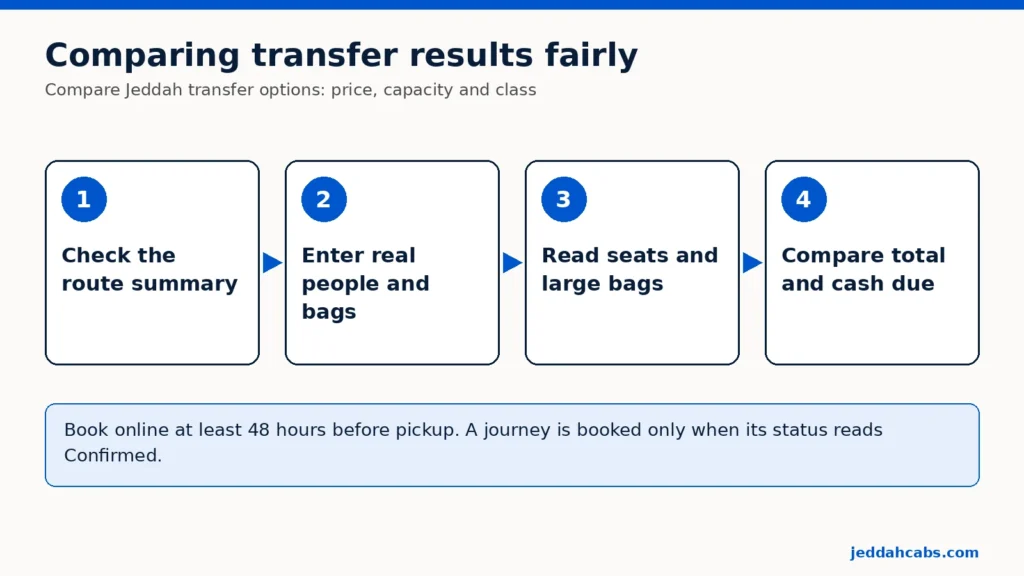
Compare Jeddah transfer options for the same journey first
A comparison is only as good as the search behind it. Before looking at any vehicle, read the route summary: the pickup place, the destination, the date and time in Saudi local time, and the passengers and bags you entered.
Two results that both say “Jeddah” can describe different trips. A pickup at King Abdulaziz International Airport and a pickup at a Jeddah hotel are separate journeys with separate prices. A drop-off at a Taif hotel and a drop-off at a Jeddah hotel are separate again. If any detail in the summary is wrong, change the journey and search again rather than comparing the wrong result. Our short guide to rechecking the airport behind a result explains the habit.
Keep one search per plan
If you are weighing two plans, such as going straight to Taif from the airport or spending a night in Jeddah first, run each plan as its own search and note the results separately. Do not carry a figure from one plan into the other. The live route checks show why: Jeddah Airport to the Taif InterContinental is about 197 km by road, while Jeddah Airport to the Jeddah Hilton is about 21 km. The journeys are not variations of one another.
What each result card tells you
Every card in the results brings together a handful of details. Read them as a set.
- Vehicle class. Economy, Business & Executive, Luxury, VIP van, Premium SUV, seven-seat SUV, family van, large van, minibus or coach.
- Example model, “or similar”. The model is an example of the class, not a promise of a particular car.
- Seats and large bags. The two capacity figures. Cabin bags are entered separately in the search.
- Price in your chosen currency. One of the 13 display currencies.
- A minimum booking amount line, if the fare for that journey would otherwise be lower than the minimum.
The photograph is an illustration of the class. It is not a reason to choose one card over another. Our guide to reading the vehicle class before the photograph explains why the written details carry the weight.
Only fitting classes appear
The search shows only vehicle classes that pass the capacity check for the party and luggage you entered. That is helpful, because classes that fail the capacity check for the numbers you entered are left out. It also means the list depends entirely on the numbers in the search. Enter fewer bags than you will carry, and the list will include classes that do not fit your real luggage.
Sorting transfer results: what the order means
Sorting transfer results helps only once the search is right. Where the results let you order cards by price or by capacity, or narrow them by class, those controls rearrange what the search returned. They do not add vehicles, create availability or change the journey.
Ordering by price puts the lowest figure first. That is useful when every card on the list fits your party comfortably, for example two travellers with a case each on a short city journey.
Ordering by capacity puts the largest vehicles first or last. That is useful when luggage is the tight constraint and you want to see how much headroom each class gives.
Filtering by class hides the classes you have not selected. If a filter leaves the list empty, clear the filter before changing the journey. An empty filtered list means the class you chose did not appear in the results, not that no vehicle is available.
The first card in any order is not a recommendation. Sorting transfer results is a way of reading them, not a decision in itself.
Cheapest vs best-fit vehicle
The cheapest vs best-fit vehicle question comes up whenever the list has more than one card. The answer depends on how tightly your party fits.
| Situation | Cheapest card | Best-fit card | What usually decides it |
|---|---|---|---|
| Two travellers, one case each, city journey | Economy | Economy | Both are the same; take the cheaper |
| Three travellers, three large cases | Economy may not appear | Business & Executive | Economy’s stated capacity is 2 large bags |
| Six travellers, light bags | VIP van (Staria) | VIP van (Staria) | Seats fit; 2 large bags is enough |
| Six travellers, four cases | Premium SUV | Premium SUV | Staria’s 2 large bags would not cover it |
| Seven travellers, six cases | Seven-seat class | GMC Yukon XL or Hyundai H1 | Both hold 7 and 6; choose on preference |
| Ten travellers, nine cases | Toyota Hiace | Toyota Hiace | The only class that fits one vehicle |
| Long road, older travellers | Smallest fitting class | One step larger | Comfort over a longer distance |
The pattern is simple. When the smallest fitting class covers everyone with room to spare, it is both the cheapest and the best fit. When it only just fits, or the road is long, the best fit may be one step up. When a class does not cover your luggage, it is not a cheaper option at all, because it is not an option.
Signs the cheapest card is not the best fit
- Your large-bag count equals the class’s large-bag figure, and you expect to buy things during the trip.
- You are carrying a pushchair, a folding wheelchair or sports equipment that the bag count does not describe.
- One traveller needs more legroom or an easier step in and out.
- The journey is one of the long ones, such as Jeddah Airport to Yanbu, about 323 km by road.
Reading the price: total, deposit and cash due
On Jeddah Cabs, the checkout may take only a deposit online, with the balance paid in cash to the driver. The checkout shows both amounts before you pay. When you compare options, compare the full journey price, not only what leaves your card today.
| Booking type | Share that may be taken online as a deposit |
|---|---|
| Single journey | 30% |
| Multi-leg booking | 40% |
| Return | 50% |
Two cards with similar totals will have similar splits for the same booking type. But if you are comparing, say, a return booking against two separate single journeys, the online share differs, even though the journeys are the same. Look at the total and the cash balance together.
The cash due to the driver is shown in your account as a separate line, in your booking currency. The checkout explains that it is a separate payment made directly to the driver and is not covered by any refund from us. Before the day, ask the booking team to confirm in writing how the driver will take the balance, and carry it ready.
The minimum booking amount line
Each journey has a minimum booking value equivalent to £40. If a short journey would price below that, the card or checkout shows a “Minimum booking amount” line instead. This is common on short hops within the city. It also affects comparisons involving two vehicles, because each vehicle is its own journey with its own minimum.
Keep the currency the same while comparing
Prices appear in the display currency you choose. Switching currency changes how the figures are shown, not the journey. Set the currency once, then compare every card in it; a card is not cheaper because it is in a different currency. Our guide to Jeddah airport taxi currency explains what the currency choice changes and what your card issuer may do.
One vehicle or two
For larger parties, the list may show one big vehicle, while two smaller ones could also work. Compare the two plans honestly.
One vehicle keeps the group together, gives one driver, one pickup time and one cash balance, and one booking to manage.
Two vehicles can suit a group split between two hotels, a party with a great deal of luggage, or a family that wants to leave at different times. But each vehicle is a separate journey with its own booking, its own minimum value, its own deposit and cash balance, and its own driver to meet. At the airport, two drivers also means two meeting arrangements.
To compare, search the whole group once, then search each half separately, and add up the totals. Include the second cash balance and the extra coordination in your decision, not only the figures.
Comparing one-way, return and multi-leg plans
A journey has one pickup place and one destination, and they must differ. A there-and-back trip is two journeys, each with its own time. Up to 8 stops can be added in journey order within a single journey.
That gives you three ways to cover a day with several places in it:
- One journey with stops, when the stops are brief and in order, such as collecting a relative on the way to the airport.
- Separate journeys, when you will spend time at each place and the car will not wait.
- A return or multi-leg booking, when the legs belong to one plan.
Compare them on what the day really needs. A journey with stops is not a waiting service, and a driver does not wait between separate journeys unless waiting has been confirmed in writing by the booking team.
Child seats, wheelchairs and other needs
Some requirements change which cards you should compare at all. Infant seats, child seats, boosters and a wheelchair requirement can be added in the search, and they are then confirmed for the vehicle. Add them before you start comparing, not after you have picked a favourite card, because they can change the list.
A folding wheelchair or a pushchair also takes luggage space that the large-bag figure does not show. If your party is close to a class’s limit, count such items as a large bag when you think about fit, and describe them in the booking notes. Our guide to reading the seats and bags labels in results explains how to check each card against a party with extra items.
When you compare Jeddah transfer options for a party with these needs, the best-fit card is the one that covers the people, the luggage and the equipment together. A cheaper card that covers only two of the three is not a like-for-like comparison.
Arrivals and departures compare differently
The same two cards can suit an arrival and a departure differently.
On arrival, you often do not know exactly how tired the group will be or how long the airport will take. A little more space helps if the bags are awkward or someone needs to rest. The flight number is requested at checkout for airport journeys, so enter it; it helps the booking team match the pickup to your flight.
On departure, you know your luggage better, but you may be carrying more than you arrived with. Enter the bags you expect to have on the day you leave. If a gift box or an extra case pushes you over a class’s large-bag figure, the next class up is the fair comparison.
Options outside the platform
Visitors sometimes compare a pre-booked transfer with arranging something on arrival. King Abdulaziz International Airport’s parking and transport page lists shuttle buses between terminals, the high-speed railway, car rental, private cars and on-demand transport. Each suits different travellers.
The fair comparison is not only price. A pre-booked transfer fixes the vehicle class for your party and luggage, shows the cash balance in advance, and gives you a Confirmed status and, later, a driver-assigned email with the vehicle registration. Whatever you choose, use a licensed service. The Transport General Authority regulates land transport in the Kingdom, including taxis, through licensing and safety standards.
A worked example: the Qureshis choose between two seven-seaters
Imran Qureshi is booking an arrival for five adults, his parents, his wife Sadia, his sister and himself, landing at Jeddah and travelling straight on to Taif. They have five large cases and five cabin bags.
He enters the journey from the airport to their Taif hotel, with five adults and five large bags. As the live capacity checks predict, only seven-seat vehicles and larger appear: the GMC Yukon XL, the Hyundai H1 and the bigger vans.
His cousin suggests entering four bags to see the Premium SUV, which might be cheaper. Imran does not. The Premium SUV is listed for 4 large bags, and five cases would not fit.
He orders the list by price. The Yukon XL and the H1 carry the same capacity, 7 seats and 6 large bags, and he compares them on preference. His father finds a van easier to climb into, so he chooses the H1. He writes in the booking notes that his parents are older travellers and would like the middle row.
Before paying, he uses the basket to email a secure review link to Sadia, who checks the date, the hotel name and the passenger count. She spots nothing wrong, and Imran pays the deposit. The checkout shows the amount paid online and the cash due to the driver. The status reads Confirmed a few hours later.
What made Imran’s comparison reliable was the honest search, not the ordering.
Sharing a comparison with family
If someone else in the family is paying or needs to agree, the basket can email a secure review link so another person can check the booking before one person pays. It carries the full journey, class and figures, which a screenshot of one card does not. Our page on how Jeddah Cabs works walks through the search, basket and checkout.
After you choose
Payment secures a provisional request. The booking team updates the status within 1 to 12 hours, and the journey is booked only when it reads Confirmed. Online bookings need at least 48 hours’ notice before pickup.
Only the pickup time can be changed online, and an approved new time carries a £5 rescheduling fee, converted into your booking currency and added to the cash paid to the driver. The vehicle class, passengers, pickup and destination cannot be changed online. Bookings are subject to our cancellation terms (free cancellation with a full refund up to 48 hours before pickup; inside 48 hours the deposit element of the price is kept) if the customer cancels, as the cancellation and refund policy explains. That is the best reason to compare carefully before paying rather than after. For the last leg of a trip, our guide to the Taif to Jeddah Airport journey shows how the same comparison works in reverse.
Comparison checklist
- Read the route summary: pickup, destination, date, time, passengers and bags.
- Enter the real number of adults, children and infants, and the real luggage.
- Choose one display currency and keep it.
- Read seats and large bags on every card, not the photograph.
- Use ordering and filters to read the list, and clear filters if the list empties.
- Pick the smallest class that covers everyone and everything, then move up only for a clear reason.
- Compare the total and the cash due to the driver, not only the deposit.
- For big groups, price one vehicle against two, including the second minimum and cash balance.
- Send a review link to anyone who needs to check before you pay.
- Book at least 48 hours ahead and wait for Confirmed.
To compare Jeddah transfer options with confidence, start with an honest search. Enter your real journey in the Jeddah Cabs transfer finder and compare the classes that fit.
If you cancel, cancellation is free with a full refund up to 48 hours before pickup; inside 48 hours the deposit element of the price is kept, and your statutory rights are unaffected. If we or the transport provider cancel, you receive a full refund for the affected journey.