
Jeddah taxi vehicle classes on Jeddah Cabs run from Economy saloons for up to four people to coaches with 53 seats. Each class has a stated number of seats and large bags, and each result card names an example model followed by “or similar”. What you book is the class and its capacity, not a particular car. The search does most of the sorting for you: once you enter the real number of passengers and bags, it shows only the classes that pass the capacity check for your party.
This guide is for anyone booking a transfer from King Abdulaziz International Airport, a Jeddah hotel, or onward to Taif, Yanbu or King Abdullah Economic City, who wants to understand the classes before choosing one. It explains what each class holds, what “or similar” means, how Economy and Business compare, when a six-seater is not enough, and how groups move up to vans, minibuses and coaches. It also covers child seats, wheelchairs, and what happens if you pick the wrong class. There is a table, a worked example and a checklist.
Jeddah taxi vehicle classes at a glance
The classes below are the ones the Jeddah Cabs platform offers, with the capacity figures the search uses. Model names are examples; the vehicle you receive is of that class “or similar”.
| Class | Example model | Seats | Large bags | Typical use |
|---|---|---|---|---|
| Economy | Toyota Camry class | 4 | 2 | One to three travellers with light luggage |
| Business & Executive | Shown on the card | 4 | 3 | Business travel, couples with more bags |
| Luxury | Mercedes S-Class | 3 | 3 | One or two travellers wanting the top saloon |
| VIP van | Hyundai Staria | 6 | 2 | Families with little luggage, city outings |
| Premium SUV | Chevrolet Tahoe | 6 | 4 | Families or groups with more cases |
| Seven-seat SUV | GMC Yukon XL | 7 | 6 | Seven travellers with a case each, or close to it |
| Family van / MPV | Hyundai H1 | 7 | 6 | Seven travellers with luggage |
| Large van | Toyota Hiace | 11 | 10 | Extended families and small groups |
| Minibus | Toyota Coaster | 19 | 11 | Groups travelling together |
| Coach | Coach | 53 | Ask at booking | Large groups and events |
Two points stand out. Seats and large bags do not rise together: the Staria has as many seats as the Tahoe but half the large-bag space. And the Luxury class has fewer seats than Economy. A class name tells you about comfort and style; the two numbers tell you whether your party fits. Reading Jeddah taxi vehicle classes this way, numbers first, avoids most mistakes.
How to read the numbers
Seats means passenger places, not counting the driver. Count everyone travelling, including children and infants, and enter them in the search as adults, children and infants.
Large bags means full-size suitcases. Cabin bags are entered separately in the search. A holdall that would go in an aircraft hold counts as a large bag in practice, whatever its shape.
Or similar vehicle meaning: what the card actually promises
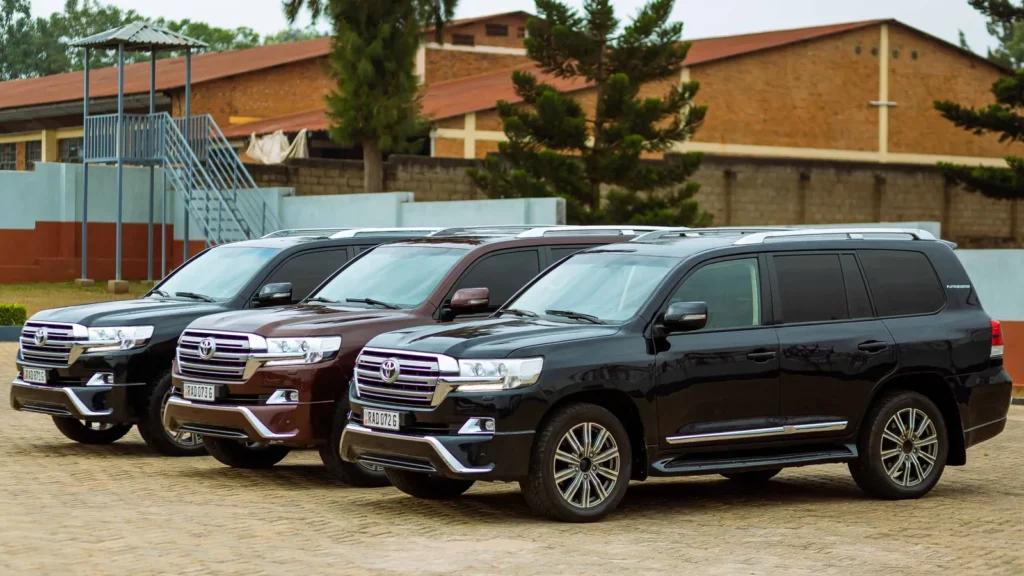
The “or similar” vehicle meaning is simple once you know it: the model shown is an example of the class. You are booking a vehicle of that class, with that seating and luggage capacity, not the exact make, colour or trim in the photograph. The photograph on a result card illustrates the kind of vehicle; it is not a picture of the car that will arrive.
This matters in three situations:
- You have your heart set on one model. Treat the model as likely but not guaranteed. If the class fits your party, the exact model rarely changes the journey.
- You need a specific feature. If something is essential, such as space for a particular item or a feature a traveller relies on, describe it in the booking notes and ask the booking team to confirm it in writing. Do not infer it from the photograph or from the model’s reputation.
- You want to recognise the car on the day. When a driver is assigned, you receive an email with the vehicle registration and meeting instructions, plus a link to view the vehicle photo securely in your account. That, not the search photograph, is the car to look for.
Can you ask for a particular model?
You can say in the booking notes that you would prefer a particular model, and the booking team will see it. It remains a preference unless they confirm it in writing. If the preference is really about a need, such as boot space for a folding wheelchair or a higher seat for an older traveller, describe the need itself. A need can be checked against whatever vehicle is assigned; a model name cannot.
Economy vs business car in Jeddah: what actually changes
Economy vs business car in Jeddah is the most common choice for one to three travellers, and it is closer than the names suggest.
Both classes seat four. The difference in the figures is luggage: Economy is listed for 2 large bags, Business & Executive for 3. For a couple with one case each, either fits. For three travellers with a case each, Business is the class whose stated capacity covers you, and the search will reflect that once you enter three large bags.
Beyond the numbers, Business & Executive is the more formal saloon, which suits business travellers going to meetings and anyone who wants more comfort on a longer road. Each class also carries its own included waiting allowance in the booking system. That allowance is not shown on search results, so if waiting time matters to you, ask the booking team to confirm it in writing rather than assuming one class waits longer than another.
When Economy is the right answer
- A short journey, such as the airport to a central hotel. Our live route check puts Jeddah Airport to the Jeddah Hilton at about 21 km.
- One or two travellers with a case each.
- A city outing with day bags only.
When Business is worth it
- Three travellers with a large case each.
- A longer onward journey, such as Jeddah Airport to Taif, about 197 km by road, where comfort counts for more.
- A work trip where arriving in a formal saloon matters.
Luxury: the smallest class, not the largest
The Luxury class, shown with a Mercedes S-Class as the example, seats 3 with space for 3 large bags. It is designed for one or two travellers who want the highest level of saloon, not for families. If you are four people, Luxury will not appear in your results, because it does not pass the capacity check.
Six seats: Hyundai Staria or Premium SUV
Five or six travellers need to leave the saloons behind. The two six-seat classes look alike on paper and are not.
Hyundai Staria (VIP van): 6 seats, 2 large bags. Spacious for people, limited for suitcases. It suits a family on a city outing, a group heading to dinner, or an arrival where most luggage has already gone ahead.
Premium SUV (Chevrolet Tahoe): 6 seats, 4 large bags. It suits five or six people with a moderate amount of luggage.
The live capacity checks show how quickly luggage decides the matter. A search for four adults with four large cases returns Premium SUV and larger only. Four people would fit in a saloon, but four cases would not.
Seven seats: GMC Yukon XL or Hyundai H1
At seven travellers, or at five with five large cases, the choice moves to the seven-seat classes. The live checks confirm it: five adults with five large bags return seven-seat vehicles and larger only.
GMC Yukon XL: 7 seats, 6 large bags. A full-size SUV with room for most of a family’s luggage.
Hyundai H1 (family van / MPV): 7 seats, 6 large bags. The same capacity in a van body, which some families prefer for getting children in and out.
Seven travellers with seven large cases exceed both. That is the point to look at the next size up, or at two vehicles.
Groups: Toyota Hiace, Toyota Coaster and Coach
Larger parties are where class choice matters most, because the wrong vehicle cannot be fixed at the kerb.
Toyota Hiace: 11 seats, 10 large bags. The practical choice for eight to eleven people with a case each, such as an extended family arriving on one flight.
Toyota Coaster (minibus): 19 seats, 11 large bags. It suits groups where seats matter more than luggage, such as a wedding party moving between a hotel and a venue. Note that its large-bag figure is only one more than the Hiace, so a group of fifteen with a case each needs a plan for luggage.
Coach: 53 seats. For large groups, events and organised tours. Discuss luggage and access with the booking team before you book, especially for venues or hotels with limited space for large vehicles.
One large vehicle or two smaller ones
Sometimes two vehicles are better than one. A group split between two hotels, or with a lot of luggage, may be easier in two seven-seaters than in one minibus. Each vehicle is a separate journey with its own booking, its own minimum booking value equivalent to £40, and, on Jeddah Cabs, its own cash balance for the driver. For more on large arrivals, see our page on transfers from Jeddah Airport to your hotel.
Is a bigger class always the safer choice?
Not necessarily. A larger vehicle than you need usually costs more, and on some journeys it brings practical drawbacks. A coach or minibus needs more space to stop, turn and wait, which can matter at hotels with tight frontages or in older districts. Where vehicles may stop is managed on the day, so a smaller vehicle often gets closer.
The sensible rule is to book the smallest class whose seats and large bags both cover your party, then move up one step only for a clear reason:
- A long road, where extra space makes the journey easier for older travellers or children.
- Awkward items, such as a pushchair, a folding wheelchair or sports equipment, that take space a suitcase count does not show.
- Uncertain luggage, for example on a return journey when you expect to carry more than you arrived with.
If none of those applies, the smaller class that fits is the right one among the Jeddah taxi vehicle classes on offer.
How the search chooses classes for you
You do not have to work out capacity by hand. When you enter pickup, destination, date, time, passengers (adults, children and infants), large bags and cabin bags, the search shows only the vehicle classes that pass the capacity check for that party and luggage.
That makes honesty in the search the most important step. If you enter fewer bags to see a cheaper class, the results will show a class that does not fit your real luggage, and the problem appears at pickup instead. Our guide to reading the seats and bags labels in results explains how to check each card against your party.
Matching the class to the journey
The same party may choose differently for different routes.
Airport to a Jeddah hotel
A short city journey. Choose the smallest class that fits your people and bags; comfort differences matter less over a short distance.
Airport to Taif or Yanbu
Long roads change the calculation. Our live route checks put Jeddah Airport to the Taif InterContinental at about 197 km and Jeddah Airport to Yanbu at about 323 km. On journeys of that length, legroom, luggage space and the comfort of older passengers carry more weight. See our pages on the Jeddah Airport to Taif transfer and the Jeddah Airport to Yanbu transfer.
Airport to King Abdullah Economic City
For KAEC, the class depends on your party, but the destination needs care too. Our guide to giving the driver the actual KAEC venue explains why.
Journeys home with extra luggage
Return journeys to the airport often carry more than the arrival did: gifts, shopping and sometimes an extra case. Enter the luggage you expect to carry on the day of departure, not the luggage you arrived with. If that pushes you into a larger class, it is better to know when you book than when the boot will not close.
Journeys with equipment
Dive kit, golf bags and similar items take space that a suitcase count does not describe. Our guide to a Yanbu diving trip transfer with your kit shows how to describe equipment so the class fits.
Child seats, wheelchairs and access
Infant seats, child seats and boosters can be added in the search, and a wheelchair requirement can be added too. They are then confirmed for the vehicle. Add them before you compare classes, because they affect which vehicles suit. A folding wheelchair also takes luggage space, so count it with the bags and describe it in the notes. Our accessibility statement sets out how the site and service approach access.
A worked example: three parties, three classes
Sarah Whitfield is flying into Jeddah for a two-day work trip with a cabin bag and one suitcase. She searches from the airport to her hotel with one adult, one large bag and one cabin bag. Economy and Business both appear. She chooses Business, because she is going straight to a meeting.
Tom and Rachel Ellis are arriving with Rachel’s mother and their two adult sons, five adults in all, with five large cases, then heading on to Taif. They enter five adults and five large bags. Only seven-seat classes and larger appear, exactly as the live capacity check predicts. They choose the GMC Yukon XL, and note in the booking that Rachel’s mother would prefer a front or middle seat for the long road.
The Farouk family are ten relatives arriving together for a wedding, with nine large cases. They enter ten passengers and nine large bags. The Toyota Hiace appears; nothing smaller does. They book it, and put the group leader’s phone in the optional group leader field at checkout.
Each party booked more than 48 hours ahead and waited for Confirmed.
Booking rules that apply to every class
- Notice. Online bookings need at least 48 hours’ notice before pickup.
- Minimum value. Each journey has a minimum booking value equivalent to £40.
- Payment and status. Payment secures a provisional request. The booking team updates the status within 1 to 12 hours, and the journey is booked only when it reads Confirmed. On Jeddah Cabs, the checkout may take a deposit online, with the balance paid in cash to the driver; both amounts are shown before you pay.
- Changing class. Only the pickup time can be changed online. The vehicle, passenger numbers, pickup and destination cannot. To move to a different class, contact the booking team, or make a new booking plus a cancellation request. Bookings are subject to our cancellation terms (free cancellation with a full refund up to 48 hours before pickup; inside 48 hours the deposit element of the price is kept) if the customer cancels, as the cancellation and refund policy explains, so choose the class carefully before paying.
Who regulates taxis in Saudi Arabia
The Transport General Authority describes itself as the regulatory authority for land, sea and rail transport in the Kingdom, including taxis and passenger buses, through licensing of transport activities, technical specifications and safety standards. Jeddah Cabs is an official partner brand of Saudi Cab Co, and journeys are supplied by transport partners.
Class choice checklist
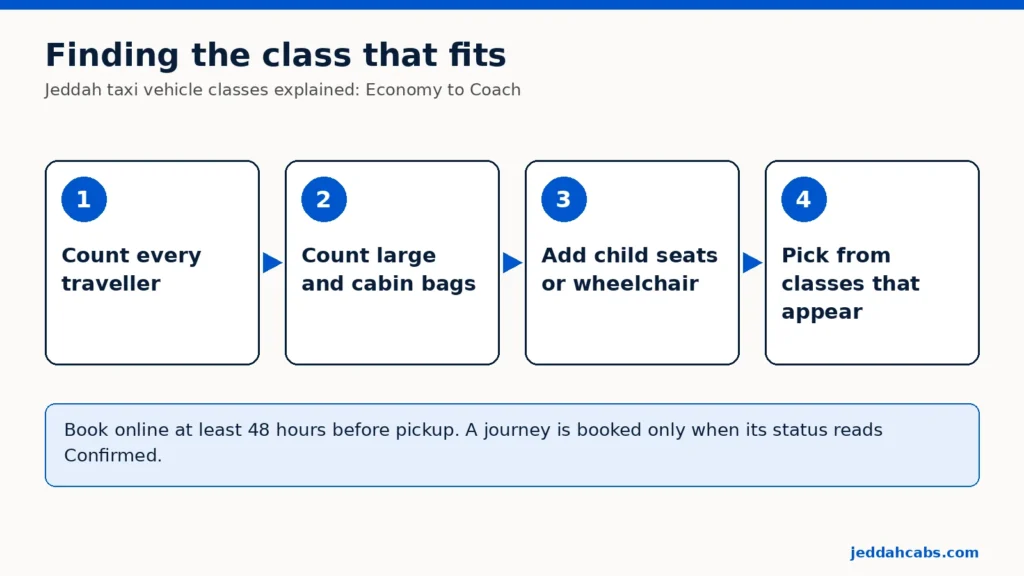
- Count every traveller, including children and infants.
- Count full-size suitcases as large bags, and cabin bags separately.
- Add child seats, boosters or a wheelchair requirement before comparing.
- Enter the real figures in the search, not smaller ones.
- Compare only the classes that appear, and read seats and large bags on each card.
- Treat the model as an example; the class and capacity are what you book.
- Put any essential feature in the notes and ask for written confirmation.
- For long routes, weigh comfort as well as capacity.
- For big groups, compare one large vehicle with two smaller ones.
- Book at least 48 hours ahead and wait for Confirmed.
Once you know your numbers, the right class usually picks itself. Enter your pickup, destination, passengers and bags in the Jeddah Cabs transfer finder to see every class that fits your journey.
If you cancel, cancellation is free with a full refund up to 48 hours before pickup; inside 48 hours the deposit element of the price is kept, and your statutory rights are unaffected. If we or the transport provider cancel, you receive a full refund for the affected journey.