
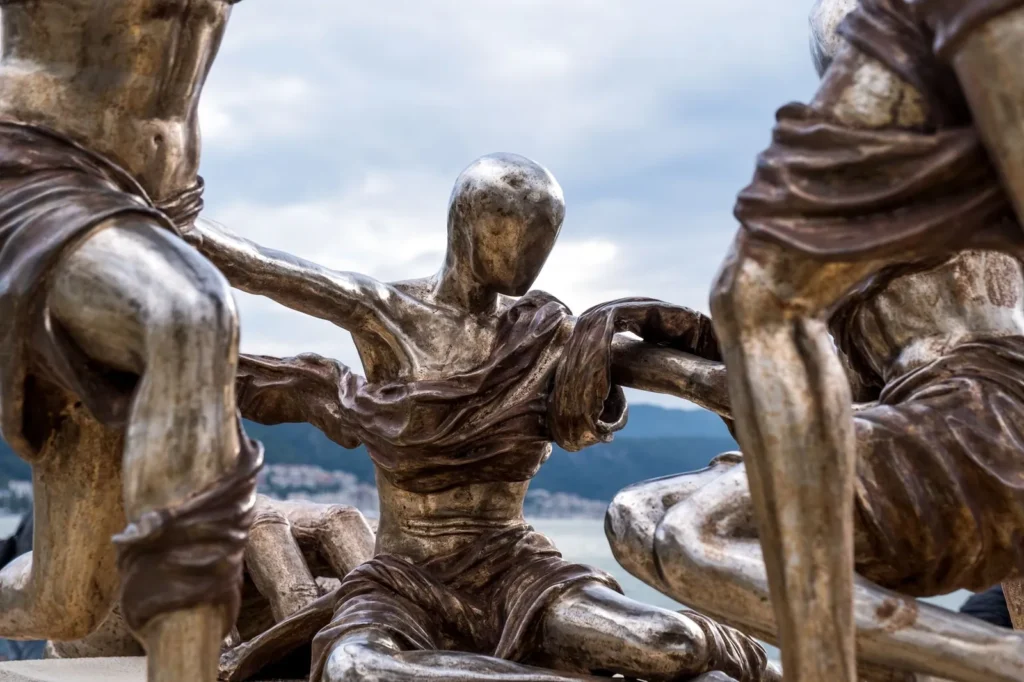
The Jeddah Sculpture Museum is a free, open-air collection of restored twentieth-century sculptures set in a landscaped park on the Al-Hamra stretch of the Corniche, with works by Henry Moore, Joan Miró and Alexander Calder among them. It is not a building with a ticket desk: you arrive by car, walk straight in among the bronzes and leave when the heat or the light tells you to. This guide explains what the collection is, where exactly it sits on the seafront, how it came to exist, and how to plan a visit that pairs it with a Corniche walk and a sensible pickup point.
What is the Jeddah Sculpture Museum?
Art Jameel, the non-profit arm of the Jameel family’s philanthropy, describes the museum as a park holding twenty major restored public artworks by Saudi and international artists, created in collaboration with Jeddah Municipality. The named headline artists on Art Jameel’s own collaboration page are Henry Moore, Joan Miró and Alexander Calder. Those three names alone make this one of the more unusual public art sites anywhere on the Red Sea coast.
The works were not made for the park. They were commissioned or bought for Jeddah’s streets and roundabouts during the city’s beautification drive of the 1970s and 1980s, weathered badly in the salt air, and were then gathered, restored and re-sited together on the Corniche. Saudi Arabia’s tourism authority refers to the site simply as Jeddah’s sculpture park on its outdoor-art pages, and most locals know it by the Arabic name Al-Hamra, after the district it sits in.
Where exactly is the sculpture park on the Corniche?
The museum occupies a dedicated plot on Al-Hamra Corniche, between the Hassan Enany Mosque (sometimes written Al-Anani Mosque in English-language reports) and Al-Salam Palace. When Arab News reported on the restoration project in August 2012, it described a site of about 7,000 square metres planned as an open museum for residents and visitors. If you know the central Corniche, that places it on the seaward side of the road, roughly where the Al-Hamra promenade meets the palace district.
This matters when you book a car. “The Corniche” in Jeddah runs for many kilometres and has several distinct sections; a driver told only “Corniche” may reasonably head for the northern Waterfront or the fountain viewpoint. Give the name Jeddah Sculpture Museum, add Al-Hamra Corniche, and mention the Hassan Enany Mosque as the landmark. Our earlier guide on choosing which Corniche stop to ask for explains why that extra precision saves a frustrating detour.
Who put hundreds of sculptures in Jeddah in the first place?
The story begins with Mohamed Said Farsi, an Egyptian-trained planner who became Mayor of Jeddah in 1972 and served until 1986. According to a profile published by Art Dubai, Farsi had grown up noticing how art shaped the public spaces of Alexandria, and he set out to do the same for a fast-growing Red Sea port that was reclaiming land from the sea for a new seafront. He brought in the Spanish architect Julio Lafuente to help plan the Corniche, and over roughly a decade Jeddah acquired more than 400 public sculptures.
The roll-call of artists is remarkable for the period and the place: Henry Moore, Victor Vasarely, Alexander Calder, Arnaldo Pomodoro, Joan Miró, César Baldaccini, Jean Arp and Jacques Lipchitz among the international names, alongside regional sculptors such as Aref El Rayess, Mustafa Senbel and Shafiq Mazloum, and Saudi artists including Maha Malluh. Farsi’s son Hani later documented the collection in the book Jeddah, City of Art, first published in 1991 and updated in 2015.
Why did the sculptures need rescuing?
Bronze and steel do not enjoy decades of humidity, salt spray and intense sun. By the 2000s many of the roundabout pieces were corroded, vandalised or simply lost in traffic schemes. Art Jameel began a restoration programme in 2011, working with Jeddah Municipality under the central Corniche waterfront development, and engaged the British conservation specialists Plowden & Smith.
Arab News reported in 2012 that 26 bronzes were selected for the first phase: twenty were dismantled and taken to a 500-square-metre workshop for full conservation, while six were treated in place. The same report named Moore, Vasarely, César, Miró, Calder and Jean Arp, plus the Egyptian sculptor Mustafa Senbel and the Syrian artist Rabi’a Al Akhras, among the pieces chosen. Lighting, visitor maps and a training scheme for Saudi conservators were part of the package. Within two years of the project starting, twenty restored works had been moved to their new home on the Al-Hamra Corniche, which is the park you can visit today.
Which artists and works should you look for?
Treat the names below as a guide rather than a floor plan: the museum has no published catalogue we could verify, and labels on site are the authority. Based on the restoration reports and Art Jameel’s description, expect to see:
- Henry Moore – the British sculptor whose large, rounded bronzes are the collection’s best-known pieces, and the reason many visitors search for Henry Moore sculptures in Jeddah.
- Joan Miró – playful, almost cartoon-like bronze forms that read very differently in strong Red Sea light than in a European gallery.
- Alexander Calder – bold painted steel shapes, the kind of work he called “stabiles” as opposed to his hanging mobiles.
- Victor Vasarely – geometric optical pieces; his work is also represented in the newer Al-Arbaeen Lake display described below.
- Jean Arp and César – European modernists whose organic and compressed forms sit well against the sea.
- Arab and Saudi sculptors – including Mustafa Senbel and Rabi’a Al Akhras, whose inclusion was a deliberate part of Farsi’s vision.
Several of these artists also have pieces elsewhere in the city that were never moved to the park, so a sculpture you remember from a roundabout photograph may not be here. Attribution can be confusing because several artists are represented by more than one piece around the city. If a label does not match what you expected, assume the label is right and your memory of a photograph online is wrong.
How does the open-air museum differ from the Jeddah Art Promenade?
Visitors often conflate two separate sculpture displays on the water. The Jeddah Sculpture Museum at Al-Hamra holds the restored historic collection. The Jeddah Art Promenade, launched in December 2021 ahead of the inaugural Saudi Arabian Grand Prix, is a newer waterfront display further north near the Corniche circuit, featuring contemporary work such as the golden falcon that appears to stand in the sea; Formula 1’s own destination guide describes it as a globally curated open-air gallery. Visit Saudi lists the Jeddah Art Promenade as a seaside art experience in its own right.
A third site joined the list in 2025: Al-Arbaeen Lake in historic Jeddah was turned into an open-air gallery of fourteen international works, led by the Ministry of Culture with Jeddah Municipality. Arab News, citing the Saudi Press Agency on 1 July 2025, named pieces by Vasarely, Calder (two works), Pomodoro, Miró and Lorenzo Quinn. If you have a serious interest in modern sculpture, the three sites together make a coherent half-day, but each needs its own drop-off; our planner for an art day out across Jeddah’s venues and districts covers how to sequence them.
When is the best light for the Corniche sculptures?
The park is outdoors and unshaded for most of its area, so timing is about comfort as much as photography. From roughly November to February, Jeddah’s daytime temperatures are the mildest of the year and a late-morning visit is pleasant. For the rest of the year, aim for the first hour after sunrise or the last ninety minutes before sunset.
Photographically, the sculptures face a western sea horizon, so late afternoon puts warm side-light on the bronzes with the Red Sea behind them; sunrise gives you cooler light and almost nobody else in the frame. The lighting installed during the 2012 restoration means the park is also walkable after dark, when the Corniche fills with families. If photographs are the main point of your trip, our guide to a Jeddah photo outing with transfers between locations suggests how to chain the museum with the fountain and Al-Balad.
Is there an entrance fee or opening hours?
As published by Art Jameel in October 2026, the museum is a public park rather than a ticketed venue, and we found no official admission charge. We also found no officially published opening hours. In practice it is an open stretch of Corniche landscaping, but temporary closures for events, maintenance or Jeddah Season installations do happen, and the municipality does not always announce them in English.
Our advice is simple: do not build a tight itinerary around this one site. Treat it as a pleasant, usually accessible stop, confirm on the day by checking the Visit Saudi Jeddah pages or the municipality’s social channels, and have a Plan B such as the Al-Hamra promenade itself or the Hassan Enany Mosque exterior next door.
A fictional afternoon: two friends and a sunset walk
This is an invented scenario, not a real customer. Imagine two friends on a weekend city break, staying in a hotel on Tahlia Street. They book a car in the transfer finder for a drop at the Jeddah Sculpture Museum, Al-Hamra Corniche, giving the Hassan Enany Mosque as the landmark. They arrive about ninety minutes before sunset, spend forty minutes among the Moore and Miró pieces while the light softens, then walk north along the promenade.
Rather than return to the same spot, they have asked their driver to collect them at a named café on the Al-Hamra promenade a little further along. Their luggage is at the hotel, so the car can be an economy saloon, and they are back on Tahlia in time for dinner. The whole outing needed two addresses, one landmark name and a flexible pickup; nothing else.
How should you pair the museum with a Corniche walk?
The Al-Hamra section of the Corniche is one of the better walking stretches in central Jeddah: a wide paved promenade, benches, shade structures and views across to the King Fahd Fountain. A natural route is to start at the sculpture park and walk north with the sea on your left. The fountain is visible for most of the way and is lit after dark; our separate guide to where to watch the Jeddah Fountain and how to get there explains the viewpoints.
If you would rather combine art with art, the Hayy Jameel creative district in the north of the city is Art Jameel’s indoor complex and makes a logical second stop; read our notes on planning a Hayy Jameel exhibition, cinema or library visit before you go, because its programme changes. Either way, keep the walking leg to what the weather allows and let the car do the joining-up.
Where should a taxi drop you and pick you up?
Drop-off is straightforward: the Corniche road has lay-bys and parking areas along Al-Hamra, and drivers can stop briefly close to the park entrance. Ask for the Jeddah Sculpture Museum by name and confirm the Hassan Enany Mosque as a reference point so there is no confusion with the Art Promenade further north.
Pickup is where visitors go wrong. Mobile signal is good, but the promenade is long and looks the same for hundreds of metres, so “I’m on the Corniche” helps nobody. Pick a fixed landmark before you set off: the mosque forecourt, a named café, or the sculpture park entrance you arrived at. If you walk, agree the new point with your driver by message, with a photo of the nearest sign if possible. Late evenings on weekends, the Corniche road is slow and crowded, so allow a generous buffer rather than timing a pickup to the minute.
Practical details for families and visitors with limited mobility
The park is flat, paved and buggy-friendly, with the sculptures spaced widely enough that children can move between them without touching the works. There is no fencing around most pieces, so supervise small children: these are conserved bronzes, and the whole point of the 2012 project was to stop them being damaged. Public toilets along the Corniche exist but are not evenly spaced; using facilities at your hotel or a café before you arrive is wise.
Wheelchair users will find the promenade surface good, though kerb cuts between the road lay-bys and the park are not guaranteed everywhere. If step-free access is essential, ask the driver to stop at the main park entrance rather than a random lay-by, and consider a larger vehicle if a folding chair is travelling with you.
Dress, conduct and respect for the setting
The sculpture park sits next to a working mosque and in a family recreation area. Modest, loose clothing that covers shoulders and knees is the norm for everyone, and it is also what keeps you comfortable in the sun. Photography of the sculptures is entirely normal; photographing other visitors, particularly families, without permission is not. During prayer times, the mosque will be busy and its forecourt is not a photo spot; wait a few minutes and the area clears.
There is no café inside the park itself, but the Al-Hamra promenade has kiosks and cafés within an easy walk. Carry water in all seasons, and remember that the park has very little shade at midday even in winter.
One more point on conduct: the restored bronzes have a protective patina applied by conservators. Leaning on them, letting children sit on the lower pieces or resting bags against plinths wears that layer away faster than the weather does. Enjoy them at arm’s length, as you would in any gallery.
A fictional morning: a solo visitor between meetings
This second scenario is also fictional. A visitor in Jeddah for work has a free morning before an afternoon appointment in the Al-Rawdah district. She books a car from her hotel for a sunrise drop at the sculpture park, spends half an hour photographing the Calder and Moore pieces in soft light, and then walks to a promenade café for breakfast.
Instead of booking a return to the hotel, she books her second leg directly from the café to her meeting address, using the café name as the pickup point. The two legs cost her nothing in waiting time, and she has seen the best of the collection before the day heats up.
Checklist before you go
- Enter “Jeddah Sculpture Museum, Al-Hamra Corniche” as the destination and name the Hassan Enany Mosque as the landmark.
- Do not confuse it with the Jeddah Art Promenade (north, near the circuit) or the Al-Arbaeen Lake display (historic Jeddah).
- Visit early morning or late afternoon outside the winter months; the park is unshaded.
- Check Visit Saudi or municipality channels for temporary closures or Jeddah Season works.
- Agree a precise pickup landmark before you start walking the promenade.
- Carry water, wear modest loose clothing, and keep children from climbing the works.
- Allow a generous buffer for weekend-evening Corniche traffic.
Booking a car to the Corniche sculptures
The Jeddah Sculpture Museum rewards an unhurried visit, and the only logistics that matter are a precise drop-off and a pickup point you can describe. Enter the park as your destination in our transfer finder, choose a vehicle that suits your group, and add the Al-Hamra landmark in the notes so your driver takes you to the right stretch of Jeddah’s long seafront.
Sources reviewed 15 October 2026: Art Jameel (collaborations page describing the Jeddah Sculpture Museum), Aga Khan Development Network and Archnet (Corniche mosque records used for the Hassan Enany landmark context), Visit Saudi (Jeddah Art Promenade and outdoor-art pages), Art Dubai (profile of Mayor Mohamed Said Farsi), Arab News reports of August 2012 and July 2025 (the latter citing the Saudi Press Agency), Formula 1 official destination guide (Jeddah Art Promenade launch). No official opening hours, admission policy or work-by-work catalogue could be verified, and artist attributions should be checked against on-site labels. Photo: leventkalkan / Pexels.