
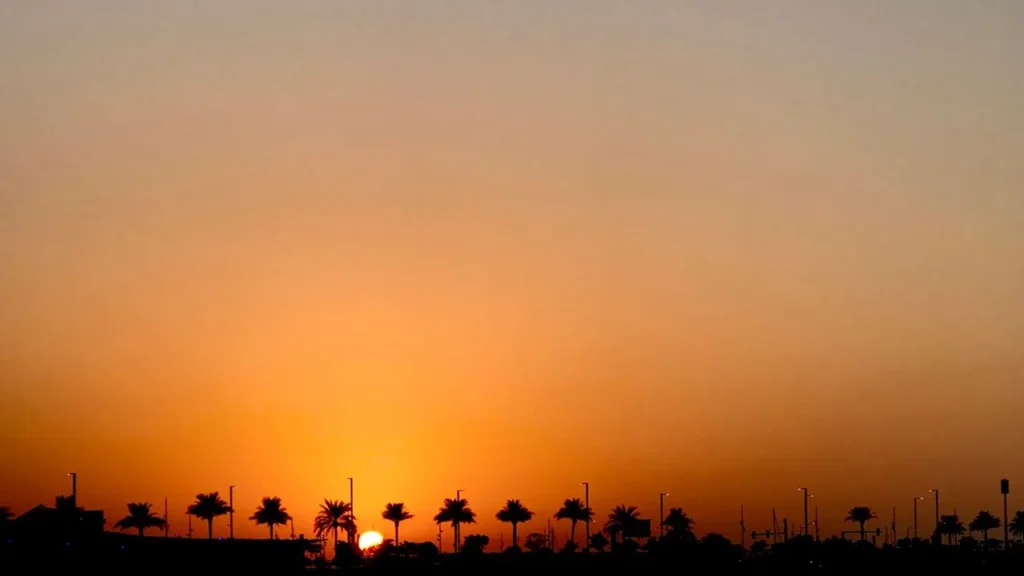
The best photography spots in Jeddah for a visitor with a car and a few hours are the lanes of Historic Jeddah, the long waterfront along the Corniche, the city’s open-air sculptures and King Fahd’s Fountain after dark. Choose two or three of them, put them in a sensible order around the light, and book each road journey with a clear start and finish rather than asking a driver to wander until something looks good. That turns a vague wish into a photo outing that actually works.
This guide is for travellers, hobby photographers and anyone who has hired a photographer for a session in Jeddah. It covers the main photography spots and what makes each one worth the trip, how to plan sunset photos in Jeddah on a coast that faces west, when stops within one journey make sense and when separate journeys are better, what Saudi law says about photographing people, what to check before bringing a drone, and how the booking rules apply. It does not give opening hours or sunset times, which change through the year and should be checked for your date.
Photography spots in Jeddah worth building a route around
Jeddah is spread out along the Red Sea, so distance between spots is the first thing to plan for. These are the places most visitors photograph, with facts from official sources.
Historic Jeddah (Al-Balad)
UNESCO lists the old town as Historic Jeddah, the Gate to Makkah, and describes tower houses built in the late nineteenth century, coral stone houses and wooden roshan screens, along with mosques, souqs and small squares. For photographers, that means texture, carved wood, shaded lanes and deep doorways. It is a walking district, so the car sets you down at the edge and collects you later. Our guide to Al Balad by taxi after check-in or on another day explains how to choose drop-off and pickup points.
Restoration work continues in the district, so a building you saw online may be covered in scaffolding on the day. Treat that as part of the visit, not a failure of the plan. Walks often end on the far side of the district, and our note on an Al-Balad walk that finishes somewhere else explains why the pickup point may differ from the drop-off.
The waterfront and the Corniche
Saudipedia’s entry on Jeddah city describes a 4,500 m waterfront running from al-Nawras Roundabout in the north to Jabir Bin al-Harith Street, with green areas, swimming beaches and a hanging walkway. It also mentions Al-Nawras Island on the northern Corniche, with restaurants, cafés and a marina. Wide sea views, promenades and long leading lines make this the natural place for sunset photos in Jeddah.
“The Corniche” is too long to be one destination. Our guide to which part of the Jeddah Corniche to ask for helps you choose a named point.
Open-air sculptures
The same Saudipedia entry describes Jeddah as home to a very large collection of outdoor sculptures and models, an open museum with works by artists including Henry Moore, Victor Vasarely and César Baldaccini. Sculptures on roundabouts and along the waterfront make striking subjects, but many sit where a car cannot stop. Our guide to planning an art day by taxi looks at which pieces are practical to visit on foot.
King Fahd’s Fountain
Saudipedia’s page on King Fahd’s Fountain describes water propelled up to 312 m and illuminated by around five hundred lights. A tall column of lit water over the sea is one of the city’s classic night images. It helps to choose where to stand before you go, and our guide to where to see the Jeddah fountain covers viewing places and the ride there.
Landmarks around the city
Saudipedia’s list of Jeddah’s visual icons names the Flagpole in King Abdullah Bin Abdulaziz Al Saud Square and Khuzam Tower in the Khuzam Palace area. Museums such as Khuzam Palace, now the Jeddah Museum, can add an indoor stop for the middle of a hot day. Check each venue’s own rules on photography inside.
A Jeddah photo outing needs a shortlist, not a drive-around
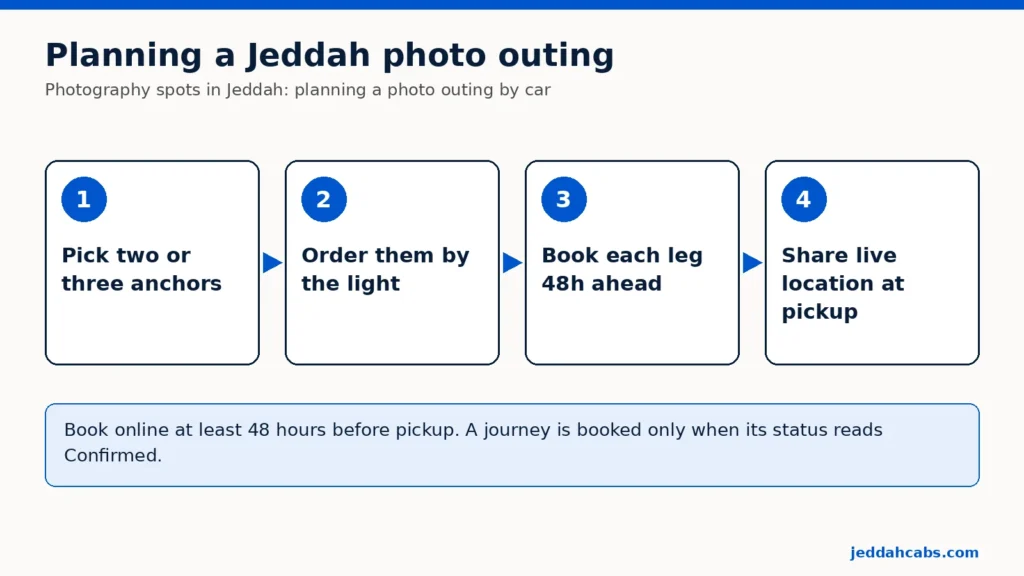
A Jeddah photo outing works best with two or three anchors. Each anchor is a place you want to spend real time at, where you will get out of the car and walk. Everything else is a bonus.
Asking a driver to cruise until something catches your eye rarely works. A booked journey has a pickup place, a destination and a time. It is not a hire by the hour. If you want a flexible roaming day, you need to break it into planned journeys or accept that some ideas will wait for another trip.
How to choose your anchors
- Light. Which places look best in soft light, which at night?
- Distance. Group places that are close together. The old town and the southern waterfront pair more easily than the old town and the far north.
- Walking. Which places need time on foot? Historic lanes and the promenade do.
- People with you. A partner who is not a photographer may enjoy one anchor with a café more than four quick stops.
Sunset photos in Jeddah: planning around the light
Jeddah sits on the eastern shore of the Red Sea, so the sea lies to the west and the sun sets over the water. That makes the waterfront the obvious choice for sunset photos in Jeddah.
Getting the timing right
Look up the sunset time for your date from a reliable source, and plan to arrive at your chosen point well before it. Light often changes quickly around sunset, and you will want time to find a spot, set up and take a few test frames.
Sunset is also the time of the Maghrib prayer. Be considerate of people praying near the waterfront, and do not make them the subject of your photographs.
The pickup after dark
Set the return pickup for well after sunset. The blue hour and the lit fountain can be the best part of the evening, and you do not want to leave just as the light turns good. Choose a pickup point that is easy to find in the dark, such as a named car park, hotel or road junction, and send the driver a live location when you are there.
Stops within one journey or separate journeys?
There are three ways to structure a photo outing. The right one depends on how long you want at each place.
| Plan | How it works | Suits | Watch out for |
|---|---|---|---|
| One journey with stops | Up to eight stops in journey order, ending at a final destination | Brief stops to take a picture from the roadside or a short walk | Waiting is not shown in the search; ask the booking team to confirm any waiting in writing before paying |
| Separate journeys | One journey to each anchor, a later journey onward or home | Time on foot at each place, such as the old town or the promenade | More journeys to book, each with its own time and minimum value |
| One way and walk | A journey to one place, walk to the next, a journey home from there | Places close enough to walk between | Heat and distance; check the map carefully |
For most photographers, separate journeys are the better plan for anything longer than a short stop. The car sets you down, the journey ends, and another journey collects you from a named point later.
Photographing people and places: what the law says
Saudi Arabia’s Anti-Cyber Crime Law lists among its offences the invasion of privacy through the misuse of camera-equipped mobile phones and similar devices, and defamation or damage to others through information technology devices. The penalties include imprisonment and fines.
In practice, that means:
- Ask before photographing people. Especially families, women and children. If someone says no, respect it and delete the image.
- Think before posting. A picture of a stranger that seems harmless to you may not be to them.
- Follow signs and staff. If a venue, building or staff member asks you not to photograph, stop.
- Check venue rules. Museums, galleries and private developments set their own rules on cameras, tripods and commercial shoots.
Drones
Drones are regulated by the General Authority of Civil Aviation. GACA’s frequently asked questions direct people to its Unmanned Aircraft Systems portal for licensing, registration and customs clearance of drones. Do not assume you can fly a drone because you have one in your bag. Check GACA’s requirements well before you travel, and if they are unclear, leave the drone at home.
Camera kit and the car
A photo outing usually means more bags than a normal day out.
Counting kit in the search
The search asks for passengers, large bags and cabin bags. A camera backpack is usually a cabin bag. A hard case with lenses, lights or a gimbal is often a large bag. A tripod in its bag is a long item; mention it in the booking notes. Results show only vehicle classes that pass the capacity check for your count.
| Party and kit | Classes that usually make sense |
|---|---|
| One or two people with camera bags | Economy or Business and Executive |
| Photographer, assistant and a model with cases and lights | Business and Executive or Premium SUV |
| Small group of four to six with kit | Premium SUV or Hyundai Staria |
| Larger crew with stands and cases | Hyundai H1 family van, GMC Yukon XL or Toyota Hiace |
Our guide to reading the vehicle class before the photograph explains why the class, not the example model, is what you book.
Keeping kit safe
Keep cameras and lenses with you, not in the boot, when you get out for a long walk, because the car will leave once the journey ends. Carry spare batteries and cards so a flat battery does not end the outing early.
When you have hired a photographer
If you have booked a photographer for a family or couple session, their plan and your transport are separate arrangements. Ask the photographer for the locations, the order and where the session ends. Then book journeys that match, with the final pickup from where the session actually finishes rather than where it started.
A driver does not scout locations or wait while a session moves around on foot. If the photographer suggests a new location on the day, remember that the booking does not change by itself.
Photography spots in Jeddah for a short stay
How many photography spots in Jeddah you can cover depends on how many days you have, not on how many places are on your list. These outlines are starting points, not timetables.
One free day
Pick one daytime anchor and one evening anchor. The old town suits the afternoon, when you can walk the lanes, rest in a café and move on. The waterfront suits the evening, with sunset over the sea and the lit fountain after dark. That is three journeys: hotel to the old town, old town to the waterfront, waterfront back to the hotel.
Two free days
Split the day and the night. Spend one outing on the old town and an indoor stop such as a museum, and return to the hotel to rest. Give the second day to the waterfront and the sculptures, with the fountain to finish. Each outing is shorter, and each has room for the light to be better or worse than you hoped.
Three or more days
With more time, you can repeat a place in different light. Many photographers find the same lane or stretch of promenade looks entirely different at another hour. Revisiting one strong location usually gives better pictures than adding a fifth new one.
Whatever the length of your stay, write the outing down as journeys before booking, each with a pickup place, a destination and a time. If a place does not fit into a journey, it does not fit into this trip.
A worked example: an afternoon and evening with a camera
Daniel Hughes, a keen amateur photographer, is in Jeddah for four days with his wife, Priya. He wants the old town’s doorways in soft light and the waterfront at sunset. Priya wants a relaxed evening with dinner.
Daniel chooses two anchors and books three journeys:
- Journey 1: hotel to a named gate at the edge of Historic Jeddah in the late afternoon, with a note saying they will walk from there.
- Journey 2: from a second named point on the far side of the district to a named spot on the waterfront, set to arrive well before sunset.
- Journey 3: from a restaurant near the waterfront back to the hotel, set late enough for dinner after the blue hour.
He searches for two adults with one large camera case and two cabin bags, and chooses an Economy car. Each short journey is checked against the minimum booking value, and he notes the cash due to each driver at checkout. All three are booked six days ahead and read Confirmed the next morning.
On the day, a lane he wanted is closed for restoration. He photographs the next one instead. The walk across the district takes longer than planned, but Journey 2 had room in it. At the waterfront he sets up before sunset, photographs the sky and the lit fountain, and they walk to dinner.
Heat, battery and small practicalities
- Heat. Most photography spots in Jeddah are outdoors. Carry water, wear a hat and plan outdoor walking away from the hottest part of the day, keeping indoor stops such as museums for the middle of it.
- Phone battery. You need a charged phone to send a live location at each pickup. Carry a power bank.
- Pickup points. Save each pickup point on your map before you set out, with a screenshot in case of weak signal.
- Weather and haze. Check the forecast the day before. Wind and haze change how the sea and sky look, so if your stay is long enough, look at the forecast before choosing which evening to book for the waterfront.
- Respect. In a historic district that is also a living neighbourhood, keep doorways clear and ask before photographing inside shops.
Booking rules for a photo outing
- Notice. Online bookings need at least 48 hours’ notice before each pickup, so plan the whole outing in advance.
- Status. Payment secures a provisional request, updated within 1 to 12 hours. A journey is booked only when it reads Confirmed.
- Minimum value. Each journey has a minimum booking value equivalent to £40. Short city journeys may show a “Minimum booking amount” line.
- Payment. Jeddah Cabs may take only a deposit online, with the balance paid in cash directly to the driver. The checkout shows both amounts.
- Changes. Only the pickup time can be changed online, by requesting a new pickup time from your account. An approved change carries a £5 rescheduling fee, converted into your booking currency and added to the cash paid to the driver. Stops, places, passengers and vehicle need the booking team.
- Cancellation. Bookings are subject to our cancellation terms (free cancellation with a full refund up to 48 hours before pickup; inside 48 hours the deposit element of the price is kept) if you cancel. If we or the transport partner cancel, or cannot supply the journey and you do not accept a suitable alternative, you receive a full refund for the affected journey. See the network cancellation and refund policy.
For a step-by-step view of booking, see how Jeddah Cabs works.
Checklist before you book a photo outing
- Choose two or three anchors from the main photography spots.
- Order them by light: textured lanes in soft light, the waterfront for sunset, the fountain after dark.
- Look up the sunset time for your date and set arrival well before it.
- Decide between stops, separate journeys or one way and walk for each part.
- Count camera cases as large bags and mention tripods and stands in the notes.
- Check venue rules on cameras and GACA’s requirements before bringing a drone.
- Book every journey at least 48 hours ahead and wait until each reads Confirmed.
- Save each pickup point and carry a power bank for live location sharing.
When your shortlist and timings are ready, enter each journey in the Jeddah Cabs transfer finder and book a photo outing in Jeddah with every leg, including the ride home after sunset, already arranged.