
To choose a cooking class in Jeddah, start with what you want to do with your own hands and what you hope to understand afterwards. A meal, a tasting walk and a cooking experience can all involve good food, but they offer different kinds of participation. Establish the actual class format, menu and accepted participants before paying or arranging the journey.
A visitor might want an enjoyable afternoon, a couple might want a shared activity, or a home cook might want to understand an unfamiliar dish. Those are useful starting points. “We like food” is less helpful because it does not tell the organiser whether you want to cook, watch, taste or simply sit down to dinner.
Choose participation before choosing cuisine
Imagine the moment you would most enjoy: preparing ingredients, following a chef’s explanation, working with your companion, or eating the finished meal. Your answer helps distinguish a practical class from a demonstration or restaurant visit. Ask what guests actually do during the proposed booking rather than assuming that the word “experience” means hands-on involvement.
Jeddah operator Julienne describes hands-on sessions in which guests prepare a meal with chef guidance and then eat together. Its website describes different cuisines and session formats. That makes it a relevant local example of participatory cooking, but not a promise of a particular menu, available date or place for your party.
Use that distinction when comparing other organisers. A chef preparing food in front of an audience may offer an interesting demonstration without giving each guest practical tasks. A tasting walk may explain food through several stops rather than a kitchen session. None is automatically better; choose the format that answers the reason you wanted the activity.
Write a one-sentence learning goal
A useful goal might be “I want to understand how the components of a dish fit together” or “We want to prepare part of a meal together”. Avoid promising yourself mastery after one visit. The organiser can explain whether the proposed session supports your modest goal. A short, honest intention makes that conversation clearer than a long list of cuisines.
If your main goal is to eat a particular dish, a restaurant may be the more direct choice. If it is to hear about neighbourhood food traditions, investigate a suitable guided experience. The Historic Jeddah guided-walk guide covers a different kind of organised visit; it does not establish that a walk includes cooking instruction.
Read the proposed menu as a working session
A menu tells you more than what will be served. It can reveal whether the booking centres on several components, a particular technique or a shared meal with limited practical work. Ask which parts guests prepare, which parts arrive ready and which stages the chef demonstrates. That answer helps you understand where your participation will happen.
Do not assume everyone will make every component independently. Some activities may divide tasks, use shared preparation or ask participants to work together. Ask about the actual format for your session. If individual practice matters to you, say so before paying rather than expecting the organiser to redesign a shared event after you arrive.
Someone interested in a particular cuisine should also ask what that session will cover, rather than treating a cuisine label as a complete syllabus. A single meal cannot represent every household, region or tradition. Enjoy the organiser’s selected dishes without expecting a definitive cultural education or claiming afterwards that you have mastered a whole national cuisine.
Think about whether you could use the learning at home
If you hope to repeat something later, ask whether the explanation includes ingredients you can identify and equipment you understand. You do not need to demand a simplified menu, but should know whether the session is primarily recreational or designed to leave participants with practical guidance. An enjoyable class can still be worthwhile even if you never recreate the exact meal.
Ask whether written recipes or permitted notes are part of the purchase. Do not assume they are included because a promotional photograph shows a recipe card. If you receive material, check what it covers while questions can still be answered. Avoid recording the whole session or photographing another guest’s work without the organiser’s permission.
Choose a format that suits your party
A public session can suit someone comfortable learning alongside people they have not met. A private occasion may suit a party with a particular shared purpose. Ask what is actually offered for your date and group. A private enquiry does not guarantee exclusivity, a bespoke menu or a venue willing to accept your preferred number of guests.
Tell the organiser whether everyone wishes to cook. One person may be enthusiastic while another would prefer to watch and eat. That difference matters when the purchase is based on participation. Ask whether a non-participating companion can attend, what their arrangement would be and whether they are included in the accepted guest count.
Do not add a spectator at the kitchen entrance because there is an empty chair. A cooking space may organise tasks, equipment and the meal around its confirmed participants. Any accompanying person should be accepted beforehand. A transport booking carrying extra passengers does not create extra class places or grant access to the venue.
Children need an accepted role
Julienne’s published FAQ says children attending require direct adult supervision. That is the named operator’s condition, not a universal rule for every Jeddah class. Ask your chosen organiser about the particular child’s participation and the responsible adult’s role before describing the event as a family cooking session.
Separate a child who will participate from one who will accompany the family without participating. Ask what is permitted and who will supervise each child. Do not assume the chef also provides childcare, or that a parent fully occupied with a cooking task can silently transfer responsibility to another guest. Resolve the actual arrangement with the venue.
Discuss food requirements before buying a place
Describe dietary requirements and relevant allergy concerns to the organiser in advance. Ask what it can actually accommodate within the proposed menu and working environment. Where a medical question affects your decision, obtain appropriately qualified advice. An article, a transport company or another participant cannot establish that a class or meal is suitable for you.
Distinguish a preference from a requirement when explaining what you need. Ask whether an alternative changes the menu, your participation or what you will eat. Do not assume that removing one ingredient from the final plate resolves every concern raised by the preparation environment. The organiser must explain its own arrangements without this guide offering a safety guarantee.
If the answer is unclear, pause the booking rather than relying on an informal promise that “something will be found”. A clearly accepted alternative can be useful; an unspecified possibility is still unresolved. Where the proposed class cannot meet your needs, choose a different activity or food arrangement instead of pressuring staff during the session.
Keep the meal and the class connected
Ask whether the food requirements discussed apply to the practical tasks as well as the meal you would be served. A participant might be able to eat an alternative but need a different role in the cooking stage. That is a question for the organiser to answer about its actual session. Do not quietly assume the two stages have identical arrangements.
Be equally clear about personal preferences. If you dislike a central ingredient or do not want to work on a particular component, ask whether the menu is still a sensible choice. Another cuisine or a different activity may serve you better. A class should be selected for something you want to engage with, not only for a convenient calendar slot.
Ask how the session will be explained
For a visitor, unfamiliar ingredient names can make an otherwise enjoyable session difficult to follow. Ask about the teaching language and how questions are handled. Being able to order dinner in a language does not necessarily mean you can follow a practical explanation at the same pace. Tell the organiser what would help you understand the activity.
Also explain whether you are a complete beginner or already cook regularly. You need not exaggerate either confidence or difficulty. The useful question is whether the session’s intended level matches what you want from it. A recreational introduction should not be mistaken for professional training, while a specialised session may not be the best first kitchen experience.
Ask whether instructions are given to the whole group, at individual work areas or through a mixture of demonstration and practice. You are not demanding a particular teaching method; you are understanding what you are purchasing. If shared tasks are part of the format, discuss how members of your party will take part rather than leaving one person to do everything.
A fictional pair comparing two offers
Imagine Amal enjoys cooking and her friend Daniel mainly wants a sociable meal. This is a fictional example. They find one offer describing chef demonstrations with dinner and another describing guest preparation. Amal initially assumes both will give her equal practice, while Daniel assumes both will involve mostly sitting and eating.
They ask what guests do at each stage and discover their expectations differ. They might choose the demonstration because Daniel prefers that format, or agree on a practical session whose shared roles appeal to both. The good result is an informed choice. Neither offer needs to be criticised merely because it serves a different purpose.
Compare the complete purchase, not the dinner price
A cooking session may involve guidance, preparation space, ingredients and the meal, depending on the organiser’s actual offer. Compare that described purchase with another class of similar scope. Comparing it only with a restaurant main course overlooks the activity you wanted. Equally, a high price does not prove better instruction or more time at a workstation.
Ask what the quoted amount includes for each accepted participant. Clarify any separately charged companion arrangement, materials or private-session components before paying. Read the actual terms for changes, cancellations and guest substitutions. This guide cannot supply a universal refund entitlement or promise that a missing participant’s place can be used by someone else.
Do not assume that a shared booking lets your group change the menu or move the session to a different time. Those may be separate requests. Ask whether they are accepted and whether they change the purchase. Keep the final description with the reservation so you can distinguish a confirmed arrangement from an earlier idea discussed by message.
Transport remains a separate service
Class admission, instruction and food are not included simply because a passenger journey ends at the venue. The Jeddah tour and pickup-inclusions guide explains how to distinguish activity components from the road booking. Settle the learning experience with its organiser, then arrange the journey serving the accepted session.
If an organiser offers its own pickup, clarify whether that is part of your particular purchase and how it operates. Avoid arranging a second car before checking the first arrangement. If no pickup is confirmed, request transport separately. The aim is to know who supplies each component, not to turn every activity enquiry into a transport package.
Prepare for the actual working space
Ask the venue what clothing, footwear or personal items it wants participants to use. Follow its instructions for the actual kitchen and tasks. Do not treat a social-media photograph as a preparation guide, or bring personal tools expecting to use them. The organiser should explain what it supplies and what belongs in your own small bag.
Ask where coats, bags or other belongings can be placed so that they do not become an assumption at the work area. A visitor arriving between accommodation bookings should not presume that the class venue stores travel luggage. Resolve any separate storage need before making the class part of a moving-day schedule.
Photographs can be part of an enjoyable memory, but participation comes first. Ask about permission and the point at which pictures are appropriate. Respect the organiser’s instructions and other guests’ privacy. You do not need to create content throughout the class to get value from it; attention to the explanation may be the thing you came for.
Leave room for questions and the eating stage
A hands-on experience may continue into a shared meal, as Julienne describes for its sessions. Ask your own organiser about the complete session rather than planning to leave as soon as cooking stops. Leaving early may mean missing part of what you purchased. Discuss any unavoidable departure constraint before the organiser accepts your reservation.
Do not assume that food can be taken away afterwards. Ask whether that is allowed and what the venue’s arrangement would be. A class booking does not promise leftover portions, packaging or suitability for a later journey. If your main plan depends on taking food to someone else, establish that separately rather than using it as an unstated expectation.
Decide what will make the experience worthwhile
Before attending, identify two questions you would like to answer through the session. They could concern how the parts of a meal are organised, how the organiser describes an ingredient, or why a particular component is prepared in a certain order. Keep them appropriate to the class, and let the chef explain within its actual scope.
Afterwards, record what you personally understood rather than claiming expertise you have not gained. If you want to try something later, use the material the organiser permits you to keep and seek further guidance where needed. Do not convert remembered demonstrations into authoritative instructions for others. An enjoyable visitor class can be valuable without becoming a qualification.
A companion may value the shared activity more than the learning notes. That is a legitimate outcome too. Discuss expectations before attending so you are not judging the session by different hidden standards. Practical participation, a pleasant meal and learning a small new idea can coexist, but the purchase should explain which of them the organiser actually intends to offer.
Fit the class into your Jeddah visit
Confirm the session’s actual location and arrival instructions with the organiser. A brand’s general address or an old map result should not replace the directions attached to your accepted reservation. Ask which entrance receives participants. If several people arrive separately, keep their class arrangements consistent rather than relying on one person to explain late additions at reception.
Choose surrounding activities that leave room for the class itself. Someone wanting an additional cultural visit could investigate the Jeddah art-visit guide as a separate choice. Do not treat two individually attractive activities as a workable combination until their actual appointments and practical demands fit together.
Describe only the passengers and belongings that will make the ground journey. Venue-supplied ingredients and kitchen equipment do not need to be counted as luggage in a car. If you have an independently accepted takeaway arrangement or other items, describe what will actually travel and confirm the transport scope instead of assuming every item can be accommodated.
A clear booking should answer these questions
Before paying, you should know the format, the proposed menu, the tasks guests undertake, the accepted members of your party, the language arrangement and the complete purchase. Relevant food requirements and child supervision must have clear answers from the appropriate people. If the description remains simply “food experience”, ask for enough detail to know what your place means.
Once the activity is accepted, explore Jeddah Cabs routes for the passenger journey and confirm that booking separately. The class organiser supplies the cooking experience; the transport reservation supplies its agreed road journey. Starting with the right activity choice helps you spend the day doing what you actually came to enjoy.
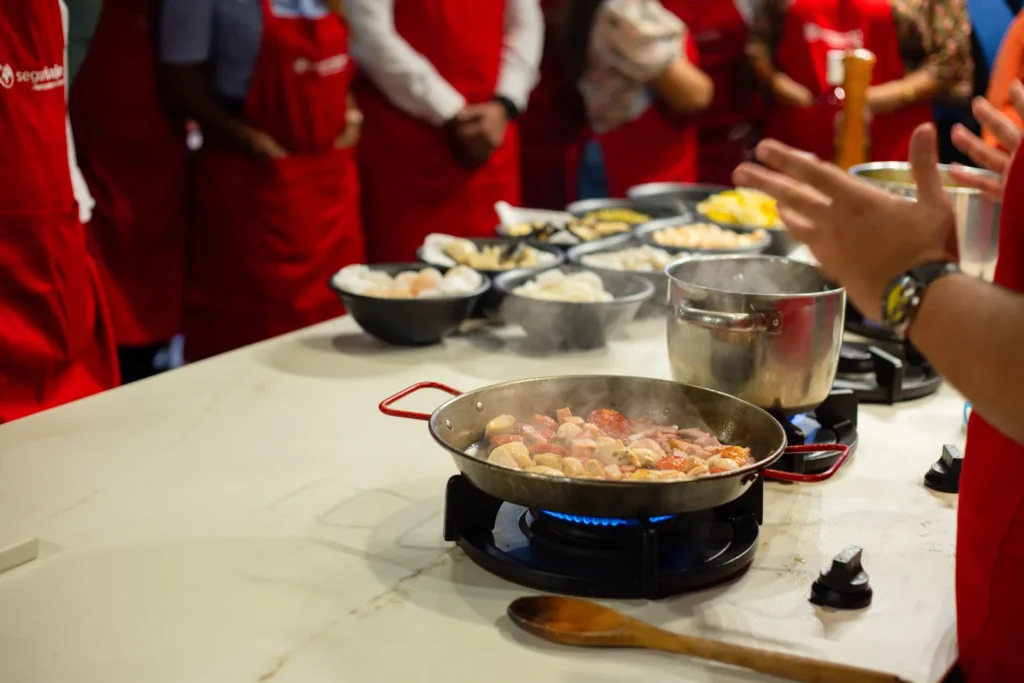
Generic cooking-session photograph outside Saudi Arabia; not Julienne, a Jeddah class, a promised menu or evidence that any dietary requirement can be met. Photo: Nisy Ripoll / Pexels, used under the Pexels licence.