

Seeing Jeddah with kids works best when the day is built around one or two places, each reached by its own booked journey, with child seats added in the search and the ride home already in place before you leave the hotel. The city has a long public waterfront, a walkable historic district and several indoor attractions, so a good family day is less about fitting everything in and more about choosing well and keeping the car journeys simple.
This guide is for parents, grandparents and anyone organising a family day out in Jeddah by private car. It covers which kinds of places suit children, whether to combine the old town and the coast in one outing or split them over two days, how to add child seats and count the party correctly, what the Saudi Ministry of Health advises about heat, and how the booking rules work when small children are part of the plan. It does not recommend particular restaurants or give opening hours, which change and should be checked with each venue.
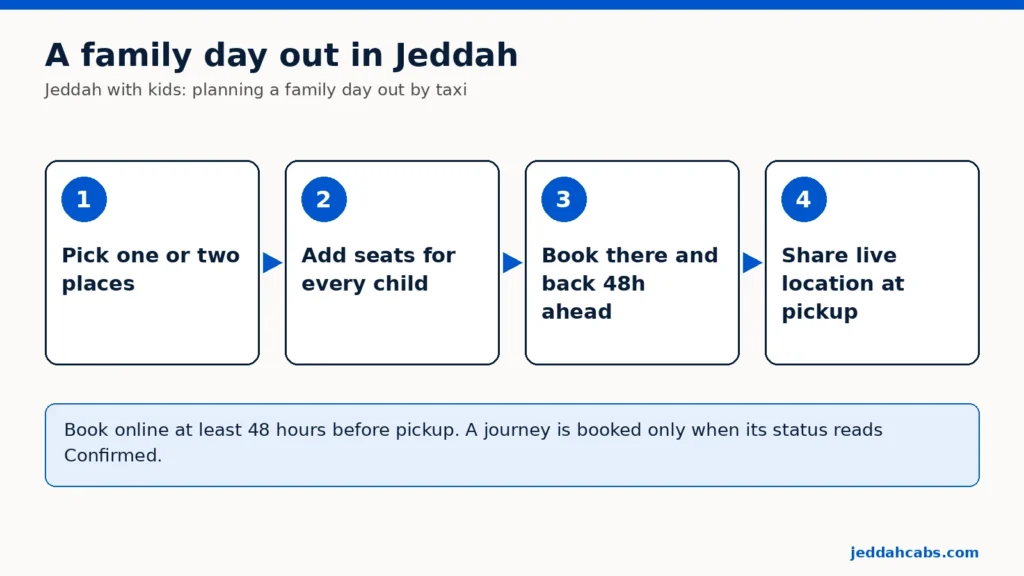
Jeddah with kids: what the day really involves
A family outing is a chain of small decisions: where you start, how long the children will last, where you eat, and how you get back. Adults can stretch a plan when it runs long. Children usually cannot, and a tired four-year-old in the heat changes the day faster than any traffic.
That is why the most reliable approach with Jeddah with kids is to think in journeys rather than in attractions. Each journey has one pickup place, one destination and one time, set in Saudi local time. A there-and-back trip is two journeys, because the pickup and the destination must differ. Once you see the day as two, three or four clear journeys, the rest of the planning becomes much easier.
A private car also gives you things a street taxi may not: the right seat for each child, space for a pushchair, and a driver who knows in advance how many people are coming.
Choosing places for a family day out in Jeddah
Jeddah has more to offer families than a single list can hold, but most visits fall into a few types. Picking one type per outing helps.
The waterfront and the Corniche
Saudipedia’s entry on Jeddah city describes the waterfront as a 4,500 m stretch running from al-Nawras Roundabout in the north to Jabir Bin al-Harith Street, with green areas of more than 275,000 square metres, swimming beaches and a hanging walkway equipped with services for visitors.
For children, open space and a sea view are often the best part of a day. The waterfront is long, though, so “the Corniche” is not a destination on its own. Our guide to which part of the Jeddah Corniche to ask for explains how to choose a named point along it so the driver takes you to the section you actually want.
Historic Jeddah (Al-Balad)
UNESCO lists the old town as Historic Jeddah, the Gate to Makkah, inscribed in 2014. It is a district of coral stone houses, carved wooden window screens, souqs and small squares. Older children who like stories and old buildings often enjoy it. Toddlers in pushchairs may find it harder, because the lanes are narrow and surfaces vary.
A visit to Al Balad is a walk, not a single door. The Jeddah Cabs guide to visiting Al Balad by taxi after check-in or on another day covers drop-off and pickup points at the edge of the district.
Indoor and ticketed attractions
When the day is hot, an indoor visit with a timed ticket can anchor the plan. Museums, galleries and immersive art spaces work well for children who like to look and touch where allowed. Book the ticket first, then build the journeys around its entry time. Our guide to getting to teamLab Borderless and back by taxi shows how that works for one popular venue.
An evening sight
Some families like to finish the day with a view of King Fahd’s Fountain, which Saudipedia describes as sending water up to 312 m into the air. If you want to include it, read the guide to where to see the Jeddah fountain and check the viewing arrangements before you go, rather than assuming the fountain will be running at a given moment.
Heritage and coast: one outing or two?
Many families want to see both the old town and the sea. The question is whether to do them together.
| Question | One combined outing suits you if | Two separate outings suit you if |
|---|---|---|
| Ages of the children | Eight and over, used to long days | Under five, or needing a nap |
| Length of your stay | One free day in Jeddah | Two or more free days |
| Time of year | Cooler months | Hot months, when outdoor time is short |
| What you want | A short look at each place | Time to play, swim or explore properly |
| Grandparents with you | Happy to walk and sit in the car between stops | Need rest at the hotel between outings |
| Budget for journeys | Prefer fewer journeys | Happy to book separate outings |
A combined outing usually means three journeys: hotel to the first place, first place to the second, and the second place back to the hotel. Two separate outings means two journeys each, with a rest at the hotel in between. The second plan has more journeys but far more slack, and slack is what a family day needs.
If you choose the combined version, make every movement visible. A drop-off in Al-Balad and a later pickup from the waterfront do not automatically include the drive between them. Book it as its own journey with its own time.
Child seats for a Jeddah outing: adding them in the search
Child seats for a Jeddah outing are chosen in the transfer finder at the same time as the passengers. The search lets you add an infant seat, a child seat or a booster, and once added they are confirmed for the vehicle as part of the booking. Add them at the search stage, not later in a note, because the vehicle is matched to what the booking says.
Saudipedia’s summary of the traffic law in Saudi Arabia states that drivers and passengers must wear seat belts and that child seats must be used. Whatever your habits at home, plan for every child to travel in a suitable seat.
Which seat for which child
Choose by your child’s size and your own judgement as a parent, using the manufacturer’s guidance you already know from home:
- Infant seat for babies.
- Child seat for toddlers and young children.
- Booster for older children who have outgrown a child seat but are still small for an adult belt.
If you are not sure which fits, describe the child’s age and approximate height in the booking notes and ask the booking team.
Counting children and infants
The search asks for adults, children and infants separately. Enter every person, including babies who will sit in an infant seat. Seats in a car are physical seats, and each child seat takes one. A family of two adults and three young children in seats will usually need more than a standard four-seat car.
Pushchairs, scooters and day bags
The search also asks for large bags and cabin bags. On a day out, a folded pushchair counts as a large bag. A small scooter, a cool bag and a beach bag are usually cabin bags, though a bulky beach kit can be a large bag. Our guide to reading the three capacity labels in results explains how the numbers work.
Which vehicle suits your family
When you plan Jeddah with kids, the vehicle matters as much as the places. Results show only vehicle classes that pass the capacity check for your party and bags. Each class is shown with an example model “or similar”.
| Class (example model, or similar) | Seats | Large bags | Typical family day out |
|---|---|---|---|
| Economy (Toyota Camry class) | 4 | 2 | Two adults and two older children with day bags |
| Business and Executive | 4 | 3 | Same party with a pushchair and a beach bag |
| Hyundai Staria (VIP van) | 6 | 2 | Two adults, grandparent and three children, light bags |
| Premium SUV (Chevrolet Tahoe) | 6 | 4 | Six people with a pushchair and beach kit |
| Hyundai H1 (family van) | 7 | 6 | Larger family with pushchairs and bags |
| GMC Yukon XL | 7 | 6 | Same, as an alternative seven-seat class |
| Toyota Hiace | 11 | 10 | Two families sharing one vehicle |
In the live capacity checks, four adults with four large cases saw only Premium SUV and larger; five with five saw only seven-seat vehicles and larger. On a day out you carry less than on an airport run, but child seats and a pushchair take space quickly, so count honestly.
Heat, water and timing for children
The Saudi Ministry of Health’s summer heat advice lists infants and children among the groups most at risk, alongside older adults and pregnant women. It advises drinking plenty of fluids without waiting until you feel thirsty, wearing lightweight clothing, using sunscreen, a wide-brimmed hat and sunglasses, scheduling outdoor activities carefully and resting in shaded areas. It also says plainly not to leave children in cars, which can reach dangerously high temperatures.
For a family day out in Jeddah, that advice turns into a few planning habits:
- Put outdoor time where it is cooler. Check the forecast for your date and plan beach or waterfront time away from the hottest part of the day.
- Use indoor places as the midday anchor. A museum or an immersive attraction can fill the middle of the day.
- Carry water for everyone. Pack more than you think you need.
- Keep the walk from the car short. Choose drop-off points close to where you want to be.
- Build in rest. Two short outings with a rest at the hotel often beat one long one.
Prayer times and opening hours
Ask each venue about its opening hours on your date, including whether anything pauses around prayer times, and check prayer times for the day from a reliable local source. Leave space in the plan rather than timing every stop to the minute.
How the journeys fit together
A family day out usually takes one of three shapes.
Shape one: out and back
Hotel to one place, and back to the hotel later. Two journeys, each booked with its own time. This is the simplest shape and suits young children best.
Shape two: a chain of places
Hotel to place A, place A to place B, place B back to the hotel. Three journeys. Set each pickup time with a margin, because you cannot rebook a car at short notice once you are out.
Shape three: a journey with stops
A single journey can include up to eight stops in journey order. That can suit a short pause, such as collecting a grandparent from another hotel on the way. It is not a way to keep a car waiting while you spend two hours at a beach. Waiting time is not something the search shows, so if you need the driver to wait at a stop, ask the booking team to confirm it in writing before you pay.
For anything longer than a brief pause, book separate journeys. The car sets you down, the journey ends, and a different journey collects you later.
A worked example: the Rahmans’ day by the sea and in the old town
Farah and Adil Rahman are visiting Jeddah from Leicester with their children, Zara, who is eight, and Sami, who is three. Adil’s mother, Nasreen, is travelling with them. They have three full days in the city.
Their first idea is one long day: Al-Balad in the morning, the waterfront in the afternoon and the fountain in the evening, all from one car. When they write it out, the problems are clear. Sami still naps after lunch, Nasreen prefers to rest in the afternoon, and the forecast is warm.
They split it:
- Day two, morning: hotel to a named point at the edge of Historic Jeddah, and a return from a second named point near a café where they expect to finish. Zara loves the old houses. Sami rides in the pushchair.
- Day three, late afternoon: hotel to a named section of the waterfront with play space, and a return after dark from the same point.
In the search, they enter three adults and two children, add a child seat for Sami and a booster for Zara, and count the folded pushchair as a large bag. The results show a Hyundai Staria, a Premium SUV and larger classes. They choose the Premium SUV for its luggage space.
All four journeys are booked more than 48 hours ahead, on the same evening. Each short city journey is checked against the minimum booking value, and Farah notes the cash balance due to each driver shown at checkout. They wait until all four read Confirmed.
On the waterfront day, Adil sends the driver a live location from the agreed point ten minutes before pickup. The children are tired, fed and ready for the hotel.
When plans change with children
Children get ill, sleep late or melt down, and plans change. It helps to know what can be changed and how.
Changing the pickup time
If the time needs to move, you can request a new pickup time from your account before the original pickup time. The request stays pending until the booking team approves it. An approved new time carries a £5 rescheduling fee, converted into your booking currency and added to the cash paid to the driver at pickup. A rejected request costs nothing. Only one open time request is allowed per booking.
Changing anything else
The pickup place, destination, number of passengers and vehicle cannot be changed online. If a grandparent decides not to come, or you need a bigger car because a cousin joins, contact the booking team. Otherwise it means a new booking plus a cancellation request for the old one.
Cancelling
Bookings are subject to our cancellation terms (free cancellation with a full refund up to 48 hours before pickup; inside 48 hours the deposit element of the price is kept) if you cancel. If we or the transport partner cancel, or cannot supply the journey and you do not accept a suitable alternative, you receive a full refund for the affected journey. The full terms are in the network cancellation and refund policy. Because of this, set your plan realistically from the start. A shorter day that you actually do is better than an ambitious one you cancel.
Booking rules in brief
- Notice. Online bookings need at least 48 hours’ notice before each pickup.
- Status. Payment secures a provisional request. The booking team updates the status within 1 to 12 hours, and each journey is booked only when it reads Confirmed.
- Minimum value. Each journey has a minimum booking value equivalent to £40, which matters more on short city journeys. If a fare would be lower, the checkout shows a “Minimum booking amount” line.
- Payment. Jeddah Cabs may take only a deposit online, with the balance paid in cash directly to the driver. The checkout shows both amounts, and your account shows the cash due to each driver. That cash amount is a separate payment and is not covered by any refund from us.
- Currency. You can view prices in one of several display currencies, including riyals and pounds.
- Contact. Checkout asks for a mobile number. Give one that will be answered on the day.
For an overview of each step, see how Jeddah Cabs works.
What to pack for the car
Days out in Jeddah with kids go more smoothly with a short list:
- water for everyone, and a snack for each child;
- sun hats, sunscreen and a light layer for air-conditioned indoor spaces;
- wipes, a change of clothes for small children and a bag for rubbish;
- a charged phone with the pickup points saved and a small power bank;
- the booking references for every journey, each showing Confirmed.
Keep valuables and documents with an adult rather than in a beach bag that goes on the sand.
Checklist before you book a family day out
- Choose one main place per outing, or two at most, based on the children’s ages.
- Decide between one combined outing and two separate ones using the table above.
- Write the day as journeys, each with a pickup place, destination and time.
- Enter every adult, child and infant, and add an infant seat, child seat or booster for each child who needs one.
- Count a pushchair as a large bag and bulky beach kit honestly.
- Check the forecast, and put outdoor time away from the hottest hours.
- Check tickets and opening hours with each venue directly.
- Book every journey at least 48 hours ahead, including the return.
- Wait until each journey reads Confirmed, and note the cash due to each driver.
- On the day, send a live location from the pickup point a few minutes before the time.
When you know where the family is going and who is coming, open the Jeddah Cabs transfer finder, enter each journey with the right seats for the children, and book your family day out in Jeddah with the ride home already arranged.