
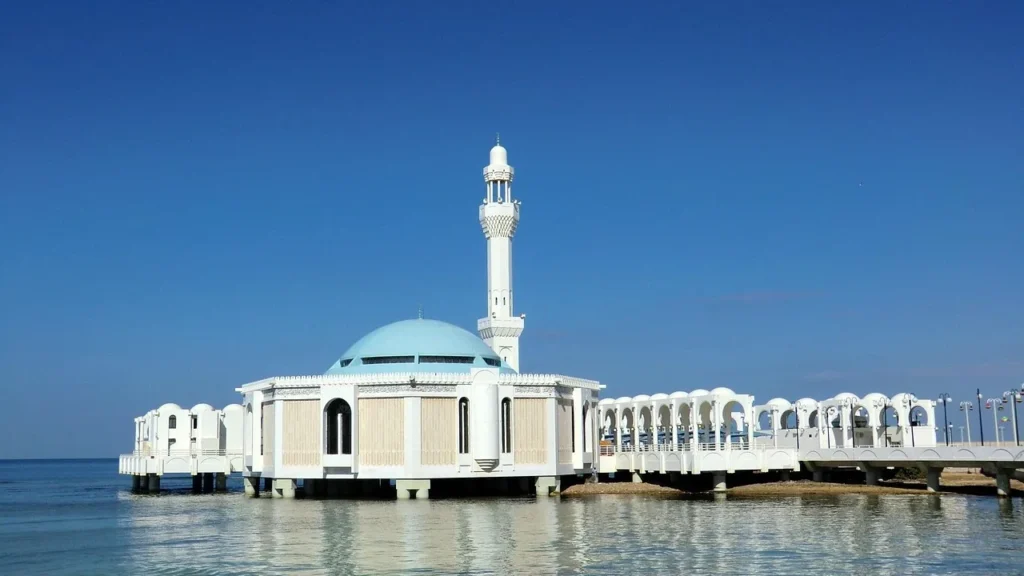
The floating mosque Jeddah is known for is Al-Rahmah Mosque (often written Al Rahma), a white mosque built out over the Red Sea in the Al-Shati district and joined to the shore by a walkway. It is a working place of worship and a well-loved sight, so the best visit is planned around the prayer times, the light you want and the way home. Book a car to the mosque by its name, check the drop-off in the route summary, and book the pickup as a separate journey for when you expect to be ready.
This guide is for visitors staying in Jeddah, or passing through on the way to or from the airport, who want to see the mosque, pray there, or photograph it at sunset. It covers what the official sources say about the building, its several names, how to fit a visit around prayer times, what dress and conduct rules apply in public places, how to combine the mosque with the seafront or a meal, and how the Jeddah Cabs booking rules shape a short outing like this.
What is the floating mosque in Jeddah?
Saudipedia’s entry on Al-Rahma Mosque places it on the Red Sea coast in the al-Shate’ neighbourhood of Jeddah and records that it was built in 1985. It describes the building as the first mosque in the world to be built on the sea’s surface, which is where the “floating” name comes from.
Saudipedia also notes:
- a pathway with low walls connects the mosque to the mainland;
- the main dome rests on eight supporting columns and has a detailed chandelier;
- the building has fifty-two surrounding domes and twenty-three external canopies;
- a white minaret is topped with a turquoise dome, and fifty-six stained-glass windows are set around the main dome;
- Quranic verses run through the interior in Ruq’ah, Naskh and Diwani calligraphy;
- there is a men’s section and a suspended wooden prayer area for women.
A Saudi Press Agency feature on the mosque, published in March 2025, gives the site as 2,400 square metres and says the mosque accommodates 2,300 worshippers, including 500 women in the suspended wooden prayer area. Saudipedia gives the same figure of about five hundred for the women’s area, so treat the totals as approximate. Either way, it is a neighbourhood-sized mosque, not a vast complex, and that affects how busy it feels at prayer times.
Al Rahmah Mosque Jeddah, Fatima Al Zahra Mosque or the floating mosque: one building
People search for this place under several names, and it helps to know they are the same building before you type one into a booking form.
| Name you may see | Where it comes from |
|---|---|
| Al-Rahma Mosque / Al Rahmah Mosque Jeddah | The current name used by Saudipedia and the Saudi Press Agency |
| Floating Mosque | The popular name, from its position over the sea |
| Fatima Al Zahra Mosque | An alternative name given by the Saudi Press Agency |
| Masjid al-Sayyidah Fatimah | The original name, according to Saudipedia, before it was renamed |
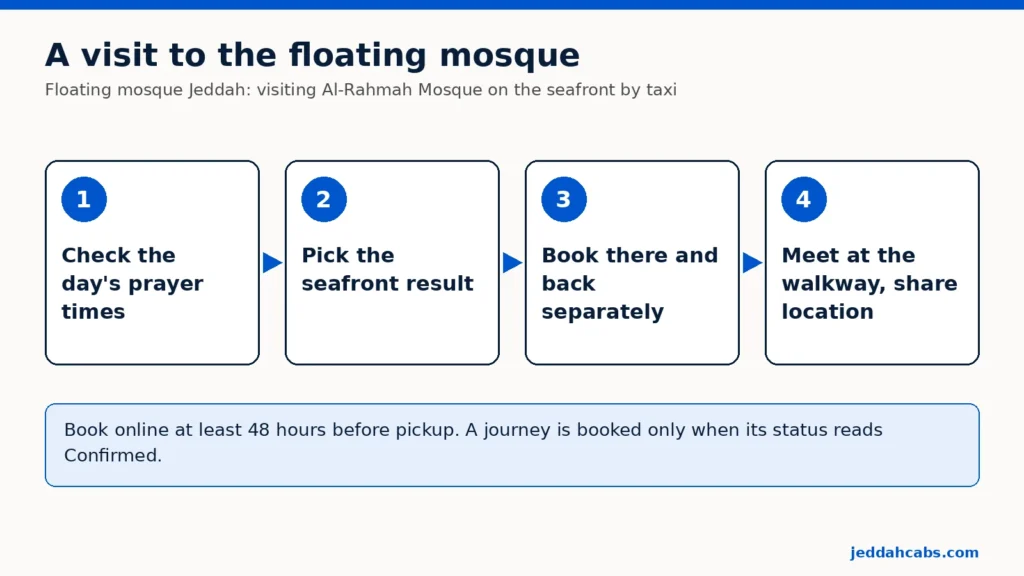
The practical point is this: a map search may list more than one of these names, and a different mosque elsewhere in the city may share part of a name. When you enter the destination, choose the result on the seafront in Al-Shati and read the destination line in the route summary. If it shows an inland street or a different district, you have picked the wrong result.
Many visitors ask for the Fatima Al Zahra Mosque because that is the name a relative remembers from an earlier trip. The driver will understand you, but the booking should still point at the right place.
Getting there: booking the drop-off
A booked journey has one pickup, one destination, a date and a time. For a mosque visit that usually means:
- Outward journey: from your hotel, home or the airport to Al-Rahmah Mosque.
- Return journey: from the mosque, or from wherever you walk to afterwards, back to your hotel or on to a restaurant.
The pickup and destination must differ, so going there and back is always two journeys, each with its own time. Every journey has a minimum booking value equivalent to £40, which makes a single long outing better value than several short hops.
We do not quote a distance for this trip, since it depends on where you start. Check the distance shown in the route summary.
Where the car stops
We cannot promise exactly where a car may stop outside the mosque. Kerbside rules and traffic on the seafront are managed on the day. Agree a meeting point in the booking notes, such as “at the start of the walkway” or “outside the car park entrance”, and share your live location with the driver when you are ready to be collected.
From the airport
If you land at King Abdulaziz International Airport and want to see the mosque before checking in, you can add it as a stop on your airport journey. Up to eight stops can be added in journey order, but a stop is a short pause, not a sightseeing session with the car waiting. For a visit longer than a look from the walkway, it is better to check in first and come back. The guide to adding a short sightseeing stop to an airport journey looks at when this works.
Timing your visit around prayers and light
Prayer times
The five daily prayers set the rhythm of any mosque. At and just before prayer times, the mosque fills with worshippers, and a visitor who has come mainly to look around or take photographs will be in the way. At other times it is quieter.
Prayer times change through the year with the sun. Check the day’s times for Jeddah in a local prayer-time app or on the notice at the mosque, and plan around them:
- To pray there, arrive early enough to make ablutions and find a place before the call.
- To see the building and take photographs, go between prayers and leave well before the next one.
Sunrise and sunset
The Saudi Press Agency feature calls the mosque “a photographer’s dream, especially at sunrise or sunset”. Sunset is the popular choice for visitors staying in the city, because the light falls across the sea behind the building. Maghrib prayer comes at sunset, so a sunset visit is also a busy one. If you want both the view and a calm walk, arrive in the late afternoon, see the building first, and step back to the shore as the call for prayer begins.
If photographs are the main purpose, the guide to planning a photo outing in Jeddah with booked transfers shows how to link several viewpoints without open-ended driving. A sunrise visit is quieter but needs an early pickup. Remember that free waiting counts from the booked pickup time, so if the family is slow to leave a hotel in the dark, book the time you will really be at the door.
How long to allow for a floating mosque Jeddah visit
How long you need depends on what you came for, and it is worth deciding before you set the return time.
- A look and a photograph from the walkway: a short visit, though families with small children or older relatives walk more slowly than they expect.
- Prayer at the mosque: allow time for ablutions before the prayer, the prayer itself, and the slow exit when a congregation leaves together.
- A sunset visit: allow for arriving before the light changes and for the busy period around Maghrib.
- Friday: the midday congregational prayer on Friday draws larger numbers at most mosques, so expect more people and more traffic nearby.
A floating mosque Jeddah visit rarely needs to be long, but it should not be rushed. Setting the return pickup a little later than you think you need costs nothing, while a car that arrives while half the family is still inside puts everyone under pressure and may run into paid waiting.
With children or older relatives
The walkway from the shore is on foot, and the car cannot follow you along it. If someone in the party uses a wheelchair, add the wheelchair requirement in the search so it is confirmed for the vehicle, and ask the mosque staff on arrival about access inside. For small children, add the right child seats in the search: infant seat, child seat or booster. Agree one meeting place for everyone before you separate into the men’s and women’s areas, because phones are often switched off or silenced during prayer.
Dress and conduct at the mosque
Saudi Arabia’s public decorum rules, published on the official Visit Saudi eVisa portal, say that all visitors to public places shall dress modestly and must not wear clothing with images or phrases that violate public decency. At a mosque, visitors usually go further than the minimum: long sleeves and long trousers or skirts, and a headscarf for women.
A few practical points follow from the building itself:
- the mosque has separate areas for men and women, so a family may be apart inside and should agree where to meet afterwards;
- shoes come off before the prayer area, so wear something easy to remove;
- keep voices low, and do not photograph people at prayer;
- the walkway is outdoors, so bring water and something for the sun.
We could not find an official visitor policy for Al-Rahmah Mosque, for example on tours, photography inside, or entry for people who are not Muslim. If anyone in your party is not Muslim, or if you want to photograph the interior, ask the mosque staff on arrival and be content to enjoy the building from the walkway if the answer is no. Questions of prayer or worship are for a qualified scholar, not a transport company.
Pairing the mosque with the seafront or a meal
The mosque is one of many things along Jeddah’s coast, and it works well as part of a longer evening. The waterfront is long and divided into separately developed stretches; Saudipedia’s page on Saudi waterfronts describes the ROSHN Waterfront (formerly the Jeddah Waterfront), the Northern Corniche and the Central Corniche, with the Central Corniche alone stretching 3.6 km. That is too far to walk between casually, so each additional place usually means another booked journey.
| Plan | Journeys to book | Best for |
|---|---|---|
| Mosque only | Hotel to mosque; mosque to hotel | Prayer, a short visit, a quick photograph |
| Mosque, then dinner | Hotel to mosque; mosque to restaurant; restaurant to hotel | A relaxed evening with one fixed meal |
| Mosque as a stop on a longer journey | Hotel to restaurant or seafront, with the mosque as a stop | A brief look from outside on the way elsewhere |
| Mosque and a walk on a named seafront stretch | Hotel to mosque; named seafront place to hotel | Visitors happy to walk or take a separate short journey between the two |
For the seafront part, name one exact place rather than “the Corniche”. The guide on which part of the Jeddah Corniche to ask for explains the sections, and the guide to building a Jeddah evening around one area helps you keep the plan compact. If the fountain is on your list, read about where to see the Jeddah fountain, since it is viewed from particular places on the shore.
If a meal is the second half of the evening, make the restaurant a named destination, as the guide on making the restaurant a real final stop suggests.
Can the driver wait while we visit?
For a short look, the free waiting that comes with every booking may be enough, but it counts from the booked pickup time, so it is a buffer for a slow start, not time at the mosque. The free allowance depends on the class:
| Vehicle class | Free waiting | Rate after that |
|---|---|---|
| Economy | 15 minutes | SAR 1.50 per minute |
| Business & Executive, VIP van (Staria), MPV/family van (H1) | 30 minutes | SAR 2.00 per minute |
| Premium SUV (Tahoe or Yukon) | 45 minutes | SAR 2.50 per minute |
| Luxury (S-Class) | 60 minutes | SAR 4.00 per minute |
Extra waiting can be added at checkout in 15-minute steps up to two hours, charged at the class’s per-minute rate. For a floating mosque Jeddah trip with prayer included, most families find it simpler to book the return as a separate journey at a set time than to keep a car waiting. The driver will not wait beyond what was booked.
Worked example: a sunset floating mosque Jeddah visit with a grandmother
Bilal and Sana Qureshi are staying in a Jeddah hotel with their two children and Sana’s mother, Nasreen, who walks slowly. They want Nasreen to pray Maghrib at the floating mosque and the children to see it at sunset, then have dinner by the sea.
They check the prayer times for their date and see that Maghrib falls a little after 6 p.m. They book three journeys in a Hyundai H1:
- hotel to Al-Rahmah Mosque, pickup at 4:45 p.m., with a note: “Elderly passenger, please drop as close to the walkway as safely possible”;
- Al-Rahmah Mosque to a named seafood restaurant, pickup at 7:00 p.m., with a note to meet at the start of the walkway;
- restaurant to hotel, pickup at 9:00 p.m.
In the destination search, one result for “Fatima Al Zahra Mosque” is inland, so they choose the seafront result in Al-Shati instead and confirm it in the route summary. They book five days ahead, pay the deposit on each journey and wait for all three to read Confirmed. On the evening, they see the building in the late-afternoon light, Nasreen and Bilal go in for prayer while Sana and the children wait on the shore, and they meet at the walkway as agreed. Bilal shares his live location with the driver at 6:55 p.m.
Booking rules for a short Jeddah outing
Notice and confirmation
Because the planner will not accept a pickup less than 48 hours away, a sunset visit needs deciding at least two days in advance. Once you pay, you hold a provisional request; the booking team usually settles it within 1 to 12 hours, and you can count on the car when the status says Confirmed.
Deposit and cash
With Jeddah Cabs, checkout can take a deposit and leave the rest for the driver in cash. You see both sums before paying, and each journey in your account lists what the driver should receive.
Changes and cancellations
If prayer times or the weather make you want a different hour, request a new pickup time in your account before the booked one. A change that is approved adds £5, in your booking currency, to the driver’s cash; a declined one is free. The mosque, the restaurant, the number of people and the car cannot be swapped online.
Cancelling yourself is free, with a full refund, up to 48 hours before pickup; inside 48 hours the deposit is kept. Should we or the transport partner cancel, or be unable to run the journey with no alternative you accept, you get all your money back. Details are in the network cancellation and refund policy.
Checklist before you book
- Decide why you are going: to pray, to see the building, to photograph it, or all three.
- Check the prayer times for your date and choose an arrival time that fits your purpose.
- Search the destination by name and confirm the seafront result in Al-Shati in the route summary.
- Book the outward journey and a separate return, or a follow-on journey to a named restaurant or seafront place.
- Add a meeting point to the booking notes, and plan to share your live location at pickup.
- Choose a vehicle that fits everyone, adding child seats or a wheelchair requirement if needed.
- Pack modest clothing, a headscarf for women, easy shoes, water and a light layer.
- Book at least 48 hours ahead and wait for each journey to read Confirmed.
When you know the evening you want by the sea, enter each leg in the Jeddah Cabs transfer finder. A deposit online secures the booking, and you pay the balance in cash to your driver on the day.