
If Wadi Al Disah is the reason you want to travel north from Jeddah, book around the canyon outing rather than treating it as a roadside stop. Reaching Tabuk and visiting the valley are separate decisions. Your gateway journey gets you to a base; a suitable local plan determines what you can actually do in the landscape.
This distinction matters when you are comparing a domestic flight with a long regional road approach. It also matters when a photograph makes the valley look like somewhere you can simply drive into and explore. Start by defining the outing you want, confirming the current access and operator arrangements, and choosing a base that supports it. Then settle the journey from Jeddah.
Turn “see the canyon” into a specific outing
People can mean quite different things by a Wadi Al Disah visit: seeing the scenery from an agreed arrival point, spending time walking, joining a guided landscape excursion, or taking photographs as part of a longer regional trip. These plans do not require identical transport or preparation. Explain your intended activity before asking a provider to quote.
Our useful starting question is: what do you want to be able to do after stepping out of the vehicle? If the answer is a gentle scenic visit, say that. If it is an extended walk, ask about the actual route, terrain, support and suitability. A transport reservation alone should not be read as confirmation of a guided walk or an outdoor activity.
A photography plan needs similar care. Tell the operator whether you want ordinary visitor photographs or are planning equipment, commercial work or a particular activity. Check any permissions directly with the relevant authority. Do not infer that public visitation allows every kind of filming, equipment use or access beyond designated areas.
What the official sources establish
Visit Saudi’s Tabuk day-trip information identifies Wadi Al Disah as a valley in the Prince Mohammed bin Salman reserve, with mountain scenery, palms and historical remains. That establishes its regional and landscape context. It does not confirm the suitability or availability of a particular excursion on your dates.
The reserve’s own visitor questions and contact information explain that day visitors are welcome, with no-entry areas and activity-specific requirements. Visitors are asked to follow designated roads and paths and the relevant instructions. Check the current position for your planned activity rather than applying the general welcome to every track, campsite or location.
Use those sources to form questions for the operator: where does the visit begin, which areas are included, what activity is actually offered, and which restrictions affect it? An attractive tourism description is a starting point for planning. It is not an itinerary confirmation, a weather assessment or permission to improvise off-road driving.
Make the local operator’s proposal the anchor
Ask for a description of the outing before buying the approach from Jeddah. The proposal should identify the meeting place, included transport, activity scope, expected physical demands and what happens if conditions change. If the operator offers pickup from accommodation, confirm the actual address and whether that collection is part of the price.
Check what the word “tour” means in that proposal. Does it include guiding, or only a vehicle? Are food, water or any equipment included? Is there a defined walk or simply time at a scenic place? These are reasonable questions, not requests for an embellished itinerary. The answers help you choose the right experience and avoid paying for assumptions.
Describe the party’s needs honestly
Tell the operator about the passengers’ walking preferences and any practical access needs. You do not need to share unnecessary personal information; describe what the outing must accommodate. For example, say that one traveller needs a short walking option or assistance getting into a vehicle. Ask whether the proposed activity can meet that requirement before booking.
If part of the group wants a more demanding outing, ask whether there is a supported alternative for the others and how the group reunites. Do not assume anyone can wait comfortably at an unspecified roadside point. A split group creates additional meeting and transport needs that should be settled in the proposal, not discovered after arrival.
Establish who changes the plan
Ask who decides whether the activity proceeds when weather, access or local instructions change, and how you will be notified. Find out what alternative, rescheduling or cancellation conditions apply. Those conditions may differ from your hotel and flight arrangements. Read them as separate commitments rather than assuming that one changed outing automatically changes the whole holiday.
Keep the provider’s current contact channel with the reservation. If you are leaving Jeddah before the final activity update, agree when the operator will confirm it. Avoid interpreting the absence of a message as proof that everything remains unchanged. A clear check-in point is more useful than repeatedly refreshing an old advertisement.
Choose a base for the confirmed plan
Tabuk can serve as a gateway and accommodation base, but the city and the valley are not the same destination. Ask the operator how the proposed excursion works from your chosen accommodation. You may also be considering a closer stay as part of a wider road trip. Compare those actual arrangements instead of assuming all “Tabuk region” hotels are equally convenient.
For a city base, consider the ordinary parts of the stay as well as the excursion: check-in, meals, bag storage, the meeting point and the journey to your next departure. For a different base, ask what services and collection arrangements are available there. A scenic accommodation photograph does not answer the practical questions that determine whether the stay fits.
A return to the same room can simplify the outing
If you return to the same accommodation, you may be able to travel with only the items needed for the excursion, subject to the hotel’s confirmed storage arrangements. That is different from checking out and carrying all your international luggage through a local activity. Tell the operator which design you want so the vehicle and schedule can be assessed accurately.
If the outing ends at a different base, obtain a proposal for that complete sequence. A round-trip excursion may not be interchangeable with a hotel move. Ask where your cases remain, who is responsible for them and how the final drop-off is handled. Combining the two jobs may be possible, but it needs explicit agreement.
Now choose the approach from Jeddah
Saudipedia identifies Tabuk’s airport as Prince Sultan Bin Abdulaziz International Airport, with the code TUU. Compare current airline results for your dates with a regional road itinerary that a provider has assessed. Use the exact airport and accommodation names in any request; a regional destination label is not a precise arrival point.
A flight approach can leave more of the holiday available for the local stay, but you must check the actual schedule, baggage terms and accommodation arrival. A road approach may fit when the journey north is a deliberate part of a broader trip. It needs its own realistic pacing and confirmed overnight stages where appropriate, rather than being squeezed around a canyon booking.
This guide does not publish a fixed Jeddah–Tabuk duration or confirm a long-distance vehicle on demand. Ask for the available proposal for your actual starting point, destination and date. If the road journey would leave the group tired before the excursion, moving the activity to another day may be more useful than choosing a larger car.
Separate the regional car from the canyon vehicle
A vehicle suitable for the Jeddah approach does not automatically establish suitability for every part of a local outdoor visit. Ask the excursion operator what transport its route requires and what it supplies. An SUV label in a transfer search is not evidence of authorisation, off-road capability for a specific route, or inclusion of a canyon excursion.
Our vehicle class guide explains the descriptions used for ordinary transfers. Use it for the ground journey it actually describes. For the outdoor activity, use the operator’s current proposal. Keeping those responsibilities separate avoids asking a regional transfer driver to improvise an excursion that was never agreed.
Where the two vehicles meet, identify the handover point. Ask whether the first driver finishes there or whether a separately agreed return is involved. Share the arrival details with the excursion provider only as needed for the meeting. A clear handover makes it possible to understand where one service ends and another begins.
Prepare for the activity described, not an online image
Request the operator’s packing and clothing guidance for the particular outing. Ask about footwear, sun exposure, drinking water and what you should carry yourself. Follow current local weather and authority instructions. Do not assume the scenery in a photograph represents the conditions you will encounter or the route you will take.
Keep the activity bag distinct from your larger luggage. Put the items needed during the outing within reach and establish where everything else stays. If you carry a tripod, bulky camera case or other equipment, describe it in advance. Our equipment transport advice can help with the ordinary car stage, while the operator must assess the activity stage.
Plan communication before leaving your base
Save the meeting instructions, contacts and accommodation address in a form that does not depend on opening a long email chain. Agree who in the party holds the full reservation record. Do not presume mobile reception, a particular app or a convenient charging point at every part of an outdoor journey; ask the operator about the communication arrangement it uses.
Tell anyone expecting you later which confirmed stage you are on, rather than sharing a speculative arrival time from a map. If the operator changes the return arrangement, update the person arranging the next vehicle. This is a practical communication plan, not a promise of constant connectivity or an alternative to following the operator’s instructions.
Respect the reserve as a managed landscape
Follow signs, designated routes and the instructions of the responsible personnel. Take your litter away and avoid disturbing wildlife or removing natural material. The reserve’s official guidance is relevant throughout the outing, including when a guide or driver is present. Booking a paid visit does not exempt you from the site’s requirements.
Do not ask a driver to find an unapproved shortcut to a viewpoint or a quieter route through a restricted area. If a requested location is unavailable, choose an alternative the operator can legitimately provide or revise the outing. A photograph from another visitor does not prove that the same access remains allowed.
Historical remains should also be approached respectfully. Ask your guide to explain the context and the appropriate viewing arrangements. Avoid touching, marking or climbing material for a picture. A satisfying landscape visit can include learning why the place is managed, rather than treating it only as a backdrop.
A fictional choice: one canyon day or a northern circuit?
Imagine a fictional couple already spending time in Jeddah. They want Wadi Al Disah and initially request a car “to Tabuk and the canyon.” Their first question mixes a long approach, accommodation and an outdoor excursion. When they seek a local proposal, they discover that the excursion has a defined meeting arrangement that must be considered separately.
They compare a focused Tabuk stay with a longer northern road circuit. The focused stay gives the canyon outing its own date and room to move it within the visit. The circuit adds accommodation changes and more travel, so they would need to confirm each transition and decide what happens if the outdoor activity changes.
They choose the focused stay because the valley is their main interest. The decision is not a claim that flying always wins, or that every visitor needs the same number of nights. It shows how a clear activity priority can simplify the gateway choice. Another party whose main interest is the road journey might reasonably choose a different design.
Compare proposals by what they actually cover
List the approach to Tabuk, accommodation, local excursion and departure separately. For each proposal, note the pickup and endpoint, included services, requested equipment and change conditions. This prevents an attractive headline price from hiding a missing airport journey or an assumption that guiding is included.
If one option includes a local vehicle and another expects you to meet at the activity point, add the required meeting journey to the comparison. If one includes meals or equipment, note those too. Compare like-for-like scopes before choosing. You do not need an invented “average tour price” to make a sensible decision using real offers.
Consider how the design affects your last night as well. If you return to Jeddah before an international flight, that final journey needs its own assessment. The last-night Jeddah guide helps with the accommodation choice, while the airline or provider confirms the regional leg. Do not assume the canyon outing can double as your airport departure stage.
Decide what remains worthwhile if the outing changes
Before paying for the approach, imagine the canyon excursion moving to another date or becoming unavailable. Would you still want the Tabuk stay? If you have other confirmed reasons to visit, you may keep the accommodation and change one activity. If the valley is your only purpose, a more flexible reservation design may matter more than a small saving on the journey.
Write down an acceptable alternative in terms of experience, not simply another landmark name. You might want a guided heritage activity, a restful day at the base or to leave the region earlier. Check any replacement’s current availability independently. A tourism list does not prove that the substitute fits the same date, transport or passenger needs.
Discuss this possibility with the other travellers before departure. A party can disagree about whether a revised outdoor visit still meets the purpose of the trip. Settling that preference early helps you interpret an operator’s update calmly, without feeling obliged to accept an unsuitable replacement simply because the approach has already been purchased.
Keep one person responsible for the reservation changes, but ensure everyone knows the revised meeting details. Updating the local activity without updating accommodation collection or the next departure leaves the plan inconsistent. Recheck those dependent stages together whenever the canyon date changes.
Questions before a Wadi Al Disah booking
Can I add the valley as a stop on a Jeddah transfer?
Ask for the entire proposed itinerary to be assessed. An outdoor visit may require different transport, access arrangements and activity support from an ordinary road journey. Do not rely on a short-stop assumption when the actual purpose is walking, guiding or a substantial landscape excursion.
Does a transfer SUV include the excursion?
No such inclusion should be assumed. Rely on the explicit confirmation. Vehicle class, a road transfer, a guided activity and reserve requirements are separate matters. Obtain the excursion operator’s proposal for the route and activity you want.
Can I leave the timing until I reach Tabuk?
You can leave optional choices open, but establish the essential meeting and availability arrangements before committing travel around the activity. If the outing is the main reason for going, uncertainty about it could change the value of the entire trip. Ask what can be confirmed and what remains subject to conditions.
Arrange the Jeddah ground stage with clear limits
Use the Jeddah Cabs route planner for the actual ground journey you are considering, then seek confirmation for any regional itinerary or special request. Provide the starting address, destination, date, passengers and bags. Keep the local excursion as a separately identified arrangement unless the proposal explicitly combines the services.
The result should be a plan in which the Jeddah approach supports the canyon visit rather than consuming it. Knowing what you want to do, who provides it and where each stage ends makes the gateway decision clearer. It also protects you from mistaking an attractive landscape image for a complete travel arrangement.
Official source information checked 27 September 2026. Flights, reserve access, local instructions and activity arrangements can change. Confirm the proposed outing with the responsible operator and authority before relying on it.
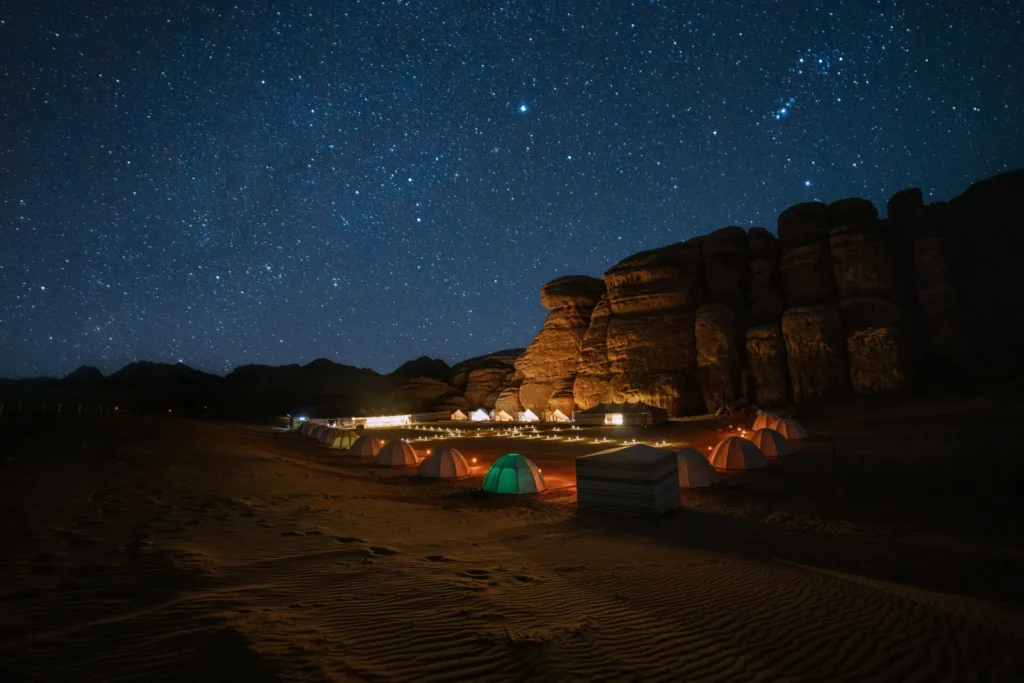
Tabuk desert context photograph, not Wadi Al Disah or evidence of permitted camping or a supplied excursion. Photo: SALEH . / Pexels, used under the Pexels licence.