

A pre-booked taxi to a hospital in Jeddah works best for a planned appointment, booked at least 48 hours ahead as two separate journeys: one to the hospital at a fixed time, and one back with a pickup time you choose and, if the finish is uncertain, extra waiting added at checkout. It is not a service for emergencies. If someone is seriously unwell or injured, call the ambulance number, 997, or the unified emergency number, 911, rather than booking a car.
This guide is for patients, the relatives who go with them and people visiting someone in hospital, including families who have come to Jeddah from abroad for treatment or to support a relative. It explains how to set up the journey there and the journey back when you do not know exactly when the appointment will end, how the wheelchair option and waiting time work, what to write in the booking notes so the driver finds the right building, and how to book on behalf of a parent. It does not give medical advice. For anything about your health or treatment, speak to the hospital or your doctor.
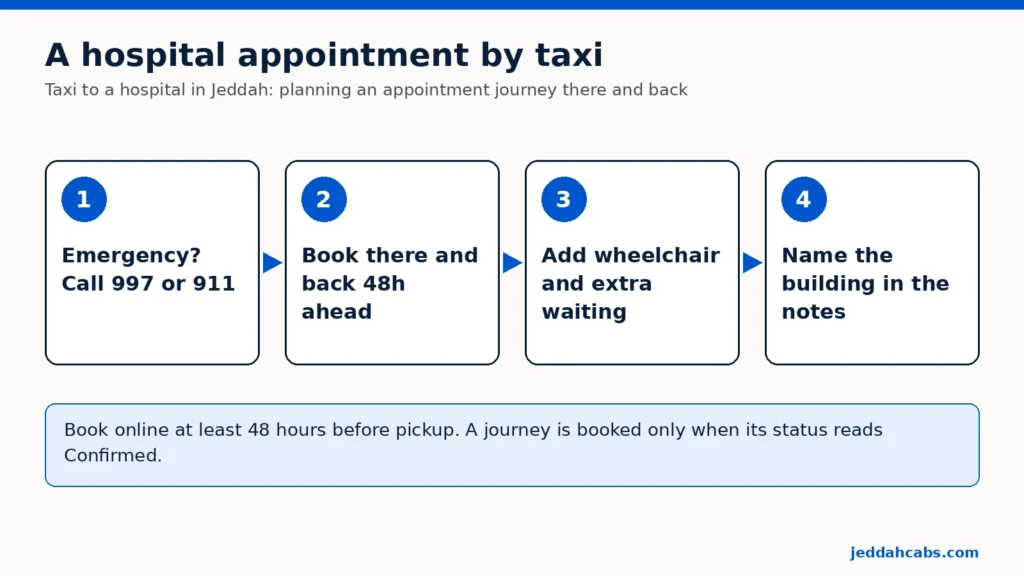
First: emergencies are not a taxi journey
A booked car is for planned travel. It needs 48 hours’ notice, and it cannot give first aid or take priority on the road. In an emergency, use the official numbers.
The Saudi Red Crescent Authority lists 997 for ambulances on its contact page. Saudipedia’s entry on the National Center for Security Operations explains that 911 is the single national emergency number, and that the first of its security operations centres was established in Makkah Province, which includes Jeddah, in 2014.
For health questions that are not emergencies, the Ministry of Health runs the 937 service, which it describes as offering medical consultation through doctors around the clock, as well as receiving patient reports, complaints and feedback. Save 997, 911 and 937 in your phone before you travel.
When a taxi to a hospital in Jeddah makes sense
A booked car suits journeys you can see coming at least two days ahead:
- an outpatient clinic appointment, a scan or a follow-up visit with a date and time on the letter;
- a planned admission or discharge where the hospital has given you a day and an approximate time;
- visiting a relative who is staying in hospital, within the hospital’s visiting hours;
- an arrival at King Abdulaziz International Airport for a planned course of treatment, followed by the journey to a hotel near the hospital.
It does not suit anything that cannot wait 48 hours. A search for a pickup inside that window returns a message that the journey must be booked at least 48 hours in advance.
Hospital appointment transport in Jeddah: two journeys, not one
The booking system, described step by step in how Jeddah Cabs works, treats a journey as one pickup, one destination and one pickup time. The pickup and destination must be different, so a trip to the hospital and back is two journeys, each booked with its own time. That is the most important thing to understand about hospital appointment transport in Jeddah, because it shapes everything else.
The journey there is the easy part. You know the appointment time, so set the pickup early enough to arrive, find the right building and check in. Many hospital letters ask patients to arrive before the appointment; follow what your letter says. We do not quote journey times, because traffic in Jeddah varies too much, but the planner shows the route and the distance once you enter both addresses.
The journey back is the hard part. Clinics run late, tests get added, and a pharmacy queue can take longer than the appointment itself. The next section is about that problem.
Why not one car that waits all day?
A driver waiting outside a hospital for an unknown length of time is not something you can book. What you can book is a return pickup at a set time, with free waiting included in the vehicle class and, if you want it, paid extra waiting of up to 2 hours added at checkout. The rest of this guide shows how to use that well.
The uncertain finish: choosing the return pickup time
The return journey depends on a guess. Make it an informed one.
Start with what the hospital has told you. Is it a single consultation, or a consultation followed by blood tests, a scan or a pharmacy collection? Ask the clinic, when you confirm the appointment, how long patients are usually there. Then choose one of three approaches.
| Approach | How to book the return | Best when | Watch out for |
|---|---|---|---|
| Fixed time with a buffer | Set the return pickup at your best estimate of the finish, and add 30 to 60 minutes of extra waiting | A routine follow-up with a predictable length | If you finish early, the car is not there yet |
| Later time, wait indoors | Set the return pickup generously late, with the class’s free waiting only | You would rather wait in a hospital café than risk the car leaving | A long wait for a tired patient |
| Maximum waiting | Set the return at the earliest realistic finish and add up to 2 hours of extra waiting | Uncertain appointments, several departments, or a discharge | Waiting beyond what you booked cannot be promised |
For most outpatient visits, the first or third approach works best, because the car is ready from a sensible time and the paid extra waiting covers the likely overrun.
How free and extra waiting work
Free waiting counts from the booked pickup time. It does not start when the car arrives, or when you come out of the clinic. Each vehicle class includes free minutes, and after those, waiting is charged per minute.
| Vehicle class | Free waiting from the booked pickup time | Rate after the free minutes |
|---|---|---|
| Economy | 15 minutes | SAR 1.50 per minute |
| Business & Executive, VIP van (Staria), family van (H1) | 30 minutes | SAR 2.00 per minute |
| Minibus (Hiace or Coaster) and Coach | 30 minutes | SAR 2.50 per minute |
| Premium SUV (Tahoe or Yukon) | 45 minutes | SAR 2.50 per minute |
| Luxury (S-Class) | 60 minutes | SAR 4.00 per minute |
Extra waiting is added at checkout in steps of 15, 30, 45, 60, 90 or 120 minutes. It is priced at the class’s per-minute rate and added to the booking, and the driver’s instructions show the total, for example 75 minutes from the booked pickup time for a Premium SUV with 45 minutes free and 30 minutes extra. Waiting beyond what you booked cannot be promised, so if the appointment may run very long, choose a later return time rather than relying on the driver to stay.
Wheelchairs, walking frames and reduced mobility
A wheelchair requirement can be added in the search, before you choose a vehicle, and it is then confirmed for the vehicle. Add it whenever the patient will travel with a wheelchair, even a folding one, so the vehicle offered has room for it alongside the passengers and bags.
Use the booking notes to describe the practical details: whether the chair folds, whether the patient can move from the chair to a car seat with help, and whether a walking frame or other aid will travel too. Describe what the driver needs to know for the journey, not the patient’s medical history. Our accessibility statement sets out our approach, and our guide to Jeddah taxi vehicle classes shows how the classes differ in seats and luggage space.
A larger class often helps even for a small party. A van with a wide door and space for a chair can make getting in and out easier for someone who is unsteady after an appointment. The planner shows only the classes that pass the capacity check for the number of passengers and bags you enter.
Getting to hospitals in Jeddah: naming the right building
Large hospitals are not one door. A campus may have several buildings, separate outpatient and inpatient entrances, and different gates for different services. The most common problem when getting to hospitals in Jeddah is not the route but the final few hundred metres.
Take the details from the appointment letter or the hospital’s own website, not from a general map pin. As an example, King Faisal Specialist Hospital & Research Centre’s page on patients and visitors information sets out visitor rules and visiting hours for its Jeddah branch, and its related pages say that in Jeddah the outpatient building has all outpatient clinics on Level 1, with some services, such as family medicine and physical therapy, in the North tower. That is the kind of detail that belongs in your booking notes.
In the notes for the journey there, write:
- the hospital’s full name and the building or tower named on the letter;
- the clinic or department, and the entrance if the letter names one;
- whether the patient uses a wheelchair or needs help getting out of the car.
We cannot promise where a car may stop at a hospital, because drop-off areas and access are controlled by the hospital and can change. For the return, agree a meeting point that the patient can reach easily, and send the driver a live location when you come out.
Visiting a patient: check the hospital’s rules first
If the purpose of the trip is a visit rather than an appointment, check the hospital’s visiting rules before you book, because they decide your pickup times.
King Faisal Specialist Hospital’s page, at the time of writing, gives separate visiting hours for general wards, the maternal ward and special care units at its Jeddah branch. It also says that children under 14 are not allowed to visit, that no more than two visitors at a time are recommended, and that visitors must not bring food. Other hospitals set their own rules, which can change. Read the current page for the hospital you are visiting, and plan the car around its hours.
Set the return pickup for shortly after the end of visiting time, or earlier if you plan a short visit, and add some extra waiting if saying goodbye may take longer than planned.
Booking for someone else
Many hospital journeys are booked by a son, daughter or friend for an older relative. The checkout supports this. If the booking is for someone else, it asks for the traveller’s name, the traveller’s phone number and an emergency contact, and there is an optional field for a group leader’s phone.
Use it properly. Put the patient’s own phone number in the traveller field only if they will answer it on the day; otherwise use the number of the relative who will be with them. The basket can also email a secure review link, so a brother or sister can check the details before one person pays. Each journey has a minimum booking value equivalent to £40, and prices can be shown in one of several currencies; our guide to paying in pounds, riyals or another currency explains the choice.
Once a driver is assigned, the account shows the driver’s name, and the driver-assigned email includes the vehicle registration and a link to view the vehicle photo securely in the account. That helps an older passenger recognise the right car outside a busy entrance.
Arriving in Jeddah for treatment
If the appointment follows a flight, book the airport journey separately. Enter the flight number at checkout, set the pickup time after the scheduled landing, and consider extra waiting, since immigration and baggage can take time and free waiting counts from the booked pickup time. For reference, the Jeddah Hilton is about 21 km by road from King Abdulaziz International Airport. Our page on getting from Jeddah Airport to your hotel covers the arrival journey.
Avoid booking the airport pickup and the first appointment too close together. A delayed flight should not put the appointment at risk.
If the appointment moves
Hospital appointments change. Plan for that before you book.
- Only the pickup time can be changed online. From your account, before the pickup time, you can request a new pickup time. The request stays pending until the booking team approves it. An approved new time carries a £5 rescheduling fee, converted into your booking currency and added to the cash paid to the driver. A rejected request costs nothing.
- The place cannot be changed online. If the appointment moves to a different hospital or building, that needs the booking team, or a new booking plus a cancellation request.
- Cancellation. Bookings are subject to our cancellation terms (free cancellation with a full refund up to 48 hours before pickup; inside 48 hours the deposit element of the price is kept) if you cancel. If we or the transport partner cancel, or cannot supply the journey, you receive a full refund for the affected journey. The cancellation and refund policy has the details.
Worked example: a clinic follow-up with a parent
The example below uses fictional people, but it shows how a taxi to a hospital in Jeddah can be set up for a parent.
Zainab Hussain, who lives in Manchester, has flown to Jeddah to go with her father, Yusuf, to a follow-up clinic appointment. Yusuf walks short distances but uses a folding wheelchair for anything longer. The appointment letter gives a date, a time of 10:30, the building and the clinic, and says the visit includes a consultation and blood tests.
Three days before, Zainab books two journeys from their hotel. She adds the wheelchair requirement in the search, which leaves her a choice of classes that can carry the chair, and chooses a family van for the space. For the journey there, she sets a pickup time that allows for traffic and the walk from the entrance to the clinic, and writes the building and clinic name in the notes, adding that her father will need a moment to transfer from the chair.
For the return, the clinic has told her that patients who need blood tests are often there for most of the morning. She sets the return pickup at 12:30 and adds 60 minutes of extra waiting. With the 30 minutes of free waiting that comes with the van, the driver’s instructions show 90 minutes from 12:30. She puts her own phone number in the traveller field, because her father does not use messaging apps, and lists her brother in Riyadh as the emergency contact.
On the day, the tests run late. Zainab messages the driver at 12:45 to say they are at the pharmacy, then sends a live location when they reach the entrance. They leave inside the booked waiting.
Checklist before you book a taxi to a hospital in Jeddah
- If anyone is seriously unwell, call 997 or 911 instead of booking a car.
- Confirm the appointment date, time, building and clinic from the letter or the hospital’s website.
- Ask the clinic roughly how long the visit usually lasts.
- Book at least 48 hours ahead, as two journeys: there and back.
- Add the wheelchair requirement in the search if the patient uses one.
- Choose a class with space for the chair, the passengers and any bags.
- Set the return pickup time using one of the three approaches, and add extra waiting at checkout if needed.
- Write the building, clinic and mobility details in the booking notes.
- If booking for a relative, enter a phone number that will be answered on the day and a reachable emergency contact.
- Wait for the status to read Confirmed, and check the driver’s name and vehicle in your account before the day.
When you have the appointment letter in front of you, open the Jeddah Cabs transfer finder, enter the hotel or home address and the hospital, add the wheelchair option if needed, and book the journey there and the journey back with the waiting that suits your appointment. Jeddah Cabs takes a deposit online and the balance is paid in cash to the driver, and the checkout shows both amounts before you pay.