

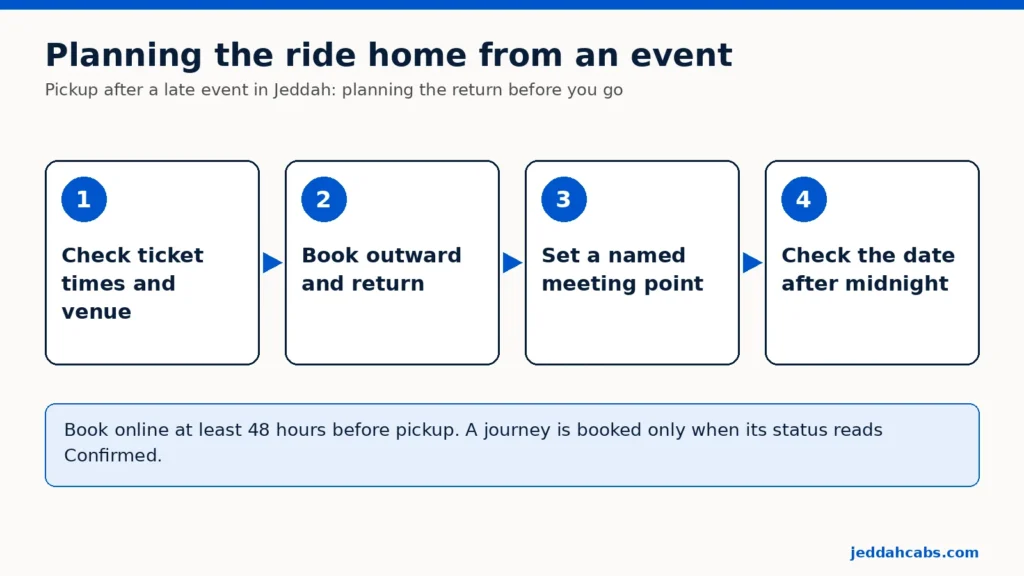
A pickup after a late event in Jeddah needs to be booked before the event, not on the night. Online bookings need at least 48 hours’ notice, so the return must be planned in advance: a named meeting point you can walk to, a pickup time set after the expected finish with a margin, and the correct date, which after midnight is the next calendar day. Do that, and the end of the night is as settled as the start.
This guide is for visitors and residents going to concerts, shows and festival nights in Jeddah who want a private car home rather than searching for a ride in the crowd. It covers what to check on your ticket, how to choose the return time and date, how to pick a meeting point, how to share one car between friends staying in different places, what to do if the evening changes, and the booking rules that apply.
Why late events need their own plan
Jeddah hosts a busy calendar of evening events. According to Saudipedia’s entry on Jeddah Season, the season is part of the Saudi Seasons initiative and was first held in 2019. The 2022 edition had zones including City Walk, Jeddah Pier, Jeddah Jungle, Jeddah Yacht Club, Jeddah Superdome, Jeddah Art Promenade, Prince Majid Park and Historic Jeddah, and the 2024 edition offered about 5,000 events across five zones. Visit Saudi describes the 2025 season as 85 days of live music, beach fun, family adventures and cultural experiences.
Large venues bring large crowds. Saudipedia’s entry on the Jeddah Superdome, for example, notes it can host four separate events at the same time, with over 5,000 parking spaces.
When thousands of people leave at once, late at night, three things become harder: finding one car among many, reaching someone by phone, and staying together as a group. A return booked before you go, to a clear place at a clear time, removes most of the uncertainty.
Start with the ticket and the organiser
Before booking any journey, check your ticket or event confirmation for:
- the venue name and, where relevant, the zone or hall;
- the start time and, if given, the expected finish;
- instructions for arriving and leaving by car or taxi;
- whether re-entry is allowed and what you may bring.
Venue access, road closures and drop-off or pickup areas are set by the organiser and the authorities for each event. We do not know in advance where a car may stop on a given night, and we do not promise a particular gate or pickup spot. If the event’s name does not make its location obvious, read our note on checking the venue behind an event name.
Two journeys, booked together
An evening out by private car is two journeys: one there and one back. The system requires the pickup and destination to differ, so a there-and-back trip is always two bookings, each with its own time. The outward booking does not keep a car for you during the event.
The outward journey is the easy part. Set your hotel or home as the pickup, type the venue, and check the route summary. Time it from the doors-open time, not the headline act.
The return journey is the Jeddah event return taxi, booked from a meeting point near the venue to wherever you are going afterwards. Book it at the same time as the outward journey, while you are thinking clearly and have the ticket in front of you.
Choosing the return time
You rarely know the exact moment an event ends. Headline sets overrun, encores happen, and leaving a large venue takes time. A few principles help:
- set the pickup for when you expect to be at the meeting point, not when the music stops;
- add the time it takes to leave the venue and walk to the meeting point;
- if in doubt, set it a little later; waiting a few minutes at the meeting point is better than a driver waiting while you are still inside.
| Type of evening | What is uncertain | How to set the return |
|---|---|---|
| Concert with a published end time | Encores, crowd exit | After the published end, plus time to walk out |
| Festival zone with no fixed end | When you will want to leave | Choose your own leaving time and stick to it |
| Show or performance with seating | Interval length, exit queues | After the scheduled end, with a modest margin |
| Event followed by a meal | When the meal will finish | Book the return from the restaurant, not the venue |
If dinner comes after the event, the return starts from the restaurant. Our article on making the restaurant a real final stop covers that sequence.
Included waiting time differs by vehicle class and is not currently shown in the search results. Ask the booking team to confirm in writing how long the driver will wait at the meeting point.
Leaving before the end on purpose
Some people choose to leave a little before the final act or the last firework, to avoid the busiest minutes at the exits. That is a perfectly good plan, as long as it is decided in advance and the return is booked for that earlier time.
Agree the leaving time as a group before you go. If only some of you want to leave early, give them their own return journey, because one booking cannot be split between two leaving times on the night.
Getting the date right after midnight
This is the mistake that catches the most people. If an event starts at 9pm on a Friday and you want to be collected at 12:30am, the pickup is on Saturday, not Friday.
The transfer finder uses Saudi local time and the calendar date of the pickup. When you book:
- check the date shown in the search matches the calendar day of the pickup, not the day the event starts;
- read the confirmation email and your account to make sure the date is right;
- if you are booking from another country, convert to Saudi local time first.
A pickup booked for 12:30am on the wrong day means a car arriving almost 24 hours early, or not at all when you need it.
Choosing the meeting point
The pickup place is as important as the time. A good meeting point for event night transport in Jeddah is:
- named and specific: a map pin and a written description, not “outside the venue”;
- reachable on foot after the event, allowing for crowd control;
- a short way from the busiest exits, where a car can stop lawfully on the night;
- the same for everyone in the group.
Put the meeting point in the booking notes and share it with everyone before you set off. If you are unsure whether it is practical, ask the booking team when you book. On-the-night access is still set by the organiser and the police, so follow their directions if they differ.
Festival zones, heritage districts and waterfronts
Not every event happens inside a single building. Jeddah Season zones have included outdoor areas along the waterfront, parks and Historic Jeddah, which UNESCO inscribed as a World Heritage Site in 2014 under the name Historic Jeddah, the Gate to Makkah.
At outdoor and district events, the nearest place a car can reach may be some distance from where you spend the evening, and access arrangements can change from night to night. Pick a meeting point on the edge of the area, reachable on foot, and follow the organiser’s published arrangements. If you plan a walk through a district that finishes somewhere other than where you started, our article on an Al-Balad walk that finishes somewhere else explains how to set the pickup at the end point.
Sharing one car between friends
Groups often travel home to different places. The system lets you add up to 8 stops to a journey, visited in the order you enter them. That means one return booking can drop friends at different hotels on the way.
Things to check:
- Order the stops sensibly, in the order you would pass them, and check the route summary.
- Choose the vehicle for the whole group. Enter every passenger; the results show only classes that fit. Economy and Business cars seat four, a Hyundai Staria or Premium SUV six, a Hyundai H1 or GMC Yukon XL seven, and a Toyota Hiace eleven.
- Name one lead contact whose phone number is in the booking, and a second person as backup.
- Agree how the cash balance is shared before the night, not in the car.
If part of the group might leave early, give them their own booking. A shared return cannot be split into two cars on the night.
Worked example: three friends at a concert
Priya, Hannah and Noor have tickets for a concert at a large venue in Jeddah. Doors open at 8pm and the ticket says the show ends at 11:30pm. The concert is on a Thursday.
Priya and Hannah are staying at one hotel; Noor is staying with her aunt in another district.
Outward. They book one journey on Thursday from Noor’s aunt’s home, with a stop to collect Priya and Hannah at their hotel, then on to the venue. They set the pickup so they arrive soon after the doors open.
Return. They agree a meeting point a short walk from the venue, save its map pin, and book a return with Priya and Hannah’s hotel as a stop and Noor’s aunt’s home as the destination. They set the pickup for 12:15am, allowing for an encore and the walk out. Because it is after midnight, Priya checks the date: Friday, not Thursday. She puts her number and Noor’s in the notes.
Payment. The checkout shows a deposit online and a cash balance for each journey. They agree to split the cash and each carry riyals.
On the night, the show overruns slightly. They walk to the meeting point, send the driver a message, and are on their way home within minutes of reaching it.
On the night
A few habits make the end of the evening simpler, whoever you are with.
Phone, battery and staying together
A flat battery can undo a good plan. Before you go:
- charge your phone fully and bring a power bank if the venue allows it;
- save the booking reference, meeting point and pickup time offline, and write them on paper;
- give a second person the same details;
- agree that anyone who gets separated goes straight to the meeting point;
- carry riyals for the cash balance due to the driver.
Your account shows the driver’s name once one is assigned, which helps you find the right car at the meeting point.
Getting into the right car
At the end of a busy night, many vehicles and offers of a ride may be around the venue. Stick to your plan.
- Go to the agreed meeting point rather than accepting a lift from someone who approaches you.
- Check the driver’s name against the one shown in your account once a driver is assigned.
- Confirm the booking reference or your name with the driver before loading anyone into the car.
- If something does not match, stay where you are and contact the booking team.
Family evenings and children
Evening events with children need a slightly different plan.
- Set an earlier return. Young children often flag before the end. A return booked for a sensible hour, even if you miss the last part, usually makes for a better night.
- Add child seats. Enter each child and infant in the search and add an infant seat, child seat or booster; they are then confirmed for the vehicle. This applies to the return as well as the outward journey.
- Plan the walk out. A crowd leaving a venue is hard work with a pushchair or a sleepy child. Choose a meeting point with that walk in mind, and mention a pushchair in the notes.
- Keep one adult free. One adult carries the phone and the meeting point details; another looks after the children.
If the evening changes
The event is moved to a different time. Request a new pickup time from your account, before the pickup time, for a paid booking. It stays pending until the booking team approves it. An approved change carries a £5 rescheduling fee, converted into your booking currency and added to the cash you pay the driver; a rejected request costs nothing.
You want a different meeting point, destination or more passengers. These cannot be changed online. Contact the booking team first, or make a new booking and send a cancellation request for the old one.
You decide not to go. Bookings are subject to our cancellation terms (free cancellation with a full refund up to 48 hours before pickup; inside 48 hours the deposit element of the price is kept) if you cancel. If Jeddah Cabs or the transport partner cancels or cannot supply the journey, and you do not accept a suitable alternative, you receive a full refund for the affected journey. See the cancellation and refund policy.
Because a cancellation by you is subject to our cancellation terms (free cancellation with a full refund up to 48 hours before pickup; inside 48 hours the deposit element of the price is kept), it is worth booking once your tickets are confirmed and your plans for the night are settled.
Late events and flights
It is tempting to fit a concert into the last night of a trip and fly out early next morning. Think carefully before doing that. A late return and an early airport journey leave very little room for sleep or for anything going wrong.
If you do it, keep them as separate bookings: the event return to your hotel, and a separate journey from the hotel to the airport, timed from your airline’s check-in and bag-drop deadlines, which you should check yourself. Do not try to go straight from the event to the airport with your luggage unless you are sure the venue allows bags and the timing is comfortable.
Booking rules for event nights
- Notice. Online bookings need at least 48 hours’ notice before pickup. You cannot book the return through the transfer finder on the night.
- Minimum value. Each journey has a minimum booking value equivalent to £40. A short city journey may show a “Minimum booking amount” line.
- Payment. Jeddah Cabs may take only a deposit online, with the balance paid in cash to the driver; the checkout shows both amounts.
- Confirmation. Payment secures a provisional request. The booking team updates the status within 1 to 12 hours, and the journey is booked only when it reads Confirmed in your account.
- Child seats and accessibility. Add infant seats, child seats, boosters or a wheelchair requirement in the search so they are confirmed for the vehicle.
For a match or event at King Abdullah Sports City, see our separate guide to match-day transport to the sports city. For an evening that combines several places in one area, read building a Jeddah evening around one area.
Checklist for a late event
- Check your ticket for venue, zone, start and end times, and any transport instructions.
- Book the outward and return journeys together, at least 48 hours ahead.
- Time the outward journey from doors opening.
- Set the return for when you will reach the meeting point, with a margin.
- Check the pickup date: after midnight it is the next calendar day.
- Choose a named meeting point you can walk to, away from the busiest exits.
- Add stops in journey order if friends are going to different places.
- Put the meeting point and two phone numbers in the booking notes.
- Ask the booking team to confirm waiting time in writing, and wait for Confirmed.
- Charge your phone, save the details on paper and carry riyals for the driver.
As soon as your tickets are confirmed, use the Jeddah Cabs transfer finder to book the journey to the venue and a separate return from your meeting point, with the date checked, so the ride home is settled before the doors open.