
The best time to visit Jeddah, for most people, is the winter season from December to February, when official figures put maximum temperatures across Saudi Arabia at their lowest of the year and Jeddah itself is among the warmest places in the Kingdom rather than the hottest. The shoulder months either side are workable too. Summer, from June to August, brings high heat and humidity on the coast, so outdoor plans shrink to the early morning and the evening. Ramadan, Eid and the Umrah peak move through the Gregorian calendar each year, and they change how busy the city and the airport feel far more than the thermometer does.
This guide is for visitors deciding when to come to Jeddah, and for anyone who has already chosen dates and wants to know what the season means for their days out and their airport transfer. It sets out what official sources actually say about Jeddah’s climate, gives a season-by-season view of the year, explains which calendar events shift from year to year, and shows how each season changes the way you book cars: the pickup times you choose, the waiting you add, and the day trips that make sense. Where we could not find an official figure, we say so and point you to the body that publishes it.
The short answer: when is the best time to visit Jeddah?
If you have a free choice and want time outdoors, the best time to visit Jeddah is December to February, with November and March as good second choices. If your dates are fixed by work, family or a pilgrimage, any month can work, provided you plan the day around the heat and humidity and check the calendar for Ramadan and the two Eids.
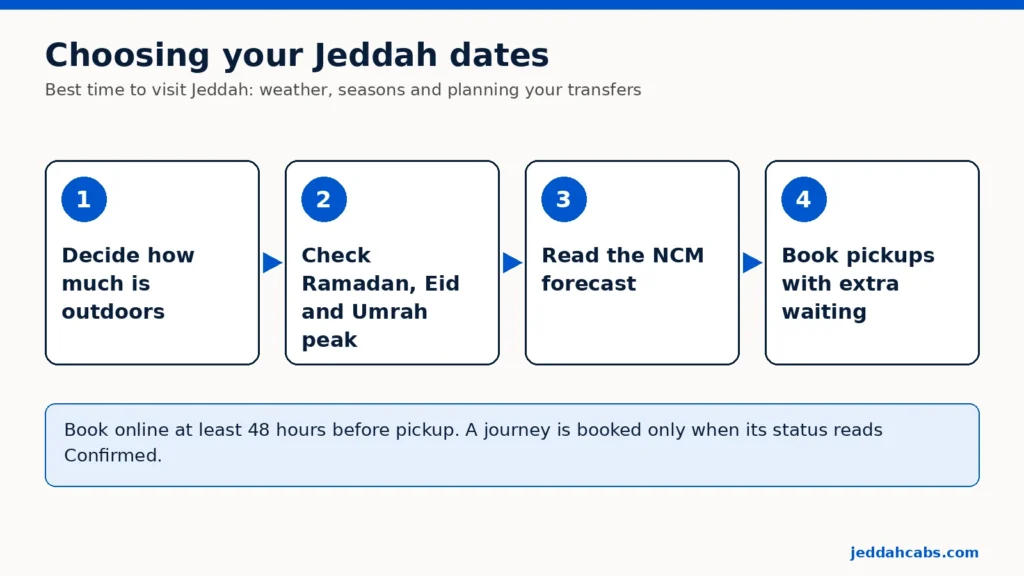
Three questions decide it for most people:
- How much of the trip is outdoors? A beach day, a walk through Al Balad or an evening on the waterfront is far more pleasant in the cooler months.
- Do you want the city busy or calm? Ramadan nights, Eid holidays and seasonal events bring crowds and a later rhythm to the day. Some visitors love that; others would rather avoid it.
- Are you pairing Jeddah with somewhere else? Makkah, Madinah, Taif and Yanbu each have their own conditions and their own calendar pressures, so the best month for Jeddah alone may not be the best month for the whole trip.
What official sources say about Jeddah’s climate
Many websites publish neat monthly averages for Jeddah, mostly estimates, and we have not used them. The figures below come from official Saudi reference sources: more general than a monthly chart, but reliable.
Saudipedia’s entry on the climate of Saudi Arabia divides the year into four seasons and gives the range of maximum temperatures across the Kingdom in each: winter (December to February) between 20 and 30 degrees Celsius, spring (March to May) between 30 and 40, summer (June to August) between 35 and 45, and autumn (September to November) between 25 and 35. The National Center for Meteorology (NCM) gives the same seasonal ranges on its own climate page. These are national figures, not Jeddah figures, so treat them as the shape of the year rather than a forecast for the coast.
The same Saudipedia entry adds two points that matter for Jeddah specifically. Humidity rises as you move towards the Red Sea coast in the west, and Jeddah and Yanbu are classed as the warmest regions in winter. In other words, a Jeddah winter is mild rather than cold, and the coast is more humid than the interior.
Saudipedia’s page on Jeddah city describes summers with high temperature and humidity, with temperatures that can reach 40 degrees Celsius, and humidity that climbs in summer as the sea warms and falls again in winter. It says light rain falls on the city, usually in winter, spring and autumn, often with thunderstorms. The prevailing winds are north-westerly and mostly light to moderate, but winter and spring can bring southerly winds that cause dust and thunderstorms.
Jeddah weather by month: a season-by-season view
People searching for Jeddah weather by month usually want a single table of temperatures. We could not find an official month-by-month table for Jeddah that we were able to read and verify, so the table below groups the months into the official seasons and adds what official sources say about the coast. For actual temperatures and humidity on your dates, use the daily forecast on the National Center for Meteorology’s weather page, which lists Jeddah separately.
| Months | Official season | National maximum range | What it means on the Jeddah coast | Planning note |
|---|---|---|---|---|
| December, January, February | Winter | 20 to 30°C | Jeddah among the warmest places in the Kingdom in winter; lower humidity; occasional rain with thunderstorms | Best for outdoor days, walks and beach visits |
| March, April, May | Spring | 30 to 40°C | Warming quickly; southerly winds can bring dust or storms | Good early in the season, plan midday indoors later |
| June, July, August | Summer | 35 to 45°C | High heat and humidity; temperatures can reach 40°C | Mornings and evenings outdoors, indoor venues by day |
| September, October, November | Autumn | 25 to 35°C | Heat easing; humidity falling towards winter; rain possible | November is a strong shoulder month |
Two cautions apply. The ranges are national maximums, and the NCM notes a clear difference between coastal and inland climates. And the Islamic calendar does not follow these months, so the busiest weeks can fall in any season.
Reading a Jeddah forecast
When you check the NCM forecast, look at humidity as well as the temperature. On the coast, a moderate temperature with high humidity can feel heavier than a higher temperature in dry air. Also look at the wind and any active weather alerts, which the NCM publishes on the same page. A dusty or stormy day changes the plan more than a degree or two of heat.
The coldest month in Jeddah, and what “cold” means on this coast
The coldest month in Jeddah falls in the winter season of December to February, which official sources identify as the coolest part of the year across the Kingdom. We have not given a single month or an average low, because we could not verify one from an official Jeddah record. If you need that level of detail, for example to plan an event, ask the National Center for Meteorology for its climate data for Jeddah.
What matters more for a visitor is that Jeddah’s winter is mild. Saudipedia classes Jeddah as one of the warmest regions in the Kingdom in winter. You will not need heavy winter clothing on the coast, although evenings by the sea can feel fresh, and air-conditioned malls, museums and cars can feel cool after a day outside.
The picture changes if you leave the coast. Taif sits in the mountains, about 197 km by road from Jeddah Airport, and inland and high-altitude places have a different climate from the Red Sea shore. If a winter trip includes Taif, check the NCM forecast for Taif separately rather than packing for Jeddah alone. Our guide to places to visit in Taif by car covers that side of the trip.
Summer in Jeddah: heat, humidity and a later day
Summer is not a closed season: families, business travellers and pilgrims arrive all year. But it changes how a day works. Keep midday for indoor places or for rest at the hotel, and plan outdoor time for the early morning or after sunset. Many visitors follow this pattern, saving the waterfront and the old town for the evening. Our guide to places to visit in Jeddah at night suggests where to spend those cooler hours.
For transfers, summer means three things:
- Waiting outside is harder. A long wait at a kerb in humid heat is tiring, especially for older relatives and small children. Agree a meeting point where people can wait indoors until the driver messages.
- Evening pickups get later. If the plan is a sunset walk and dinner, the return pickup may be later than you would choose in winter. Set it realistically rather than hopefully.
- Luggage and water. Keep water and anything you need for the journey in a bag that travels in the cabin, not the boot.
Rain, wind and dust: the days that change plans
Rain in Jeddah is light and occasional, according to Saudipedia, but it usually arrives with thunderstorms, and it tends to fall in winter, spring and autumn rather than summer. Southerly winds in winter and spring can raise dust.
If the NCM shows an alert for the Makkah region or for Jeddah on your date, consider moving an outdoor outing to another day, or choosing an indoor destination such as a museum or a mall. Journeys can also be slower in bad weather, so leave more time for any journey with a fixed end point, such as a flight or a ticketed event.
For an airport run on a stormy day, the principle is the same as on any day: book the pickup early enough that a slower journey does not put the flight at risk. We do not quote journey times, because they vary too much with traffic and weather, but the planner shows the route and distance once you enter your addresses.
Ramadan, Eid and the Umrah peak: the calendar that moves
For many visitors the most important seasons in Jeddah are not about weather at all. The Hijri calendar is lunar, and Saudipedia explains that each month begins with the sighting of the crescent moon and lasts 29 or 30 days. This means Ramadan, Eid al-Fitr and Eid al-Adha fall on different Gregorian dates each year, and the exact start of each is confirmed only close to the time.
Ramadan nights
Ramadan changes the rhythm of the city. The Saudi Press Agency, describing Ramadan in Historic Jeddah in February 2026, reported that after Taraweeh prayers the narrow lanes of Al Balad fill with lantern-lit activity, heritage cafés and cultural performances. For a visitor this can be the most memorable time to see the old town, but it means evening crowds and a later night. Our guide to visiting Al Balad by taxi helps you decide whether to go on the day you arrive or another day.
Eid holidays
Saudipedia lists Eid al-Fitr and Eid al-Adha among the Kingdom’s four official holidays, alongside Founding Day on 22 February and Saudi National Day on 23 September. Public holidays mean families out in the city, busier coastal areas and, often, busier roads to and from the airport. Book early if your dates cover an Eid.
The Umrah peak at the airport
King Abdulaziz International Airport is the main gateway for many pilgrims, and its busiest weeks follow the Islamic calendar. The Saudi Press Agency reported that the airport served about 5.3 million passengers during the peak Umrah season of 1446 AH, which it defined as 1 Ramadan to 7 Shawwal. If your arrival falls in that period, expect busier halls and longer queues, and plan your pickup accordingly.
Events and Jeddah Season
Saudipedia records that Jeddah has held Jeddah Season since 2019, as part of the Saudi Seasons programme, with arts, music, culture, entertainment and sport. It also mentions the annual Historic Jeddah Festival. Programmes and dates change each year, so check the official event listing for your dates rather than relying on last year’s calendar.
If an event is the reason for your visit, the ticket sets the time and the venue, and the season matters less than the finish time. Our guide to planning a pickup after a late event in Jeddah explains how to book the return before you go.
How the season changes your airport transfer
The booking steps are the same all year, but the season changes the details you enter.
Arrival pickups in busy periods
Free waiting counts from the booked pickup time, not from when the plane lands or when the car arrives. In quieter months, a pickup time set a sensible gap after landing, with the free waiting included in your vehicle class, may be enough. In the Umrah peak, on Eid days or on a busy evening, immigration and baggage can take longer. You can add extra waiting at checkout in 15-minute steps, up to 2 hours, priced at your class’s per-minute rate. The driver’s instructions then show the total waiting from the booked pickup time. Our page on getting from Jeddah Airport to your hotel explains the arrival journey itself.
Booking notice in peak season
Online bookings need at least 48 hours’ notice before pickup, in every season. In busy weeks, book well ahead of that minimum. Payment secures a provisional request, and the status should update within 1 to 12 hours; the journey is booked only when it reads Confirmed. In a busy period, the earlier you book, the more room there is to adjust if the first choice of vehicle cannot be supplied.
Day trips and the season
The season also decides which day trips are worth it.
In winter, outdoor days on the coast work well. A beach day, a walk along the Corniche or a visit to North Obhur fits comfortably into a mild afternoon. Our guide to a Jeddah beach day by taxi covers access to public and private beaches.
In summer, many visitors look to the mountains. Taif is about 197 km by road from Jeddah Airport, and inland areas have a different climate from the coast. Our comparison of whether to visit Taif or Jeddah first helps when the trip includes both.
Worked example: two families, two seasons
The following example is fictional, but the choices are typical.
Helen and Martin Clarke are a retired couple from Leeds with a free choice of dates. They want to walk in Al Balad, spend an afternoon on the waterfront and take one day trip. They choose late January. Their flight lands in the afternoon. They book an Economy car from King Abdulaziz International Airport to the Jeddah Hilton, about 21 km by road, with the pickup time set after the scheduled landing. January is outside the Umrah peak for their year, so they rely on the 15 minutes of free waiting that comes with Economy and add 30 minutes of extra waiting at checkout as a buffer. On their second day they walk in Al Balad in the late morning, which is comfortable in winter, and book a car back from the far end of their walk.
The Qureshi family, two adults and three children from Birmingham, can travel only in the school summer holiday in August. They book a Hyundai H1 or similar for five passengers and five large cases. Because the heat and humidity are high, they plan each day around it: a mall or another indoor place at midday, the waterfront after sunset. They set evening pickups later than they would at home, and they write in the booking notes that the children will wait inside the hotel lobby until the driver messages. The H1 class includes 30 minutes of free waiting from the booked pickup time, which suits a family leaving a hotel with small children.
Both trips work. For the Clarkes, the winter months were simply the best time to visit Jeddah; for the Qureshis, the season shaped the day rather than the date.
What the season does not change
Some rules apply in every month:
- Online bookings need at least 48 hours’ notice.
- A there-and-back trip is two journeys, each with its own pickup time.
- Only the pickup time can be changed online, by request; an approved new time carries a £5 rescheduling fee, added to the cash paid to the driver.
- Bookings are subject to our cancellation terms (free cancellation with a full refund up to 48 hours before pickup; inside 48 hours the deposit element of the price is kept) if you cancel. If we or the transport partner cancel, or cannot supply the journey, you receive a full refund for the affected journey. The cancellation and refund policy sets out the details.
Checklist: planning your Jeddah dates and transfers
- Decide how much of the trip is outdoors, and favour December to February if it is most of it.
- Check whether your dates overlap Ramadan, Eid or the Umrah peak for that year.
- Look at the NCM forecast for Jeddah, including humidity, wind and any alerts, in the week before you travel.
- If the trip includes Taif or another inland place, check that forecast separately.
- Book airport pickups at least 48 hours ahead, and earlier in busy weeks.
- Set the arrival pickup time after landing and add extra waiting at checkout if the season is busy.
- Enter the real number of passengers and large bags so the right vehicles appear.
- In summer, plan outdoor outings for mornings and evenings, and book return pickups at realistic times.
- Agree an indoor waiting point for older relatives and children.
- Wait for the status to read Confirmed before treating any journey as booked.
When you have chosen your dates, open the Jeddah Cabs transfer finder to enter your flight, your hotel and your party, compare the vehicles that fit, and add any extra waiting the season calls for. Jeddah Cabs takes a deposit online, and the balance is paid in cash to the driver; the checkout shows both amounts before you pay.