

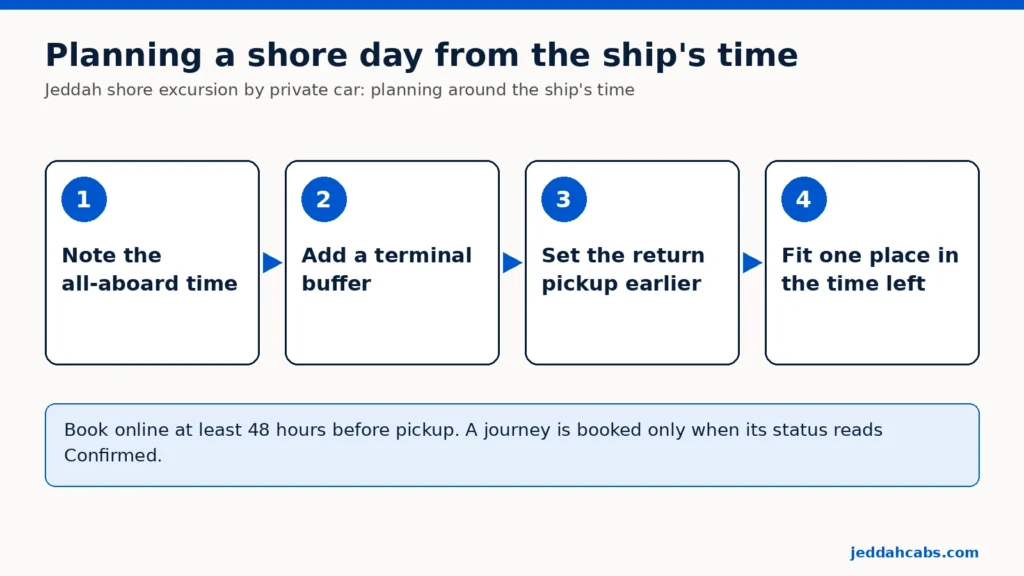
A Jeddah shore excursion by private car works when the whole day is planned backwards from the ship’s all-aboard time, not forwards from the moment you step off. Book two separate journeys at least 48 hours ahead, one from the port to a single chosen place and one back again, and set the return pickup with a generous margin before the time your cruise line says you must be on board. The ship’s schedule is fixed by the cruise line; the car simply fits inside it.
This guide is for cruise passengers whose ship calls at Jeddah for the day and who want to see something of the city independently rather than on the line’s own tour. It covers who decides what, going ashore, where a car can meet you, choosing one destination, setting a return margin, and the booking rules. If you are starting or ending a cruise in Jeddah with flights and luggage, that is a different plan, covered in our guide to the Jeddah cruise terminal transfer from the airport to your ship.
Who decides what on a Jeddah shore excursion
Three parties shape a cruise day in Jeddah, and each answers a different question.
The port. Saudipedia describes it as the first terminal for Cruise Saudi, with the first cruise from the Kingdom setting sail in 2021. Cruise Saudi’s Jeddah port page lists security, passenger and crew services and coordination with government agencies among the services there. The port and the authorities control who and what moves inside the port area.
The cruise line. The line sets the time passengers may go ashore, the all-aboard time, the documents you must carry, and any instructions for leaving and re-entering the terminal. It also runs its own excursions, and it decides what happens if a passenger is late.
The transfer. A Jeddah Cabs journey is a private road journey between two places at a booked time. It cannot give access to restricted areas, it does not change your all-aboard time, and it cannot hold a ship. Its job is to get you from the point where the line lets passengers meet ground transport to the place you want to see, and back.
Keeping these roles apart is the first step in getting back to the ship on time.
Can you go ashore independently?
Before you book anything, confirm with your cruise line that independent time ashore in Jeddah is allowed on your sailing, and what you need to do it. That can include the entry permission that applies to your nationality, the documents to carry, and any rules about leaving the terminal on your own.
For British travellers, the UK government’s Saudi Arabia entry requirements page sets out the visa and travel authorisation routes, such as the electronic travel authorisation, the e-visa and the electronic visa waiver. It does not set out a separate process for cruise passengers, so the cruise line’s instructions for your specific sailing are the ones to follow.
Bookings are subject to our cancellation terms (free cancellation with a full refund up to 48 hours before pickup; inside 48 hours the deposit element of the price is kept) if you cancel, so get a clear answer on going ashore before you book.
Start from the all-aboard time
The all-aboard time is the latest time the cruise line wants passengers back on the ship. Plan your return around it, not around the ship’s departure time. Find it in the line’s documents or the ship’s daily programme for the Jeddah call, and write it down in Saudi local time.
Then work backwards through the day in this order:
- All-aboard time, as given by the line.
- Your own buffer before that time, for queues at the terminal and security.
- Return pickup time, when the car collects you from your chosen place.
- Time at the place itself, enough to see it without rushing.
- Outward pickup time, when the car collects you from the port meeting point.
- Earliest time ashore, as given by the line.
If the gap between steps 6 and 1 is short, the best Jeddah shore excursion may be a single nearby place, or the line’s own tour. We do not quote journey times, because Jeddah traffic varies; ask the booking team when you book.
Why the return margin must be generous
A car booked for an independent tour cannot guarantee the ship will wait. Whether a ship waits for a late passenger is the cruise line’s decision alone. Arriving early costs you some time on the quayside; arriving late could cost you the rest of the cruise. Set the return pickup so that ordinary delays, such as slow traffic, a queue at a museum exit or a family member who wandered off, still leave you inside the all-aboard time.
Where the car meets you at the port
Ports are secure areas, and where a private car may stop is managed on the day by port and security staff. We do not promise a gate, a door or a kerbside spot, but you can give the booking the best information available.
- Ask the cruise line where passengers going ashore independently can meet private transport, and whether there is a name for that area in its documents.
- Type the port as the pickup in the transfer finder, then check that the route summary shows the place you expect. Our short guide on rechecking the location behind a search result explains why the result, not the name you typed, is what the driver sees.
- Use the booking notes for the cruise line and ship name, the wording the line uses for the meeting area, and a mobile number that will work in Saudi Arabia.
- Send a live location to the driver once you are through the terminal, if you can.
For the return, use whatever point the line tells you to come back to, which may differ from where you were collected.
Choosing one place that fits the time
A port day is short, and one anchor place is far more likely to get you back on time than a list of five sights.
Historic Jeddah (Al-Balad)
UNESCO lists Historic Jeddah, the Gate to Makkah, as a World Heritage Site, inscribed in 2014. It describes tower houses with decorative wooden Roshan built in the late nineteenth century by merchant families, alongside lower coral stone houses, mosques, souks and squares, and notes that the district still has living commercial and residential functions. It is a place to walk, so agree a named meeting point for the return rather than expecting a car to reach you in the lanes. Our guide to Al Balad Jeddah by taxi is written for hotel guests, but its drop-off and pickup advice applies here too.
The Corniche
The waterfront is long and made up of distinct sections, so “the Corniche” on its own is not a destination. Our guide to choosing which Corniche stop to ask for explains how to name the part you mean.
A single museum or gallery
If you prefer indoor time in the heat of the day, one museum can work well, as long as you confirm its opening for the date of your port call before you book. Our guidance on confirming a museum visit before the ride sets out what to check.
Cruise day in Jeddah by taxi: the options compared
There are three broad ways to spend a cruise day in Jeddah by taxi or tour. The right one depends on your time ashore and how much return risk you will carry.
| Question | The cruise line’s excursion | Two booked private journeys | One journey with stops |
|---|---|---|---|
| Who organises the return | The cruise line | You, with a booked return pickup | You, with a booked return journey |
| If the tour runs late | The line’s own arrangements apply | Your margin must absorb it | Your margin must absorb it |
| Flexibility on what you see | Fixed programme | One chosen place, your own pace | Several places in journey order |
| Group size and luggage | Coach or group vehicle | Vehicle chosen for your party | Vehicle chosen for your party |
| Booking notice | As set by the line | At least 48 hours before pickup | At least 48 hours before pickup |
| Best for | Short calls, first-time visitors, anyone who wants no return risk | Families or friends with a clear single destination | Travellers dropping off at one place and continuing to another |
A journey can include up to eight stops in journey order, but stops are not waiting time. If you want to spend two hours somewhere, that is a separate outward and return journey, each with its own time. Continuous waiting is not offered as a product. Each vehicle class has an included waiting allowance at pickup, but it is not currently shown in the search results, so if a short wait matters, ask the booking team to confirm in writing what applies to your booking.
Back to the ship on time: setting the return pickup
The return is the part of a shore day that decides whether the day was a success. Treat it as the main booking, not an afterthought.
Pick a return point you can reach on foot
Choose a meeting point that everyone in your party can find without help: a named hotel entrance, a museum’s main door or a clearly named gate to a district. Write it in the booking notes exactly as it appears on the venue’s own signage or website. In a walking district, choose the edge of the district rather than a lane in the middle.
Choose the time from the ship, not from the sights
Take the all-aboard time, subtract your buffer for the terminal, and subtract a realistic road journey that you have asked the booking team about. The result is the latest return pickup time. Then move it earlier, because the latest possible time leaves you no room for anything to go wrong.
Keep everyone’s phone working
Put two working mobile numbers in the booking notes. Agree a rule before you split up: everyone at the meeting point a set number of minutes before the pickup. The driver cannot wait indefinitely, and the ship will not wait for the driver.
If you are running late
Call the driver and the cruise line’s port contact as early as possible, and never ask the driver to take risks on the road.
Worked example: the Hendersons’ afternoon in Al-Balad
Moira and Callum Henderson are on a Red Sea cruise with Callum’s mother, Jean, who walks slowly but steadily. Their ship’s daily programme for the Jeddah call gives a time from which passengers may go ashore in the late morning and an all-aboard time in the late afternoon. The line confirms that independent visits are allowed and names the area where private cars can meet passengers.
They decide on one place, the historic district, because Jean wants to see the old houses and the family would rather walk slowly than rush between sights.
They book two journeys in the transfer finder more than a week before the cruise begins:
- Port to the historic district, for three adults and no large bags. They type the port, check the route summary, and add the cruise line’s name for the meeting area, the ship name and both mobile numbers in the booking notes.
- Historic district back to the port, from a meeting point at the edge of the district that they choose on a map and describe in the notes. The return time is set by working back from the all-aboard time, leaving a large buffer for the terminal queue, and then moving it earlier again because Jean will be tired.
At checkout they note the cash balance due to each driver and set aside riyals. Both journeys show Confirmed in their account within the day.
On the day, they walk the district at Jean’s pace and reach the meeting point early. The shorter visit was the price of a relaxed return to the ship, and they felt it was worth it.
What the cruise line organises and what you arrange
| Part of the day | Organised by |
|---|---|
| Permission to go ashore and documents needed | The cruise line and official entry rules |
| Time passengers may leave the ship | The cruise line |
| Security and movement inside the port | The port and the authorities |
| Meeting area for private transport | The cruise line and port staff on the day |
| Road journey to your chosen place | You, through your Jeddah Cabs booking |
| Entry, tickets or guides at the place | You, with the venue or guide |
| Road journey back to the port | You, through a separate booking |
| All-aboard time and what happens if you are late | The cruise line |
If you book a guide separately, use its written meeting and finishing points as your pickup and destination. Our note on reading the transport line in an experience booking explains how to tell whether an experience includes transport.
Booking rules that apply on a port day
- Notice. Online bookings need at least 48 hours’ notice before pickup. If you only decide to go ashore once on board, it may be too late to book online. Book before you sail, once the line has confirmed the call and the times.
- Payment and status. Payment secures a provisional request. The booking team updates the status within 1 to 12 hours, and a journey is booked only when your account shows it as Confirmed. Do not rely on a journey that still shows as pending.
- Deposit and cash. Jeddah Cabs may take only a deposit online, with the balance paid in cash to the driver. The checkout shows both amounts. Carry riyals for each driver.
- Minimum booking value. Each journey has a minimum booking value equivalent to £40. On a short hop from the port, the checkout may show a “Minimum booking amount” line. With two journeys, the minimum applies to each.
- Party and vehicle. Enter every adult, child and infant; results show only vehicle classes that pass the capacity check.
The how it works page sets out each step of a booking.
If the ship’s schedule changes
Cruise itineraries change: a call can be shortened, moved or cancelled.
- A new time on the same route. If the line moves the time ashore or the all-aboard time, you can request a new pickup time from your account, for a paid booking and before the pickup time. The request stays pending until the booking team approves it. An approved new time carries a £5 rescheduling fee, converted into your booking currency and added to the cash you pay the driver. A rejected request costs nothing.
- A different place, date or party. Only the time can be changed online. The pickup place, destination, number of passengers and vehicle cannot. Contact the booking team, or make a new booking and send a cancellation request for the old one.
- Cancelling. Bookings are subject to our cancellation terms (free cancellation with a full refund up to 48 hours before pickup; inside 48 hours the deposit element of the price is kept) if you cancel, including when a cruise line cancels a port call. If Jeddah Cabs or the transport partner cancels, or cannot supply the journey, and you do not accept a suitable alternative, you receive a full refund for the affected journey. The full terms are in the cancellation and refund policy.
Because a cancelled port call does not automatically decide the transfer refund, check what your travel insurance covers before you choose a private plan for your Jeddah shore excursion.
Families, older travellers and reduced mobility
Children. Add an infant seat, child seat or booster in the search so it is confirmed for the vehicle, and keep water and sun protection in a day bag that stays with you.
Older travellers. Choose a place with seating and shade, and a meeting point close to where you will finish.
Wheelchair users. Add the wheelchair requirement in the search and say in the notes whether the chair folds. Ask the cruise line about assistance on and off the ship, which the transfer cannot provide.
Checklist before you book a shore day
- Confirm with the cruise line that independent time ashore in Jeddah is allowed on your sailing, and what documents you need.
- Write down the time passengers may go ashore and the all-aboard time, in Saudi local time.
- Ask the line where passengers can meet private transport, and what it calls that area.
- Choose one anchor place and check its opening for the date of the call.
- Pick a return meeting point on the edge of the place, reachable on foot by everyone.
- Work back from the all-aboard time to set the return pickup, then move it earlier.
- Book both journeys at least 48 hours ahead, before you sail.
- Put the ship name, meeting-area wording and two working mobile numbers in the booking notes.
- Note the cash balance for each driver and carry riyals.
- Wait for both journeys to show Confirmed in your account before you rely on them.
When your cruise line has confirmed the Jeddah call and its times, use the Jeddah Cabs transfer finder to search the outward and return journeys, check the route summary for each, and add the ship’s details to the notes so your shore day starts and ends where it should.