
Jeddah’s city buses can be useful for a visitor when the actual route, stops and return fit the journey. Compare that complete trip with a confirmed private ride, rather than comparing a bus fare with a car price alone. Start with the places you need to reach and the walking, waiting, payment and passenger requirements between them.
This guide concerns everyday journeys while staying in Jeddah. It is not a guide to intercity coaches, a promise of an airport bus, or a list of fixed routes and fares. The decision is practical: which ordinary journeys can you comfortably make using the current municipal network, and which need another arrangement?
Use current operator information
SAPTCO’s May 2025 project update describes an expanded Jeddah network and the Jeddah Buses app, including live tracking, electronic tickets and payment options. Its official brochure describes route information, nearby stops and service notifications. Use the operator’s current information to plan your actual journey.
Older pages and downloadable maps can describe an earlier version of the service. A search result showing a route number does not establish that it still operates as shown. Check the current app or official operator channel, especially for the direction, stop and time you need. This article deliberately avoids network counts, fares and frequencies that may become stale.
Separate municipal and intercity services
A bus going around Jeddah is a different service from a coach taking passengers between cities. The ticketing system, boarding point, luggage arrangements and timetable may differ. Verify which operator and product you are viewing. A familiar company name is not proof that an intercity booking or account gives access to a city route.
Likewise, a route passing an airport-related location does not prove that it serves your passenger terminal or that it fits your flight. Airport journeys have their own terminal and airline deadlines. If that is your immediate task, establish the airport connection separately. Do not apply an everyday city-trip decision to a flight departure without further checking.
Choose one real journey to test
Start with an ordinary outing whose destination is known and whose timing has some flexibility. Use the exact starting address and the actual place you want to enter. “Corniche” and “Al Balad” name broad areas. The bus stop closest to one end of a waterfront can be unsuitable for the particular meeting place you have in mind.
The guide to choosing a Corniche destination explains that location distinction. Apply it before researching modes: identify the place first, then find whether a route serves a useful stop. A bus cannot make an undefined destination precise, just as a car booking cannot interpret every possible meaning of a district name.
Write down the full chain
Your outward journey includes the walk or other movement from the accommodation to the stop, waiting for the correct service, the bus ride and the final walk to the destination. A transfer between services adds another stage. Check each part rather than treating the line on a route map as the whole passenger journey.
Look at how the stops relate to your actual entrance and the direction you need. A stop geographically close to a building can lie on the wrong side of a road or serve the opposite direction. Follow designated crossings and official passenger access. If the route from the stop is unclear, ask the operator or destination for practical information.
Walking is part of the transport decision
Consider the party’s actual ability and willingness to walk between stops and places. Include the items carried, the conditions on the day and the number of journeys planned. A manageable walk before breakfast may feel different after a long outing with purchases. The aim is to choose a usable journey, rather than assume everyone can complete the same distance.
Ask travellers what would make the movement difficult. You do not need to share medical histories to explain a practical requirement. Someone may need a shorter walking approach, a place to sit while waiting, or assistance that must be confirmed with the operator. A generic accessibility label does not answer every question about boarding and the actual stop.
Do not infer a walking route from a straight line
A map’s distance between two points is not always a passenger walking path. Check crossings, entrances and whether the destination has provided directions from nearby public transport. Be particularly cautious about assuming a large road can simply be crossed at the closest point. Use lawful pedestrian access and reassess if the practical approach does not work.
If the final approach is unacceptable, consider a different stop, another journey design or a directly supplied road movement. You can also change the outing itself. A transport plan should not depend on persuading a traveller to complete an unsuitable walk after arrival. Establish the usable endpoint before committing to the mode.
Check direction and boarding instructions
Read the current route’s direction, not just its number. Verify the stop where you board and the stop where you leave. Save enough information to recognise the correct service without relying on one person’s phone. If the app shows a stop across the road, check whether that is the opposite direction rather than another way to board.
Use the operator’s boarding procedure. Do not assume a bus will stop wherever you signal, or that advice from an old forum still describes the current network. At the stop, compare the displayed information with your journey plan. Ask the operator for clarification where needed rather than boarding the first bus with a familiar destination word.
Transfers between city services
If the journey needs another bus, identify the interchange and the next stop before starting. Ask how ticket or payment validity works for that actual service. This guide does not promise free transfers or a particular interchange rule. A route that looks economical on paper can become less convenient if the connection requires a difficult walk or uncertain return.
Plan what you will do if the first service arrives too late for a useful connection. That can mean waiting for another verified service, changing the outing, or arranging a separately confirmed ride. Do not assume a private vehicle will be immediately available at the interchange. A fallback is a decision with a contact and usable location, not simply the word “taxi.”
Confirm a payment method you can actually use
The official project information describes digital tickets and payment options, including mada. Check the current service’s accepted method before boarding. An overseas bank card is not necessarily equivalent to every local payment method mentioned in a brochure. Ask the operator what applies to your card or account, and avoid promising cash acceptance without current confirmation.
If using the app, complete the steps you need while you have a reliable connection. Check that you can access the relevant ticket or payment record. A downloaded app alone does not prove that an account, balance or ticket is ready. Keep the operator’s support information available in case you need help with its own system.
Budget for the party rather than one traveller
Check how the operator charges for the actual people travelling and whether it publishes relevant ticket conditions. Do not assume a child, companion or visitor qualifies for a concession. Work with the fare or pass currently available to your party, and ask which journeys it covers. A pass is useful only when its conditions match your real travel.
For a private alternative, obtain a quote for the actual passengers, bags and endpoints. Compare the total for everyone travelling with the total public-transport cost for that group. Neither option is automatically cheaper or better. The result depends on what is available, what it includes and which parts of the journey the party can manage.
Compare the complete journey cost
Write down the confirmed bus fare or pass cost, any second service required and any movement to reach the first stop. Do the same for the return. Include any separately paid journey needed because the final service does not fit your plans. Comparing only the outbound fare can hide the expensive or difficult part of the day.
For the private option, ask what the accepted quote covers. Do not assume a return, waiting period or extra stop is included just because the outward journey is supplied. If your outing has an uncertain end, discuss that honestly. A city bus can offer useful independence; a private road journey can reduce some walking and coordination, subject to actual acceptance.
A fictional comparison without invented fares
Imagine two invented visitors staying in Jeddah for several days. They obtain the current city fare and discover that one outing needs two services in each direction. They record that full cost for both travellers. They also obtain a private quote for the same endpoints, with the return stated separately rather than assumed.
Their decision changes when they examine the walks. The bus works well for a flexible daytime visit with small bags. For a different trip carrying luggage to another stay, they prefer a confirmed door-to-door arrangement. They have not established that one mode wins every journey; they have matched different journeys to the tasks involved.
Prove the return before setting off
Research the return as its own trip, using the place where you will actually finish. The outward stop may not be the right return boarding point. A walk through a heritage area can end elsewhere, and a waterfront outing can leave you far from the place where you arrived. Identify that endpoint rather than assuming you will retrace everything.
The Historic Jeddah walking-route guide considers different starting and ending points. That principle matters for buses too. Check the useful return route from the actual exit and the operator’s current service information for the period when you expect to leave.
A last service is a real boundary
Ask when the relevant service operates and whether there are day-specific changes. Do not treat a general network operating interval as a guaranteed departure from every stop. Consider whether the outing’s actual end leaves room to reach the boarding point. If the plan depends on the very last possible service, discuss a more resilient alternative.
A restaurant, appointment or ticketed activity can finish later than you expected. Decide beforehand how you will respond. You might shorten the outing, use another verified route, or seek a privately supplied return. Keep the accommodation address and a usable passenger meeting place ready, while recognising that an unbooked private vehicle is not a guaranteed rescue.
Adjust the choice for bags and equipment
An ordinary sightseeing journey and a hotel move create different loads. Check the operator’s rules for what you intend to carry and how it must be kept during the ride. Avoid blocking passenger access or assuming a city bus has an intercity coach’s luggage storage. The operator must confirm its own acceptance conditions.
If requesting a car for the heavier journey, describe the actual load rather than saying “usual luggage.” The passenger and bag-count guide helps distinguish occupied seats from luggage space. The relevant comparison is a usable service for that load, not the smallest displayed vehicle or the lowest apparent fare.
Mix modes deliberately during a stay
You can use buses for some journeys and a confirmed private ride for another. Keep each booking and ticket tied to the purpose it serves. For example, a visitor may use a city route for a flexible outing and request a separate airport departure after checking the airline and terminal. No rule requires one mode for the whole trip.
Mixing modes works best when the change happens at a known passenger location. A car following an outing should collect at a lawful agreed point; it should not be expected to chase a bus around its route. If you need an intermediate handover, establish where the bus journey ends and when the party will be ready there.
Use live information without depending on one screen
Live tracking can help you understand the service, but preserve the basic route and destination separately. Keep your phone charged and know how to contact the operator. A live display changing or failing to load does not necessarily mean the bus is cancelled. Ask the service provider for the current position rather than inventing an explanation.
If travelling with companions, agree who checks updates and who keeps the group’s destination. Share the stop and return plan in a way everyone can read. A screenshot is useful context, but the current operator instructions remain important when a stop or service changes. Do not rely on a saved old map to override signs or staff guidance.
When the expected service is not usable
Reassess from where you actually are. Confirm the current stop, the service information and the party’s needs. If changing to a private journey, state that passenger location and the actual destination. Avoid sending a provider the starting hotel as the pickup when you are now at an interchange or attraction.
Ask whether the proposed replacement can be supplied and on what terms. Do not assume a fare from an earlier search still applies to a different pickup. If the alternative remains unconfirmed, consider returning by another verified public route or changing the day’s plan. The important outcome is a clear next step rather than a hurried purchase with the wrong endpoint.
A practical visitor checklist
Do not buy a stay-wide solution before testing your pattern
List the journeys you expect to make during the stay. Group flexible outings separately from appointments with a fixed arrival requirement, luggage moves and departures. Check each against the current routes. That reveals whether a bus pass or repeated tickets serve enough of your real travel to be useful, rather than assuming that several nights in the city require a particular product.
For a fixed appointment, ask when you need to be inside the actual venue and include the final walk in that calculation. You may choose a different mode for this journey even after successfully using buses for sightseeing. Conversely, a later flexible visit may suit public transport again. A successful bus outing is evidence about that trip, not proof that every journey works the same way.
If two travellers have different plans, give each a usable return rather than making both follow one person’s route. One may stay for another activity while the other leaves earlier. Agree the destination and communication method without assuming one ticket, phone or companion can remain with both. If a private return is requested, count only its actual passengers and explain where they will be ready.
- Exact starting address and destination entrance, rather than district names alone.
- Current operator route, boarding stop, direction and alighting stop.
- Usable pedestrian approach and return for every traveller.
- Any service interchange and its actual payment or ticket conditions.
- Accepted payment method ready before boarding.
- Return endpoint and service period checked independently.
- Current rules for the bags or equipment you intend to carry.
- A realistic fallback with a contact and lawful meeting point.
Try the plan against the full day. A workable outward route is not enough if the return, load or passenger approach fails. Equally, a confirmed private quote does not make buses irrelevant for other journeys. A good visitor transport plan keeps the current network available as an option and uses private transport where its confirmed arrangement solves a specific need.
If you decide to request an independently supplied car journey, use Jeddah Cabs routes and journey requests with the real endpoints and party. Confirm acceptance before relying on the service. For the bus journey, use the municipal operator’s current instructions. Giving each provider its proper role makes your everyday travel easier to assess and change.
Official municipal bus information checked 27 September 2026. SAPTCO’s May2025 project update and brochure are linked; current operator/app instructions govern routes, payment and service. The visitors in the comparison are fictional. No fixed bus fare, frequency, accessibility or private-vehicle availability is promised.
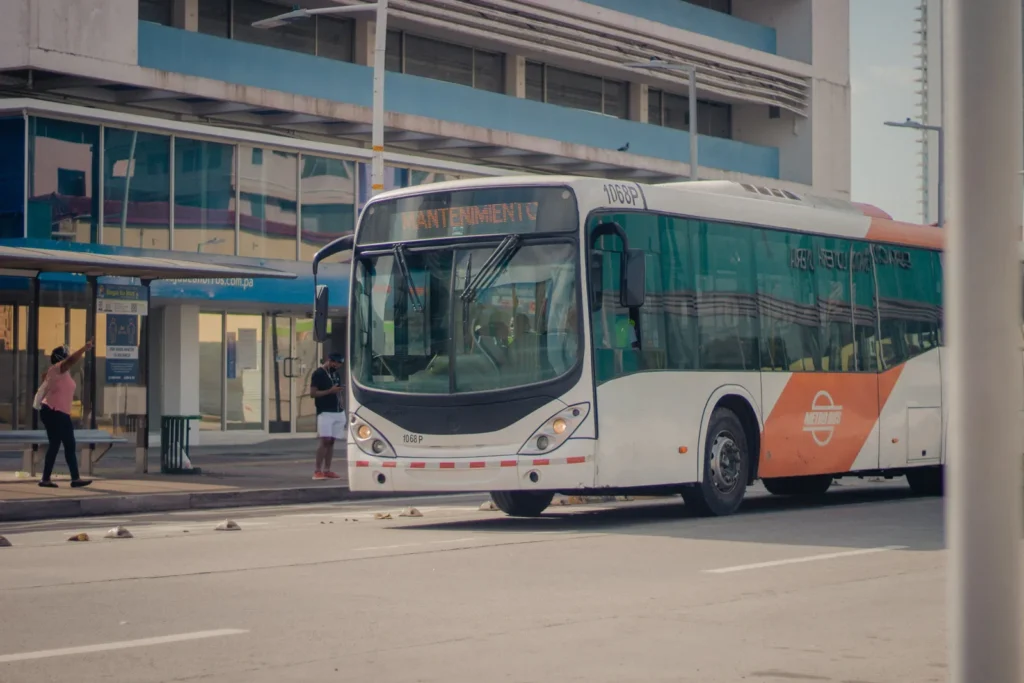
Generic city-bus context photograph outside Saudi Arabia; it does not show a Jeddah bus, route or stop. Photo: Guillermo Quiñones / Pexels, used under the Pexels licence.