
A journey from Jeddah to Rabigh needs a more precise destination than the word “Rabigh.” You may be visiting family in the town, checking into accommodation before work, attending a meeting at an industrial site, or travelling to another location within the wider governorate. Each ends differently, particularly where a host controls access.
The most useful preparation is to establish who is receiving you and where their responsibility begins. A driver can bring you towards a named address; a company host decides how a visitor enters its premises. This guide explains how to put those two arrangements together without confusing a road booking with permission to enter a workplace, residence or port.
Identify which Rabigh destination you mean
Saudipedia’s Rabigh entry describes a coastal governorate north of Jeddah with industrial activity, towns and communities. It also places King Abdullah Economic City within the governorate. That geography is the reason a broad regional label can be misleading in a journey request. A booking to a particular KAEC venue is different from a booking to Rabigh town or an industrial gate.
Start with the address on the invitation, accommodation reservation or host’s instructions. Ask for a shared map location and compare it with the written address. If they point to different entrances or premises, resolve the difference before requesting the journey. A familiar company name is not necessarily the name a driver needs for the actual handover.
For a KAEC destination, use our guide to naming the actual KAEC venue. Do not change the destination to “Rabigh” simply because both sit within the same governorate. Keep the official address and the host’s meeting instructions together so the booking remains tied to the place you actually need.
Choose the first endpoint: accommodation or host
If you are arriving internationally at Jeddah Airport, decide whether you should first reach accommodation or go directly to the host. A room gives you somewhere to leave bags and prepare for a meeting. A direct site arrival may fit a confirmed invitation, but only if the host knows about your arrival and can receive you under the relevant arrangements.
Do not make the first day depend on an informal promise that “someone will be around.” Ask for a named contact and an agreed meeting place. If that cannot be confirmed, a suitable accommodation stage may be easier to manage. Check reception arrangements too, particularly if your arrival falls outside normal room availability.
Accommodation first
This design separates the regional approach from the visit. The first car journey ends where you stay, and another movement takes you to the host when you are ready. It also keeps international luggage away from a workplace visit where bag storage may not be available. Ask the accommodation about storage if the room is not yet ready.
Use the actual property name and entrance for the arrival request. If a company has arranged accommodation, confirm whether its transport arrangements begin there or at the airport. Do not duplicate a company-supplied journey simply because the hotel and flight were booked by different people. Find out which stages are already covered before buying another.
Host first
If you need to go directly to a meeting or site, obtain confirmation that the host can accommodate the arrival sequence. Give the flight details and ask what happens if the timing changes. The host should explain where you report, who meets you and what you do if you arrive outside the agreed arrangement.
Ask where your bags can go and whether the vehicle is expected to stop outside or enter. Do not assume either is possible. A visitor may be required to continue with a host-supplied vehicle or another internal arrangement. If so, identify that handover clearly and arrange the road booking only to the point it can legitimately serve.
Industrial admission belongs to the host
Rabigh includes major industrial businesses. For example, Petro Rabigh’s official contact page identifies the company and its Rabigh contact channels. Use a company’s own channels to verify an invitation or reach the relevant team. A general contact address is not proof of a booked visitor appointment or access through any specific gate.
Ask the person inviting you for the current visitor procedure. What identification is required? Is visitor registration completed in advance? Which entrance is assigned? Must a company representative meet you? Are there instructions for the driver or vehicle? The answer needs to come from the host, not from a travel article describing the region.
Keep visitor approval separate from vehicle access
Your personal invitation may not authorise the car or driver to enter. If the road vehicle must remain outside, arrange an appropriate passenger handover with the host. If vehicle entry is proposed, ask the host what information and approval it requires. Do not send unnecessary personal documents through unrelated booking channels or assume the driver can complete site registration on arrival.
Explain any vehicle restrictions to the transport provider before confirming the journey. A gate may have a different stopping or waiting arrangement from a hotel entrance. Ask where the driver can legally unload and where the group should meet afterwards. The provider can assess its road service; the host controls the premises and internal procedures.
Do not substitute the company’s headquarters pin
A company may have offices, production premises, visitor reception and accommodation at different locations. The most prominent search result may not be your destination. Use the actual invitation and ask the host to verify the selected pin. If the instructions name a gate, include that identifier rather than leaving the driver to choose among entrances.
Check the return meeting place independently. It may differ from the arrival gate or reception. A vague “same place” can become confusing if the host moved you internally during the visit. Save the agreed return location and the person who can help you reach it. That is especially useful when a colleague made the original invitation.
A family visit has its own handover questions
For a residential destination, ask the family host for the exact building, entrance and any relevant access instructions. A street address may need an apartment or compound entrance to be useful. Confirm whether the vehicle can reach the door, where bags are unloaded and whether the host will be there when you arrive.
Keep the information appropriate to the journey. The driver needs a clear destination and a practical contact, not a detailed family itinerary. Avoid publishing a private address in a public message or sharing documents that are not needed. Use the booking provider’s appropriate channel for the necessary details.
Confirm the sleeping arrangement before the arrival
If some relatives stay with family and others use a hotel, identify both endpoints and decide how the party splits. Do not assume the same transfer can make additional drops without an agreed itinerary. Each drop changes the road plan, luggage handling and arrival responsibilities. Seek a proposal covering the actual arrangement rather than adding addresses late.
If everyone reunites for an outing later, keep that as another movement. The international arrival is primarily about reaching the right accommodation and handing over the bags. Trying to include a family visit, a room check-in and several errands can make the initial plan difficult to assess. Settle the essential arrival first.
Build the road request from the receiving arrangement
Once the host or accommodation has confirmed the endpoint, give the provider your actual pickup place, date, passengers and luggage. For an airport arrival, include the flight and confirm the meeting instructions relevant to it. For a city departure, identify the accommodation entrance or other agreed collection point. The route should begin where the party actually assembles.
Our hotel-arrival guide explains the purpose of a clear first destination. For Rabigh, extend that reasoning by naming the host handover too. A regional journey is not complete simply because the map reaches the town. It is complete when the agreed service reaches the endpoint stated in your confirmation.
This article does not confirm on-demand availability or a fixed Jeddah–Rabigh duration. Request a proposal for the particular journey and review what it includes. If the visit has a reporting deadline, share that with the provider so the plan can be assessed. Do not infer a guaranteed arrival from a general map estimate.
Choose the vehicle using the actual passenger and bag list
A business visitor may carry fewer cases than a family coming for a longer stay, but equipment can change the space requirement. Describe every bulky item and ask whether it can be carried under the provider’s conditions. A vehicle class that fits the seat count is not necessarily suitable for large cases, tools or awkward equipment.
Our vehicle class article helps interpret the choices shown. Review the stated capacity and confirm any particular access or child-seat need. If an employer is buying the journey, ensure the person completing the booking has the real party details rather than selecting a class from a previous colleague’s trip.
Keep passenger travel separate from freight
If you are visiting a workplace with materials or equipment, ask whether those items belong in passenger transport at all. Do not assume an industrial destination makes a passenger car a delivery service. Tell the provider what you propose to carry and follow the relevant supplier, host and carrier requirements. Arrange an appropriate alternative if it cannot be accommodated.
When the host supplies equipment on site, verify that arrangement before bringing additional items. It may reduce baggage, but do not omit something needed simply because another traveller said it was available previously. The host’s current instructions are the right basis for the visit, while the car provider assesses what the road vehicle carries.
Set boundaries for a meeting that may run late
Ask whether you need a point-to-point return at an agreed pickup time or a separately quoted waiting arrangement. A meeting of uncertain length can make a fixed return awkward. That does not mean the arrival driver automatically waits. Discuss the choice before confirming, and read the scope and change conditions in the proposal.
If the host controls your release from the premises, ask how you will know when you can leave and reach the pickup point. Arrange an appropriate communication sequence. A driver outside the gate may not be able to contact an internal reception or enter to find you. Nominate a person in the party who can provide the necessary update.
Do not build the return around an optimistic meeting finish
If you have a flight from Jeddah after the visit, work from the airline’s actual reporting requirements and a road itinerary assessment. Consider whether ending the visit earlier or staying in Jeddah afterwards is a more manageable design. A calendar meeting end is not a promise that you will be outside the gate with all your bags at that moment.
The final-night Jeddah guide can help if you choose to separate the regional return from the flight home. That may change where the Rabigh journey ends: a city accommodation address rather than the airport. Check the entire departure sequence before buying the last leg.
A fictional host handover with two addresses
Imagine a fictional engineer visiting a Rabigh company for a meeting. The invitation gives the company name, while a colleague sends a hotel pin. The engineer initially forwards both without explanation. The provider cannot tell whether the first journey should end at the meeting or the room, and the host has not confirmed visitor reception.
The engineer asks the host to define the sequence. They agree that the first road journey ends at accommodation, the meeting begins from a confirmed visitor point on another date, and the return from the premises uses a different agreed gate. The engineer sends each address with its purpose instead of treating them as alternatives.
This example is fictional and does not describe any company’s procedure. Its practical lesson is that a name, a room and an invitation can still leave the handover unresolved. Asking who receives you at each endpoint produces a clearer plan than sending more map pins without explaining what they represent.
Read proposals for missing responsibilities
For each ground stage, check who provides it, where it starts and ends, and what is included. Mark any company-supplied movement separately from any privately purchased one. If someone else is paying, confirm who may request changes and whom the provider contacts. A traveller should not have to guess whether the employer or family organiser has already changed the journey.
Compare current quotations using their actual scope. One might end at accommodation, another at a permitted visitor handover, and a third include separately agreed waiting. Those are not like-for-like services. A lower headline figure is not useful if it leaves a required journey or host-controlled transition unanswered.
Keep payment and reservation records in the relevant booking channel. Avoid creating duplicate journeys while several people are organising the visit. Before buying, state which stages remain unbooked and which are confirmed. That is a simple way to prevent a host’s transport plan and your own arrangements from overlapping.
Check the day before travel
Confirm that the host expects you, the chosen endpoint remains correct and any visitor instructions are current. Check the flight and accommodation details if relevant. If a gate or appointment changes, update the road provider with the revised location and seek confirmation that the booking reflects it. Editing your personal itinerary alone does not update the service.
Give the travellers the same final instructions. For a family split across accommodation, make sure each subgroup knows its destination. For a workplace visit, keep host procedures with the person who will present them. The handover should not depend on a remote organiser answering a phone just as the car reaches the entrance.
Questions before a Rabigh road journey
Is KAEC the same destination as Rabigh town?
No. Use the actual venue or accommodation you need. The wider governorate contains different destinations; a regional label does not identify the correct entrance. Check the address with the host and use it consistently in the journey request.
Does a booking to a company guarantee site entry?
No. The host’s visitor and vehicle access arrangements are separate from the road service. Obtain the relevant approval and reporting instructions directly. If the car cannot enter, identify an appropriate authorised handover before booking.
Can the driver wait until the meeting ends?
Ask for that specific arrangement and rely on the confirmed scope. An ordinary arrival journey does not imply indefinite waiting. If the finish is uncertain, discuss an appropriate return design and the procedure for communicating a change.
Request the journey to the right receiving point
Use the Jeddah Cabs route planner for the actual addresses and review the available results. Seek confirmation for regional travel, additional endpoints or any special arrangement before relying on it. Give the passenger and bag details along with the host’s practical handover instructions where relevant.
A good Rabigh plan identifies the town or site, the person receiving you and the point where the road service ends. Once those are clear, accommodation, vehicle choice and the return become easier to arrange. Precision at the destination does more for the journey than treating the whole governorate as a single pin.
Official geographic and company contact sources checked 27 September 2026. Visitor procedures, road arrangements and availability require current confirmation from the host and relevant provider.
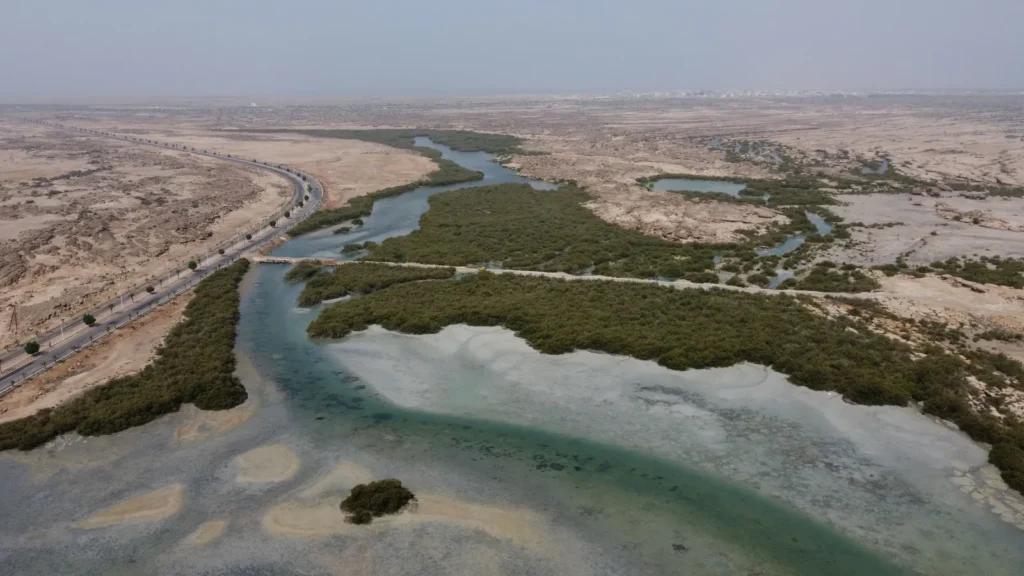
Saudi coastal-road context photograph; it does not show Rabigh or an industrial site entrance. Photo: Asad Ansari / Pexels, used under the Pexels licence.