

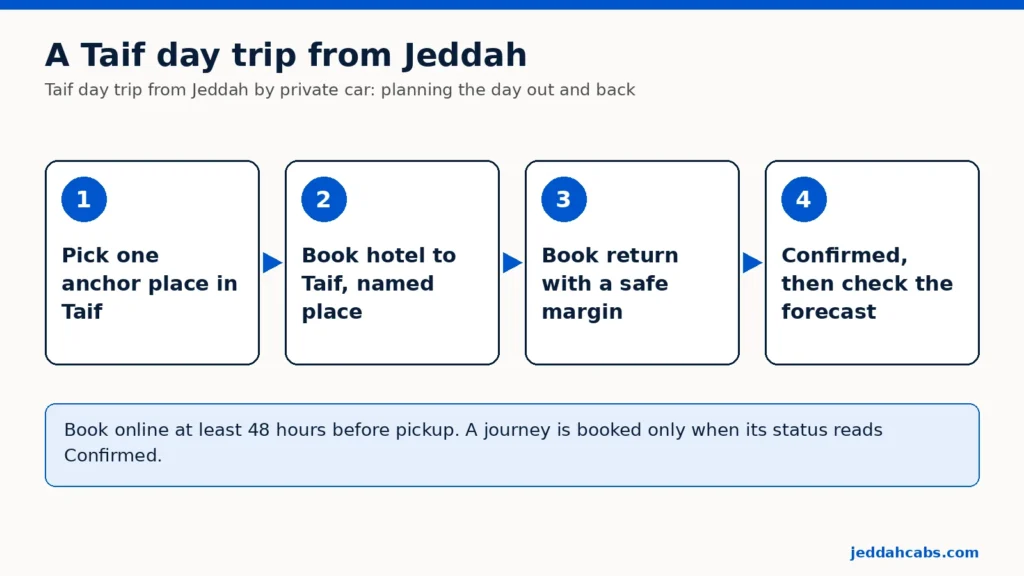
A Taif day trip from Jeddah by private car is possible, but it is a long day, and it works only when it is built as two booked journeys: one from your Jeddah hotel up to a single named place in Taif, and one back down from a named place at a time you set in advance. On live route checks the road distance between the airport and the InterContinental in Taif was about 197 km, and from Taif back to the Jeddah Hilton about 202 km, so you are committing to roughly 400 km of mountain and highway driving around a few hours in the city. Choose one main thing to do in Taif, give it most of the day, and treat everything else as optional.
This guide is for visitors based in Jeddah who have one free day and want to see Taif without moving hotels. It covers whether a day trip is the right choice at all, how to choose the place that anchors the day, how the outward and return journeys fit together, what the mountain road and the season mean for the plan, and how the booking rules apply. If you are staying overnight in Taif instead, the related guides linked below are a better starting point.
Is a Taif day trip from Jeddah the right choice?
For some trips it is the obvious answer. You are staying in Jeddah for the whole holiday, you have one free day, and you would rather see the mountains briefly than not at all. For others, a night in Taif gives a far better day for a similar amount of driving.
| Plan | Journeys you book | Time in Taif | Best for |
|---|---|---|---|
| Day trip | Jeddah hotel to Taif; Taif back to Jeddah hotel | A few hours, one main place | One free day, no wish to move hotels |
| One night in Taif | Jeddah hotel to Taif hotel; Taif hotel back to Jeddah hotel next day | An afternoon, an evening and a morning | Seeing Taif at a gentler pace, cooler evening air |
| Two or more nights | As above, days apart, with outings from the Taif hotel | Full days for Al Hada, Al Shafa or the city | Mountain outings as a main part of the trip |
The day trip saves a hotel move and the packing that goes with it. The cost is that the driving is concentrated into one day and the time in Taif is short. If you are unsure, ask who is travelling. Healthy adults who enjoy a long day often find the trip worthwhile. Young children, older relatives and anyone who feels unwell on winding roads usually do better with an overnight.
If you already plan to stay in Taif and continue somewhere else, do not book a day trip return you will not use. The guide on ordering a Taif and Jeddah itinerary shows how to arrange the stays so that no journey goes back on itself.
Jeddah to Taif and back in a day: what the road involves
Doing Taif and back in a day means two long road journeys on the same date. Saudipedia’s entry on Taif Governorate places Taif at about 1,800 metres, so the road climbs the whole way from the coast. We do not quote drive times, because they vary with traffic, the time of day and the route the driver takes.
There is more than one road up the escarpment. Saudipedia’s page on Aqabat al-Kurr, the Al Hada road, notes three things worth knowing for a day trip:
- trucks and large buses are prohibited on it throughout the year, so a group in a coach should not expect that route;
- it is often closed temporarily when fog forms or in rain;
- it reaches about 2,177 metres at its highest point.
A closure on the day may mean a different route and a longer journey. That is one reason to plan the return with a generous margin rather than to the minute.
If anyone in your party is not Muslim
Makkah lies between Jeddah and Taif. Saudi law prohibits non-Muslims from entering Makkah; the Saudi Press Agency, reporting a Makkah Police statement, referred to “the laws that prohibit entry to Makkah for non-Muslims”. If anyone in your party is not Muslim, say so in the booking notes for both journeys, so the driver plans a lawful route up and back. This is a practical routing point, and the booking team can advise if you are unsure.
Choose one anchor place for a one-day Taif visit
A one-day Taif visit goes wrong most often when it tries to cover everything. Taif is spread out, and its best-known areas lie in different directions from the city. Pick the one place that justifies the drive, make it the destination of the outward journey, and plan the day around it.
Al Hada
Al Hada lies at the top of the mountain road that descends from Taif Governorate towards Makkah. Saudipedia’s page on Jabal Kara says cable cars run for about 4.2 km between the tourist village of al-Kurr in Wadi an-Nu’man and al-Hada Park. The cable car has its own operator, tickets and hours, which the Jeddah Cabs guide to the Al Hada cable car from Taif covers in detail. Check them before you set the car times.
Al Shafa
Saudipedia lists Al Shafa and Al Hada as the mountain resort areas of the governorate. Al Shafa is a wide highland area rather than a single sight, so it needs a named farm, park or café as the destination. The guide to an Al Shafa day out built around one anchor place explains why.
Taif city
For a day focused on the city itself, Saudipedia names Shubra Palace, built in 1905 and now a museum, and Al-Ruddaf Park, one of the Kingdom’s largest recreational areas. Souq Okaz, revived in 2007, is known for its cultural festival, so check whether anything is running on your date before you make it the anchor.
Rose farms in season
Saudipedia’s page on the Rose Season says the season begins in spring with the harvest, that the festival runs for ten to fourteen days, and that Al-Ruddaf Park is its main venue. Rose farms are working farms. Confirm with the farm that visitors are welcome on your date before you build a day trip around one; the guide to planning a rose visit around confirmed access sets out what to check.
How the two journeys fit together
A booked journey has one pickup place, one destination, a date and a time. The pickup and destination must differ, so a day trip is always two separate journeys.
The outward journey runs from your Jeddah hotel to the anchor place. Enter the place by name and check the route summary, because a broad name such as “Al Hada” or “Taif” can resolve to somewhere other than the spot you mean. Put any detail about the exact meeting point in the booking notes.
The return journey runs from wherever you will be at the end of the visit back to your Jeddah hotel. That may be the same place, or it may be somewhere else, such as the lower cable car station or a restaurant in the city. Set its time now, before you travel.
We do not offer a car that waits with you all day. If you want to move between two places in Taif, for example from Shubra Palace to a café in Al Hada, that is a third journey, booked like the others. Every journey has a minimum booking value equivalent to £40, so a short hop inside Taif costs at least that.
Adding stops on the way
Up to eight stops can be added to a journey, in the order you will reach them. A stop is a short pause, not a sightseeing session with the car waiting. A quick look at a roadside viewpoint on the way up can work as a stop. The guide to adding a viewpoint stop on the road to Taif looks at when a stop makes sense and when it does not.
Setting the times for the day
A Taif day trip from Jeddah has three fixed points: when you leave Jeddah, how long you want in Taif, and when you want to be back. Work from the middle.
- Decide how long you want at the anchor place. A cable car ride and a meal is a different length from a slow afternoon at a rose farm.
- Set the outward pickup early enough to arrive with that time available, plus a margin. Pickup times are entered in Saudi local time.
- Set the return pickup at the end of that time, with some slack for queues, a late lunch or a slow walk back to the meeting point.
- Look at the light. Many visitors prefer to drive the mountain road in daylight and to see the views on the way. That is a preference, not a rule, but it shapes an early start.
If you want to stay longer on the day, a new pickup time can be requested in your account before the original time. An approved change carries a £5 rescheduling fee, converted into your booking currency and added to the cash paid to the driver. A request made on the day may not be approved in time, so set the return generously from the start.
Weather, altitude and what to take
Saudipedia gives Taif’s summer averages as not exceeding thirty degrees, with winters of roughly 3 to 18 degrees. That makes Taif pleasant when Jeddah is hot, and surprisingly cold on winter evenings. Pack for two climates:
- a warm layer, even in spring or autumn, for time at the higher viewpoints;
- water, sun protection and comfortable shoes;
- a small bag you can carry all day, since the car is not a place to leave things while you explore;
- a charged phone and a power bank, so you can share a live location with the driver at the return pickup;
- any medicines anyone needs, and something for travel sickness if the road bothers someone in your party.
Fog can arrive quickly at altitude. If the forecast for the escarpment looks poor, consider moving the trip to another day rather than spending hours in the car for little view.
Choosing the vehicle for a long day
On a day trip, the party travels with day bags rather than suitcases, so space is less of an issue than comfort. Enter everyone in the search, including children and infants, and the planner shows only classes that pass the capacity check.
| Party | Classes to compare |
|---|---|
| One to three adults | Economy, or Business and Executive for more comfort on a long drive |
| Four adults | Business and Executive, or a Premium SUV if anyone is tall or carrying bulky bags |
| Five or six people | Hyundai Staria or a Premium SUV |
| Seven people | GMC Yukon XL or a Hyundai H1 family van |
| Eight to eleven | Toyota Hiace |
Each class is shown with an example model “or similar”. Add infant seats, child seats or boosters in the search so they are confirmed for the vehicle, and add a wheelchair requirement the same way. For a larger group in a coach, remember the Al Hada road restriction on large buses and ask the booking team what is possible.
Worked example: Nadia and Salma’s day in Taif
Nadia Hussain is visiting Jeddah from Birmingham with her mother, Salma, who is seventy. They are staying five nights at a hotel near the Corniche and have one free day. Salma remembers the Taif roses from a trip decades ago and would like to see the city again.
Nadia’s first idea is to fit in Al Hada, Shubra Palace and a rose farm. When she writes it down as journeys, it becomes five bookings and a very long day for her mother. She simplifies.
- Anchor place: Shubra Palace, which Salma most wants to see. Nadia checks its opening arrangements for their date before booking anything.
- Journey 1: hotel to Shubra Palace, with an early pickup and a note that Salma walks slowly and would like a short comfort stop on the way. Nadia adds the stop in journey order.
- Journey 2: from a restaurant a short walk from the palace back to the Jeddah hotel, timed to leave a relaxed lunch after the visit.
Two women with handbags fit easily in Economy, but Nadia chooses Business and Executive for the extra comfort on a long drive. She books both journeys more than 48 hours ahead and waits for each to read Confirmed. The checkout shows the deposit paid online and the cash due to each driver, which she notes in her phone.
On the day, fog is forecast over the escarpment in the late afternoon. Because the return was set with a margin, they leave the restaurant as planned and are back in Jeddah for the evening.
Booking rules for a Taif day trip
Notice and confirmation
Online bookings need at least 48 hours’ notice before each pickup. Payment secures a provisional request; the booking team updates the status within 1 to 12 hours, and each journey is booked only when it reads Confirmed. Book both journeys together, so you are never in Taif with the outward trip confirmed and the return still uncertain.
Deposit and cash
Jeddah Cabs may take only a deposit online, with the balance paid in cash to the driver. The checkout shows both amounts, and your account shows the cash due for each journey. The cash is a separate payment made directly to the driver.
Changes and cancellations
Only the pickup time can be changed online. A new anchor place, a different pickup point, more passengers or a different vehicle need the booking team, or a new booking plus a cancellation request. Bookings are subject to our cancellation terms (free cancellation with a full refund up to 48 hours before pickup; inside 48 hours the deposit element of the price is kept) if you cancel. If we or the transport partner cancel, or cannot supply the journey and you do not accept a suitable alternative, you receive a full refund for the affected journey. The network cancellation and refund policy sets this out.
When a night in Taif is the better answer
Sometimes the honest conclusion is that a Taif day trip from Jeddah is too much for your party. Signs to look for:
- you want two of Al Hada, Al Shafa and the city, not one;
- someone in the party tires quickly or dislikes winding roads;
- the only free day falls in a season of fog or heavy rain;
- you want to see Taif in the cool of the evening.
In those cases, one night in a Taif hotel turns a rushed day into an unhurried one, for a similar amount of driving. The guide to choosing a Taif base before an outing helps you pick the hotel.
Checklist before you book
- Confirm a day trip suits everyone travelling, or choose a night in Taif instead.
- Pick one anchor place and check its opening, tickets or access for your date.
- Name the outward destination exactly and check the route summary.
- Decide where you will be at the end of the visit and name that as the return pickup.
- Set both times in Saudi local time, with a generous margin on the return.
- Note in the booking if anyone travelling is not Muslim.
- Enter the real party and add any child seats or wheelchair requirement.
- Book both journeys at least 48 hours ahead and wait for each to read Confirmed.
- Pack a warm layer, water and a charged phone, and check the mountain forecast the evening before.
When you have chosen the place that makes the drive worthwhile, enter both journeys in the Jeddah Cabs transfer finder and book your day in Taif with the ride home already arranged.