
For a first scuba experience in Jeddah, decide whether you want to try the activity or begin learning towards a qualification. Those are different purchases. A supervised introduction can help you discover how you feel about diving; a certification course involves a learning commitment beyond that first experience. Choose the outcome with the dive provider before arranging the journey to its meeting place.
The distinction matters particularly on a short visit. An attractive underwater photograph says little about the teaching, preparation or course stages attached to a booking. A holiday afternoon and a plan to qualify for future trips deserve different conversations. This guide helps a new participant ask those questions without treating a transfer booking as permission to dive.
Start with the result you actually want
Complete this sentence before searching for an activity: “At the end of this booking, I would like to…” If the answer is “find out whether I enjoy it”, investigate a supervised introductory experience. If it is “work towards a recognised diving qualification”, investigate a course and its complete requirements. Avoid using the word “course” loosely when comparing offers.
PADI describes Discover Scuba Diving as an opportunity to try diving before deciding about Open Water Diver certification. Its description says a PADI professional provides equipment and explains the basics. That introduction is not a promise that every participant will receive a diving qualification or be accepted for another programme.
The current PADI Open Water Diver page distinguishes eLearning from the later training steps arranged with a dive centre. Purchasing online learning should therefore not be mistaken for purchasing every part of the complete course. Ask the centre to describe the proposed learning sequence, assessment and total purchase in your own circumstances.
Three goals that deserve separate answers
A curious first-timer may want a supported introduction without committing to further training. A visitor who already hopes to dive on future holidays may want to understand the certification pathway. Someone accompanying an experienced diver may mainly want to join the outing socially. These people can travel together while requiring entirely different activity arrangements.
There is nothing wrong with changing your goal after speaking to a professional. There is a problem with paying for one result while imagining another. Ask what the booking is called, what it includes and what successful completion would actually mean. Keep the provider’s explanation with the reservation rather than relying on a friend’s description of a previous trip.
Compare teaching before comparing underwater scenery
A beginner often cannot judge a site from a photograph, but can judge whether the organiser answers basic teaching questions clearly. Who handles the introduction? How will the learning be explained? When can you ask questions? How does the provider decide which parts of the proposed experience are appropriate? Those answers matter more than a dramatic promotional image.
Tell the provider honestly that you have not completed a diving qualification. Do not select a certified-diver outing because its price looks attractive and expect staff to turn it into a beginner lesson on arrival. A named experience should match your actual experience level and the provider’s acceptance process. The transport company cannot make that decision for it.
PADI Travel has a Jeddah introductory-experience listing associated with Dive Point Jeddah. That is evidence of a described local offering, not confirmation of a place on your preferred date. Check the operator, current session details and acceptance directly; a date displayed on an older listing is not a live reservation.
Ask how understanding will be checked
For any unfamiliar activity, being able to repeat a booking reference is different from understanding the explanation. Tell the provider your preferred teaching language and ask how it accommodates questions. A bilingual travel companion should not be silently appointed to interpret important instruction. Establish the actual teaching arrangement with the organiser before you commit.
Ask what happens if you need an explanation repeated or are uncomfortable progressing. This is a question about the participant experience, not a request for a guarantee that everything will go ahead. You should understand who decides the next step and how you can communicate a concern. Avoid a reservation whose descriptions leave those responsibilities unclear.
Keep participation screening with qualified people
Booking a ride to a dive centre does not establish eligibility to take part. Follow the provider’s current screening process and seek appropriately qualified advice where that process requires it. If you have a health question, medication question or concern about your circumstances, raise it through that process before buying a non-refundable activity or arranging connected journeys.
This guide does not decide whether diving is suitable for you, provide underwater instructions or set a medical standard. An online article cannot assess an individual participant. Explain your circumstances accurately rather than trying to guess which answer will secure a place. The organiser needs the relevant information through its own appropriate channels.
Also tell the provider about onward flying and other activities when discussing the sequence of your visit. Obtain the applicable advice from the qualified provider and relevant professional sources. Do not build a same-day itinerary around a numerical interval copied from an unrelated holiday blog. The right plan must reflect what you will actually undertake.
Children and accompanying adults
If a child is interested, ask the specific organiser about its accepted programme, current participation requirements and adult arrangements. Do not assume an adult booking can be extended to a child by adding another passenger to the car. A family travel plan and an activity acceptance decision are separate, even when they happen on the same afternoon.
Ask who is responsible for a child who does not participate, and whether there is an accepted place for them to remain. A centre, marina or boat should not be assumed to offer supervision for spectators. Where that arrangement is unresolved, split the family activities or choose an alternative rather than improvising care on arrival.
Understand the whole course before choosing certification
If your objective is a qualification, ask for a clear description of the complete course you are considering. What preparation happens before you attend? What must happen with the centre? How is completion assessed and recorded? Which parts are included in the quoted price? Ask these questions together so the answer describes an entire pathway rather than a single attractive component.
Learning time should be treated as part of the trip, not squeezed between unrelated reservations. A visitor may have free afternoons without having the attention or continuity needed for the proposed programme. Discuss your actual available dates and commitments with the centre. Let it explain what it can responsibly arrange rather than promising yourself completion by departure.
Do not assume that finishing a preparation module makes you qualified to join a different outing. Keep the distinction between having bought material, having studied material and having completed the accepted programme. Ask the centre how it records each stage. If you later contact another organiser, describe the record accurately instead of saying simply that you have “done the course”.
Starting in Jeddah and continuing elsewhere
Some visitors want to begin learning during a Saudi stay and finish on another trip. Before buying on that basis, ask both proposed providers whether they accept that arrangement, what documentation they require and which costs would apply. Do not assume a partial booking transfers automatically, or that money paid to one centre settles another centre’s services.
Write down the agreed sequence and the person who can answer questions about it. If the second provider has not confirmed acceptance, treat continuation as unresolved. You can still investigate the first experience without pretending the whole qualification pathway is secured. A modest booking with a clear outcome is better understood than a complicated plan built on assumptions.
Read the price as a learning purchase
Two amounts can look comparable while paying for different things. One may describe an introductory activity; another may cover preparation material but exclude later centre training. Compare the actual purchase in words before comparing the totals. Ask for a breakdown that identifies the participant experience, any learning material, equipment arrangements and other separately charged components.
For a course, ask whether the quotation covers all the stages discussed, the relevant records and any additional attendance that might become necessary. Do not assume repeat sessions, unfinished stages or a change of date are free. The provider’s written terms should explain how these situations are handled; this article cannot supply a refund or completion entitlement.
For a trial, ask which equipment is supplied and what personal items the organiser wants you to bring. Avoid buying specialist kit merely because you expect to need it. Let the provider explain its arrangements first. If you already own equipment, ask whether and how it may be used; possession does not itself establish that it is appropriate for the session.
Keep activity costs separate from passenger transport
A ground journey does not include an instructor, boat place, training material, admission or equipment rental unless those items are explicitly part of a separately confirmed purchase. The guide to tour and hotel-pickup inclusions helps separate those responsibilities. Check the accepted activity first, then request the passenger journey that serves it.
Do not compare a centre’s package including several components with a transfer-only amount and call one cheaper. List what each seller is providing. That comparison exposes missing items without inventing a universal market price. It also helps you decide which organisation should answer a question when a date, lesson or meeting point changes.
Plan a first experience without turning it into an endurance day
Leave enough attention for the activity itself. A heavily packed sightseeing day can turn a new learning experience into another deadline to rush through. Discuss the proposed session with the organiser before attaching dinner reservations or a distant outing. The important issue is whether your commitments leave room for the process the provider actually describes.
Ask where the briefing begins, where personal belongings can be kept and which practical facilities are available to participants. Do not assume a marina’s public facilities are included in an operator’s booking. Questions about changing, storage or the point where you meet staff are ordinary preparation questions; they should be answered by the organisation receiving you.
Where one person participates and another does not, agree a separate plan for the companion. They might choose an independently arranged land activity or remain only where the organiser explicitly accepts spectators. Do not promise them boat access, a comfortable waiting room or a meal merely because the participant has a confirmed place.
A fictional couple choosing different outcomes
Imagine Nadia wants to discover whether she enjoys a supervised first experience, while Karim hopes to start working towards certification. This is a fictional example. They initially find one attractive listing and assume they should buy matching places. After asking about outcomes, they realise they need separate explanations of the trial and the course pathway.
Their useful decision is not whether they can share a car. It is whether the provider can accept their different goals on a workable schedule. They might arrange different activity dates or choose the same introductory experience first. Either way, the shared passenger journey follows the accepted arrangement; it does not decide what either person is entitled to undertake.
Know what you want to remember after the experience
For an introductory participant, a useful result may be understanding whether you enjoy the learning environment and want to investigate further. Ask where you can obtain the organiser’s explanation of your completed experience afterwards. Keep that information accurately described. A souvenir photograph, attendance acknowledgement and qualification record are different things, even if all three look impressive on a phone.
For a course participant, ask how questions raised during preparation will reach the person teaching you. Reading ahead can reveal unfamiliar terms or unclear expectations. Keep a short list for the provider instead of searching for instructions from unverified strangers. Your role is to arrive ready to ask; the qualified teacher’s role is to explain the applicable programme.
Think about the kind of future trip you imagine. Someone interested mainly in seeing coastal places may decide to investigate a different activity with an appropriate organiser. Someone who enjoys structured learning may want a fuller course conversation. Neither conclusion is a failure. The first experience should inform the next decision rather than force a purchase you had not intended.
Do not purchase a photographic result
If photographs are important to you, ask what the organiser actually permits or supplies. Do not assume a beginner can bring unfamiliar camera equipment into the session, or that a promotional image describes the animals or scenery you will encounter. Any photography arrangement must fit the provider’s accepted activity and instruction; it should not become a condition you pressure staff to fulfil.
You may also decide to keep the first experience private. Tell the organiser if you have questions about images, consent or how a supplied photograph would be shared. Those are booking questions for the provider, not reasons to delay the briefing or distract a participant. Settle them beforehand so attention during the session stays with the qualified person’s directions.
Make changes before the connected bookings drift apart
A change from an introductory experience to a course can alter preparation, attendance and cost. A postponement can also move the relevant centre appointment without automatically changing your transport. When a plan changes, ask what the revised activity actually is, then review the connected reservations. Do not leave an old pickup serving a session that no longer exists.
If the organiser cannot deliver the proposed activity, request its explanation and the options under your actual booking terms. Avoid treating a different site or programme as equivalent without understanding it. Whether to accept an alternative depends on the goal you identified at the start, the provider’s assessment and the revised purchase, not just the availability of a vehicle.
If you decide not to participate after preparation, communicate that promptly to the appropriate organiser. Discuss the booking outcome through its own terms. Do not feel obliged to continue because you have already paid for a ride. Passenger transport and participation are separate decisions; neither should be used to pressure you into the other.
Arrange the ground journey after the activity is accepted
Use the precise meeting location supplied for your accepted session, including the appropriate entrance and receiving contact. A centre’s shop address may not be the same as its activity meeting place. Ask the organiser which location applies to your booking. Request transport to that location rather than letting an attractive dive-site name become an uncertain destination.
Describe passengers and the belongings that will actually travel. If you are taking bulky personal kit, use the sports equipment journey guide to think through the load. If the centre supplies equipment, do not inflate the luggage description with equipment that never leaves its premises.
Only arrange a return around information the provider can meaningfully confirm. Ask which finish point applies and how a change will be communicated. Avoid assuming that a flexible lesson automatically includes a car waiting indefinitely. The accepted transport booking must explain its own timing and scope, separately from the organiser’s teaching decisions.
If you are planning an already chosen dive outing elsewhere rather than a first learning experience, the Yanbu diving-trip transfer guide covers the operator-to-road handover. These are different tasks: first choose a suitable learning experience; later describe the journey serving the confirmed activity.
The decision to make before paying
You should be able to explain your chosen outcome, the organiser accepting you, the relevant preparation, the complete purchase and the role of any companion. If one of those remains unclear, ask before treating the plan as settled. No scenery photograph or advertised qualification shortcut can replace a clear answer about your own booking.
Once the dive provider has accepted the arrangement, use Jeddah Cabs routes to explore the passenger journey and confirm the requested transport separately. Keep the learning decision with the qualified provider and the road journey with the transport booking. That gives each part of your first experience a clear purpose and responsible contact.
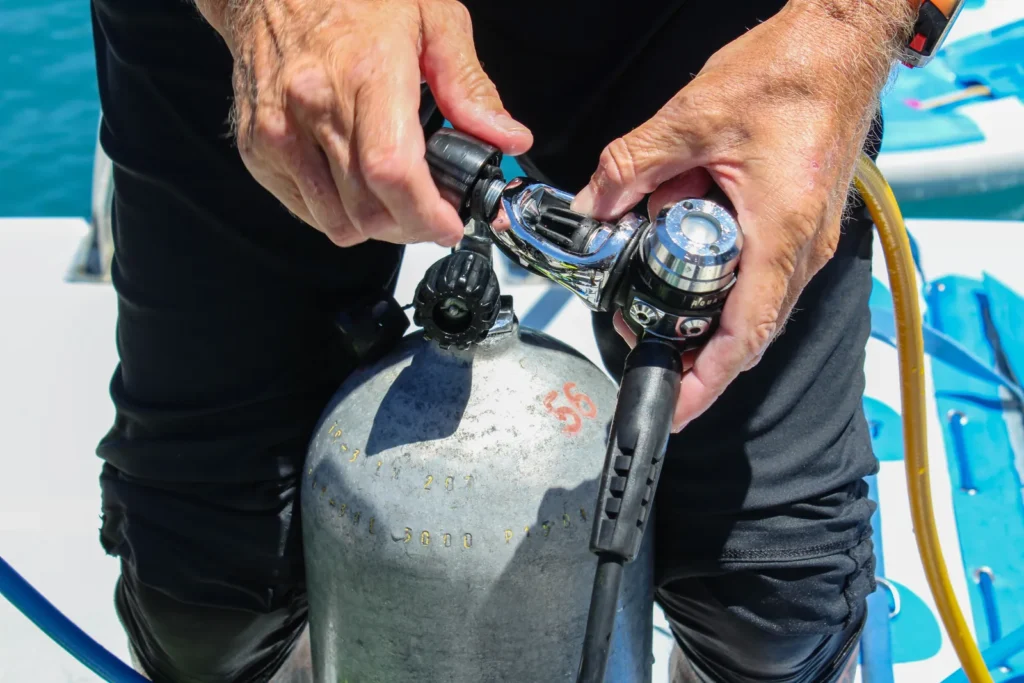
Generic scuba-equipment photograph outside Saudi Arabia; not a Jeddah provider, participant or demonstration of a recommended equipment procedure. Photo: Manuel Enrique Sankitts 🌹 / Pexels, used under the Pexels licence.