
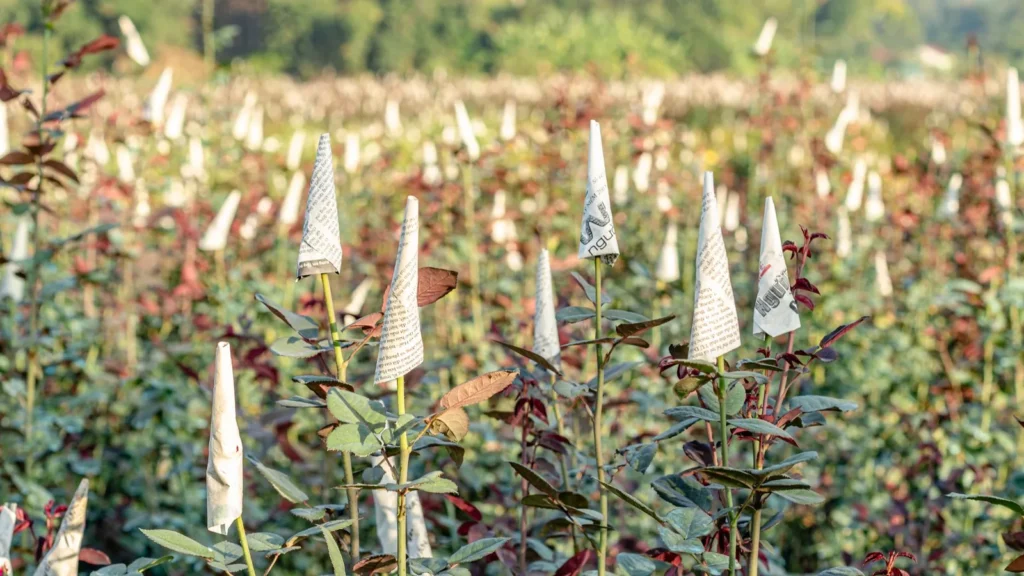
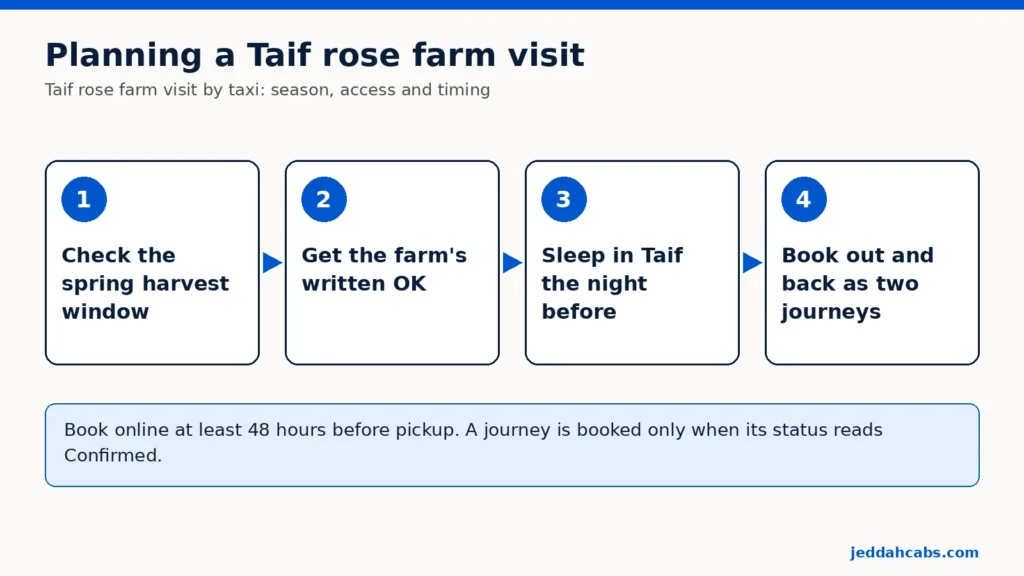
A Taif rose farm visit works best when three things are settled before you book any transport: the dates fall inside the spring harvest, a named farm has agreed to receive you, and you can be there early in the morning, when the picking happens. The taxi’s job is the simple part. It takes you from your hotel to the farm you have confirmed and brings you back at an agreed time. It cannot confirm entry, a demonstration or a tour; those come from the farm.
This guide is for visitors staying in Taif or Jeddah who want to see the rose harvest in person, and for anyone planning around the festival that the city holds in the rose season. It explains what the season is according to official sources, how the harvest window differs from festival dates, how to confirm a farm visit, why the time of day shapes where you should sleep, how to book the journeys, and what to do if the visit falls through.
What the rose season in Taif is
Taif’s roses are not just a local speciality. In 2024, UNESCO added cultural practices related to Taif roses to its Representative List of the Intangible Cultural Heritage of Humanity. UNESCO’s description sets out the year’s pattern:
- from December to February, farmers fertilise and water the land, prune the rose bushes and plant cuttings;
- the harvest takes place in March and lasts thirty-five to forty-five days;
- families and friends pick the roses in the early morning;
- the roses are processed into rose water and essential oil, used in beauty products, traditional medicine, dishes and drinks.
Saudipedia’s page on rose cultivation in the Kingdom gives the picking season as beginning at the end of March and lasting between thirty-five and forty-five days. The two sources describe the same window from slightly different angles: the start moves a little from year to year, and the season runs for five to six weeks.
So the rose season in Taif is spring, with a start around March, and it is short. Outside it, you can still buy rose products and see the mountain areas where roses grow, but you will not see a harvest.
Harvest window and festival dates are not the same thing
This is the most common planning mistake. The harvest is a farming season. The festival is an organised event with its own dates and its own venue, set each year.
The Saudi Press Agency’s reports show how both can move. In 2024, SPA reported that the Taif Rose Festival started at Al-Ruddaf Park on 28 April, organised by the Taif Rose Cooperative Society with Taif Municipality. In 2026, SPA reported that the second Rose and Aromatic Plants Global Forum opened at Taif University on 29 March, running for 11 days.
Different months, different venues, different formats. The lesson for a visitor is to check the current year’s announcement from an official source before building a trip around a festival, and to treat the harvest and the festival as two separate questions:
- Is the harvest likely to be running on my dates? Spring, from around March, for five to six weeks.
- Is there an organised event on my dates, and where? Only the current year’s official announcement can answer that.
If the harvest is what you want to see, a festival is a bonus rather than a requirement.
Where the farms are
“Taif rose farm” is not a destination a driver can use. Saudipedia notes that Taif rose cultivation is concentrated in al-Shafa, al-Hada, Wadi al-Amq, Wadi al-Bunni and Wadi Mehrem. Those are wide areas in the mountains around the city, with many separate farms.
For a booking, you need the farm’s name and an exact location. Ask the farm for a map pin or a written address, type it into the transfer finder, and check that the route summary shows the place you expect. If the pin is on a road rather than a gate, say so in the booking notes and describe what the entrance looks like, if the farm has told you.
Where your hotel is matters too. A farm near Al Shafa is closer to a base on that side of Taif; a farm near Al Hada is closer to the west. The Jeddah Cabs guide to choosing where to stay in Taif compares the bases.
Confirming a Taif rose farm visit before you book transport
A Taif rose farm visit is a visit to someone’s working farm during their busiest weeks. Do not assume a gate will be open because the season is on.
What to ask the farm
Contact the farm, or an organiser the farm works with, and get answers to these in writing:
- Do they receive visitors on your date, and at what time should you arrive?
- What will you see: picking, distillation, a shop, or a combination?
- How long does a visit usually take?
- Where exactly should a car set you down, and where can it collect you?
- Is there a charge, and is it paid to the farm on the day?
- Can children and older relatives manage the ground, and is there shade?
- Whom should you contact on the day if you are delayed?
Keep the two confirmations together
You will end up with two separate confirmations: one from the farm for the visit, one from Jeddah Cabs for the journeys. Keep them side by side and check that the date, time and place match. A transport booking does not include admission, a guide or a demonstration, and the driver cannot arrange them on arrival.
On the day at the farm
A working farm in harvest weeks is a busy place, and a little courtesy makes the visit easier for everyone.
- Send a message when you set off. Tell your farm contact that you have left the hotel, and again if the car is running late.
- Follow the farm’s lead. Walk where you are shown, keep children close to the paths, and do not pick roses unless you are invited to.
- Ask before photographing people. Pickers and families are working; a polite question first is simple good manners.
- Wear sensible shoes. Terraces and farm tracks can be uneven, dusty or damp in the early morning.
- Keep the driver’s details to hand. Once a driver is assigned, the name appears in your account. Save the contact details before you set off, in case your phone signal is patchy.
None of this changes the booking, but it is the part of a Taif rose farm visit that people remember.
Why the morning shapes where you sleep
UNESCO notes that the roses are picked in the early morning. If you want to see picking, not just a shop or a still, you need to be at the farm early.
That has a practical consequence. In our live route checks, King Abdulaziz International Airport in Jeddah to the Taif InterContinental was about 197 km by road, and the Clock Royal Tower in Makkah to the same hotel was about 106 km. A farm in the mountains may be further on. Starting that journey before dawn from Jeddah, then walking round a farm, is a long day for anyone, and a hard one for children or older relatives.
For most people, the better plan is to spend the night before in Taif. Then the farm journey is a short, early run from your hotel, and you are back for breakfast or a rest. If you are arriving from Jeddah Airport, the Jeddah Cabs guide to making your first night in Taif the destination covers that decision, and the page on the transfer from your Jeddah flight to your Taif address covers the journey itself.
Warm clothing helps. The farms are in the mountains, and early mornings there can be cool even in spring.
Taif rose festival by taxi
If you are going to the festival, rather than to a farm, the pattern is similar, with a few differences.
Confirm the venue for this year
As the SPA reports show, the main venue has changed between years. Check the current announcement for the venue’s name and location, then enter that venue in the search. In 2024, SPA also reported that festival activities extended beyond the park to factories, rose farms and markets, so a festival programme may involve more than one place. Book each place you intend to go as a named destination.
Plan the pickup, not just the drop-off
Busy events make the return harder than the arrival. Where a car can wait near a venue is managed on the day, and we cannot promise a particular gate or kerb. Agree a named meeting point in advance, set a return pickup time, and be ready to send the driver a live location from your phone. The same approach applies to any crowded event you reach by taxi.
Allow for crowds and evenings
SPA reported about one million visitors to the 2024 festival. If you go at a busy time, give yourself a generous gap between the end of your visit and the return pickup, and have a plan for children who tire early.
A Taif rose festival by taxi is two journeys: hotel to the venue, then venue back to the hotel, each with its own time.
Farm, festival or shop: choosing what you actually want
Many visitors say “rose farm” when what they want is something else. The table helps you pick.
| What you want | What to confirm first | Best time of day | Transport pattern |
|---|---|---|---|
| To see roses being picked | A named farm that receives visitors on your date | Early morning | Two journeys from a Taif hotel, early out, agreed return |
| To see distillation | A farm or factory that shows the process, and when | As the farm or factory advises | Two journeys, or one stop if the visit is brief and agreed |
| The festival atmosphere | This year’s dates and venue from an official announcement | As the programme shows | Two journeys, with a named meeting point for the return |
| To buy rose water or oil | A shop, market or farm shop and its opening | Daytime | A short stop within another journey, or two journeys |
| Mountain scenery with roses | Nothing ticketed; a named viewpoint or area | Daylight | An outing from Taif with one anchor place |
If your honest answer is the last row, the Jeddah Cabs guide to giving a Taif outing one anchor place is a better starting point than a farm booking. If you only want a brief look on the drive up from Jeddah, the guide to stops on the road to Taif explains what a short stop can include.
Booking the journeys for a rose visit
Once the farm or venue is confirmed, the booking is straightforward.
Two journeys, each with a time
A journey has one pickup place and one destination, and they must be different. So a morning at a farm is two journeys: hotel to farm, farm to hotel. Book the return for the time the farm gave you, plus a margin.
Stops and waiting
You can add up to 8 stops to a journey, in order, which suits a short call at a shop on the way back. A stop is a pause, not an hour’s wait. Each vehicle class has an included waiting allowance, not currently shown on the search results; if you need the car to wait at the farm, ask the booking team to confirm in writing what is included.
Passengers, seats and notes
Count adults, children and infants separately, and add any child seat or wheelchair requirement in the search so it is confirmed for the vehicle. In the notes, give the farm’s name, its contact number if they are happy for you to share it, and the entrance description they gave you.
Rules that apply
Online bookings need at least 48 hours’ notice before pickup, and each journey has a minimum booking value equivalent to £40. Jeddah Cabs may take only a deposit online, with the balance paid in cash to the driver; the checkout shows both amounts. Payment secures a provisional request, updated within 1 to 12 hours, and a journey is booked only when it reads Confirmed.
A worked example: an early start from Taif
Nadia Farooq is visiting Jeddah from Leeds with her mother, Rukhsana, in early April. Rukhsana has wanted to see the Taif roses for years. Nadia contacts a farm near Al Shafa, which agrees to receive them at seven in the morning on a Thursday and tells her a visit usually lasts about an hour. The farm sends a map pin and describes a green gate.
Nadia decides against a pre-dawn start from Jeddah. She books a Jeddah hotel to Taif journey for the Wednesday afternoon, with one night at a Taif hotel. Then she books two short journeys for Thursday: hotel to the farm, and farm back to the hotel, with the return an hour and a half after arrival to give her mother time. In the notes, she writes the farm’s name, the green gate and that her mother walks slowly. The return to Jeddah is booked for Thursday afternoon.
Each booking reads Confirmed well before the trip. On the morning, the driver sets them down at the gate, and they are back at the hotel for breakfast. Had they wanted a second morning in the mountains, staying on rather than going down to Jeddah and back would have been simpler, as the note on avoiding an unnecessary Taif return leg explains.
If the visit falls through
Farms work around the weather and the crop, and a visit can be cancelled at short notice.
Book transport after the farm confirms. Bookings are subject to our cancellation terms (free cancellation with a full refund up to 48 hours before pickup; inside 48 hours the deposit element of the price is kept) if the customer cancels. The Jeddah Cabs cancellation and refund policy sets this out. If we or the transport partner cancel, or cannot supply the journey, you receive a full refund for the affected journey.
Only the time can be changed online. If the farm moves your visit to a later hour the same day, use “Request a new pickup time” in your account. An approved change carries a £5 rescheduling fee, converted into your booking currency and added to the cash paid to the driver; a rejected request costs nothing. A different farm is a different destination, which needs the booking team or a new booking.
Keep a fallback nearby. A rose shop or a viewpoint in the same area gives the morning a purpose if the farm cannot receive you. Agree any change with the booking team rather than asking the driver on the day.
Your rose visit checklist
Before you book a Taif rose farm visit, check each of these:
- Your dates fall within the spring harvest, which begins around March and lasts five to six weeks.
- A named farm has agreed, in writing, to receive you on your date and at a set time.
- You have the farm’s exact location, entrance description and a contact number.
- You know what you will see: picking, distillation, a shop or a mix.
- If you want the festival, you have this year’s dates and venue from an official announcement.
- You are sleeping in Taif the night before an early visit.
- Two journeys are booked, out and back, with a realistic return time and margin.
- Passengers, child seats and mobility needs are entered in the search.
- Every journey reads Confirmed, and you have booked at least 48 hours ahead.
With the farm confirmed and the base chosen, the transport is the easy part. Use the Jeddah Cabs transfer finder to enter your hotel and the farm’s location, then choose the vehicle that fits your party.