
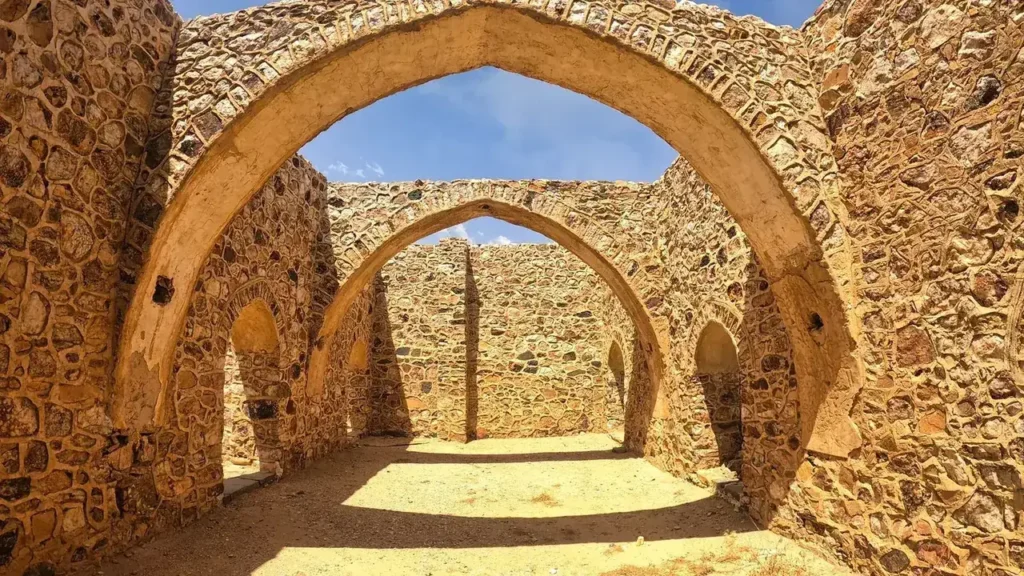
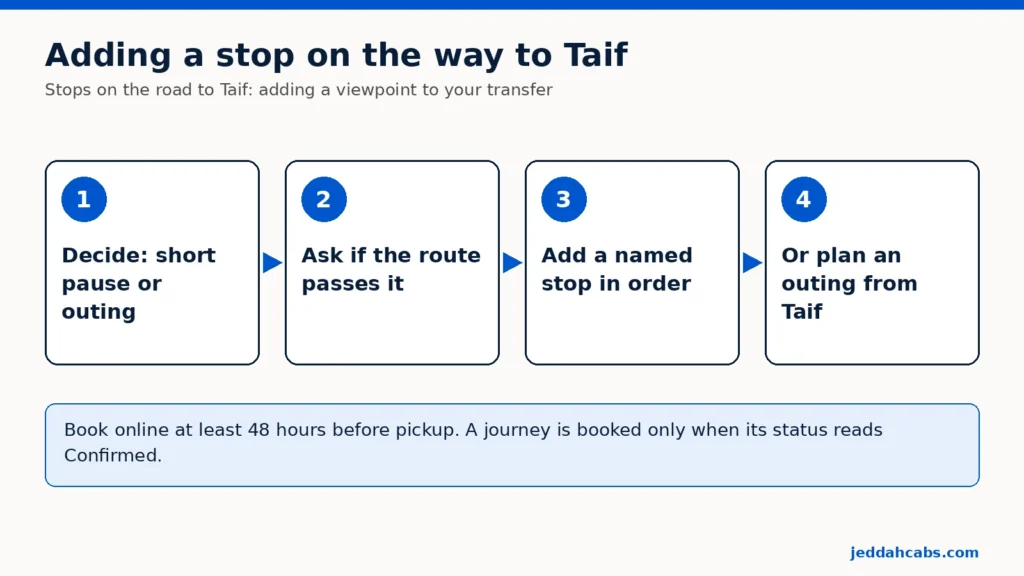
Stops on the road to Taif can be added to a transfer as named places, in journey order, but a stop is a short break on the way, not a sightseeing session with the car waiting. If what you really want is time at the al-Hada viewpoints, a cable car ride or a walk, it is usually better to go straight to your Taif hotel and plan that as a separate outing from Taif. The decision comes down to how long you want to spend, which route your transfer takes, and how everyone in the car will feel after a flight.
This guide is for travellers heading from Jeddah, usually from King Abdulaziz International Airport, to a hotel in Taif, who have heard about the mountain views and want to know whether to build them into the journey. It explains what the al-Hada road is, how stops work in a Jeddah Cabs booking, when a stop makes sense and when an outing is better, what to tell the booking team, and how to stay safe at a roadside viewpoint.
What the al-Hada road is
The al-Hada road is the mountain road between Makkah and Taif. Saudipedia’s entry on Aqabat al-Kurr gives its other names as al-Hada Road and Tal’at Karra, and sets out these facts:
- it runs for 87 km in four sections: Makkah to Arafat, Arafat to Kara, Kara to the al-Hada peak, and al-Hada to Taif, the last section being about 20 km;
- al-Hada Mountain rises to about 2,177 metres above sea level;
- the road has two lanes separated by concrete barriers, with retaining walls, rockfall protection and roadside stopping areas;
- it is the only road in Makkah Province on which trucks and large buses are prohibited throughout the year.
Saudipedia’s guide to road trips also describes the route’s shift from hot desert climate to cold, foggy weather as one of Taif’s signature features. Visit Saudi’s page on al-Hada Mountain mentions views, cable car rides and nature trails.
We do not give opening times for the cable car or any attraction, and we cannot say whether a given facility is running on your date. Check with the operator or Visit Saudi before you plan around it.
Does your transfer actually use the al-Hada road?
If you picture the al-Hada road by taxi as part of your arrival, this is the first question to ask, and it is often overlooked. The al-Hada road connects Taif with Makkah. A journey from Jeddah Airport to Taif may or may not use it, depending on the route the driver takes. In our live route checks, Jeddah Airport to the Taif InterContinental is about 197 km by road; that figure says nothing about which road the car uses.
So before you add a viewpoint stop, ask the booking team whether the route planned for your journey passes the place you want to stop. If it does not, a detour to reach it may add a long way to the trip, and it may be simpler to visit from Taif, since the al-Hada section of the road begins about 20 km from the city.
If anyone travelling is not Muslim. Saudi law prohibits non-Muslims from entering Makkah. The Saudi Press Agency, reporting a Makkah Police statement, referred to “laws that prohibit entry to Makkah for non-Muslims” and to a path dedicated for Muslims only. Because the al-Hada road runs from the Makkah side up to Taif, say in the booking notes if any member of your party is not Muslim. The driver then plans a lawful route that does not pass into Makkah, and the booking team can advise whether a visit to al-Hada is better made as an outing from Taif.
If you are travelling by coach. Large buses are prohibited on the al-Hada road throughout the year, according to Saudipedia. A group booked in a coach should not expect the route to use it. Ask the booking team what is possible for your vehicle.
How a stop works in a Jeddah Cabs booking
The booking system treats a journey as one pickup place and one destination, with up to 8 stops added in journey order. Some points follow from that.
A stop is a named place. Type it into the search, then check the route summary shows it where you expect. A description such as “somewhere with a view” cannot be priced or routed.
Order matters. Stops are visited in the order you enter them. Put them in the order you will pass them.
A stop is short. It is a pause on the way: to stretch legs, take photographs, use facilities or buy food. It is not an arrangement for the car to wait for hours while you ride a cable car or walk a trail.
Waiting time is limited. Included waiting allowances differ by vehicle class and are not currently shown in the search results. If you expect a stop to take more than a few minutes, ask the booking team to confirm in writing what is included.
Stops cannot be added online after booking. Only the pickup time can be changed online. Adding, removing or reordering stops needs the booking team, or a new booking and a cancellation request for the old one. Decide on stops before you pay.
Stop, outing or neither: choosing the right plan
| Plan | What it looks like | Good for | Less suitable when |
|---|---|---|---|
| Direct transfer | Airport or Jeddah hotel straight to your Taif hotel | Late arrivals, tired travellers, young children, tight check-in | You have one chance to see the view and will not return |
| Transfer with a short stop | One named stop on the route, a short pause, then on to Taif | A quick look and photographs in daylight on a route that passes the place | The route does not pass it, or you want more than a short pause |
| Direct transfer, then an outing from Taif | Arrive and rest; visit al-Hada another day as its own journeys | Cable car, trails, a meal with a view, or time with family | You have no spare day in Taif |
| Outing on the way back | A stop on the Taif to Jeddah journey instead | Travellers with a relaxed departure day | You are heading to a flight with a fixed deadline |
Why a separate outing often wins
After a flight, most people want to reach the hotel. A stop that sounded appealing at home can feel like a burden when everyone is tired and the light is fading. Planning the viewpoint as an outing from Taif lets you choose the time of day and the weather, and stay as long as you like, with a separate return journey booked for later.
For planning that kind of day, our guides on choosing a Taif base before a mountain outing and giving a Taif outing one anchor place explain how to set the destination and the return. If the visit centres on a table at a restaurant or a booked activity, our guide to building a Taif outing around a reservation shows how to time the journeys around it. An outing also means you can go back on another day if the first visit is spoiled by fog.
When a short stop makes sense
A viewpoint stop on the way to Taif can work well when:
- your route passes the place, confirmed with the booking team;
- you are travelling in daylight;
- everyone is rested enough to enjoy it;
- you want a short pause, not an activity;
- your hotel check-in time is not tight.
Stops that are not about the view
Many useful stops on a long transfer have nothing to do with scenery. You might want to:
- buy food and water for the journey or for the first evening;
- pick up a local SIM card or cash, if you did not at the airport;
- stop for a prayer break;
- collect keys from a rental office, if your accommodation is not a hotel.
Each of these works best as a named stop, entered in journey order, and described in the notes. If you only need a quick break for the toilet or to stretch, mention it in the notes rather than inventing a stop; the driver can advise where it is practical to pause.
What to write in the booking notes
The route summary shows places. The notes tell the booking team and driver what you intend at each one. A clear note avoids a driver treating a stop as a drop-off, or waiting longer than planned.
A useful note for a journey with a stop covers:
- the purpose of each stop, for example “short stop for photographs, about ten minutes” or “stop to buy food”;
- who is travelling, including children, older relatives and anyone with limited mobility;
- whether any traveller is not Muslim, so the route can be planned from the start;
- a mobile number that works in Saudi Arabia, and a second contact if possible;
- anything the driver should know about luggage, such as a pushchair or a wheelchair that folds.
Keep the note short and factual. It is read by people planning a route, not by a tour guide, so a list of attractions you might like to see will not help. If a stop is essential to you, say so, and ask the booking team to confirm that it can be included before you pay.
Timing a journey with a stop
A stop adds time to the journey, and time of day affects how much you will enjoy it.
Daylight. A viewpoint is only worth stopping at if you can see the view. If your flight lands in the evening, a scenic stop on the way to Taif is unlikely to be worth it. Check local sunset times for your travel date before you plan a stop around the light.
Weather. Fog can hide the view completely. If the day is misty, the driver may suggest skipping the stop, and it is usually better to agree and plan an outing on a clearer day.
Hotel check-in. Ask your Taif hotel what time check-in opens and until when reception is staffed. A long stop that pushes a late arrival even later can leave you waiting at a closed desk.
Pickup time. For an airport journey, the pickup time is normally based on your flight’s scheduled landing, and your flight number goes in at checkout. A stop does not change that. For a journey from a Jeddah hotel, set the pickup so that any stop falls in daylight.
A stop on the way back instead
Some travellers prefer to see the mountains on the way down, at the end of their stay, when they are rested and know the area. In our route checks, the Taif InterContinental is about 187 km from Jeddah Airport and about 202 km from the Jeddah Hilton.
A stop on the return works best when you are heading to a Jeddah hotel, not straight to a flight. A journey ending at an airport has a fixed deadline, the airline’s check-in and bag-drop cut-off, and a stop that runs long eats into it. If you are going to the airport, keep the journey direct and plan any viewpoint visit as an outing from Taif earlier in your stay. If you are spending a final night in Jeddah, a short stop on the way down can be a pleasant end to the Taif part of the trip, provided the route passes it; ask the booking team as before.
Worked example: the Mahmoud family’s Taif arrival
Layla and Omar Mahmoud are flying into Jeddah with their two children and Omar’s mother, Samira, for five nights in Taif. Friends have told them about the view from al-Hada.
Their flight lands in the early afternoon. Their first idea is one booking from Jeddah Airport to their Taif hotel with a stop at a viewpoint.
Before booking, Layla asks the booking team whether the planned route passes the al-Hada viewpoints. The reply explains that the route for their journey may not pass the place they have in mind and that al-Hada is easily reached from Taif.
They weigh it up:
- Samira tires easily after long flights.
- The children will be restless after the drive.
- They want to see the cable car, which they will check with the operator, not squeeze in a five-minute look.
They book:
- Jeddah Airport to their Taif hotel, direct, with the flight number at checkout, five passengers, two child seats and their luggage. They add one short named stop for food on the way.
- Taif hotel to al-Hada, on their third morning, as its own journey to a named place.
- Al-Hada back to the hotel, as a separate booking, with a pickup time set after the time they expect to spend there, and the meeting point in the notes.
Each booking shows Confirmed in their account within the day. On the third morning the weather is clear, and they spend as long as they want at the top.
Safety at roadside viewpoints
Mountain viewpoints are beautiful but not risk-free.
- Stop only where it is allowed. Saudipedia notes the al-Hada road has roadside stopping areas. The driver decides whether and where it is safe and lawful to stop, and may decline if conditions are poor.
- Watch the weather. The road can move from hot to cold and foggy. Fog reduces visibility for you and for other drivers, which is a good reason to skip a roadside stop.
- Keep away from edges and traffic. Hold children’s hands, stay behind barriers and do not stand in the road to take photographs.
- Look after belongings. Take phones and bags with you or leave them locked in the car, as the driver advises.
- Keep the stop short. A long wait on a mountain road is uncomfortable for everyone and may exceed the included waiting time.
Booking rules to know before you pay
- Notice. Online bookings need at least 48 hours’ notice before pickup.
- Minimum value. Each journey has a minimum booking value equivalent to £40, which can apply to a short outing journey in Taif.
- Payment. Jeddah Cabs may take only a deposit online, with the balance paid in cash to the driver; the checkout shows both amounts.
- Confirmation. Payment secures a provisional request. The booking team updates the status within 1 to 12 hours, and the journey is booked only when it reads Confirmed in your account.
- Time changes. You can request a new pickup time from your account before the pickup time. An approved change carries a £5 rescheduling fee, converted into the booking currency and added to the cash for the driver.
- Cancelling. Bookings are subject to our cancellation terms (free cancellation with a full refund up to 48 hours before pickup; inside 48 hours the deposit element of the price is kept) if you cancel. If Jeddah Cabs or the transport partner cancels or cannot supply the journey, and you do not accept a suitable alternative, you receive a full refund for the affected journey. See the cancellation and refund policy.
If you are wondering whether to add a stop to an airport journey more generally, our note on adding an excursion to your airport journey covers the wider question. The airport to Taif page covers the main transfer itself.
Checklist before you add a stop
- Decide what you want: a short pause, or real time at a viewpoint or attraction.
- Ask the booking team whether your route passes the place you want to stop.
- Mention in the notes if any traveller is not Muslim, and if you are travelling by coach.
- If the answer is no, or you want more than a short pause, plan an outing from Taif instead.
- Type any stop as a named place, in journey order, and check the route summary.
- Ask the booking team to confirm waiting time in writing.
- Check any attraction’s opening with the operator or Visit Saudi.
- Book at least 48 hours ahead and wait for Confirmed.
- Carry riyals for the cash balance due to the driver.
- On the day, follow the driver’s judgement on whether it is safe to stop.
When you know whether you want a direct journey, a short stop or a separate outing, use the Jeddah Cabs transfer finder to enter your pickup, any named stop and your Taif hotel, and check the route summary before you book.